For those committed to continuous improvement, particularly in HR and operations roles, developing a Lean skills management program should be a priority.
We've written extensively about skills management within a CI framework. So, in this article we've curated our top resources and their takeaways to help you make the most of your lean learning and development programs.
The 3 Fundamental Perspectives of Lean Skills Management
Skills development within a Lean, continuous improvement framework goes beyond mere regulatory compliance or employee onboarding.
To develop a dynamic skills management system that mutually benefits the organisation, employee and the learning processes themselves it is important to consider the needs of each simultaneously.
Get to know these 3 perspectives for skills management and development to create systems that organically build resilient workforces and a culture of continuous learning.
Cultivating a Problem-Solving Culture
In a Lean environment, every team member's ability to solve problems is crucial. The primary objective for organisations, at an operational level, should be to have all departments comprised of teams that don't need to be told what to do.
That doesn't mean relinquishing oversight, or strategic direction, but rather that every employee is empowered to identify and solve problems with full visibility of their contribution to the bigger picture. Innovation, continuous improvement and productivity thrives within such a culture.
Maximising Staff Skills for Organisational Growth
Leveraging staff skills effectively is an inherently Lean pursuit. It eliminates waste in the form of underutilised talent and leads to greater productivity. Plus, there are significant improvements to morale when staff are engaged in their work and supported in their efforts to expand skillsets.
Effective Staff Development Dynamics
Staff development in a Lean environment is not just about imparting skills; it's about creating a system where learning and improvement are integral to daily operations. It is important to balance top-down strategic direction with bottom-up employee engagement and ownership in staff development programs.
This nuanced approach ensures that staff development aligns with the overall Lean strategy of the organisation while also catering to the individual growth needs of employees.
The responsibility for learning and development doesn't have to just fall on leaders. Managers play an active role in fostering an environment where staff are encouraged to take ownership. This includes creating opportunities for employees to identify their own training needs, participate in problem-solving activities, and contributing to continuous improvement initiatives.
Plus, learning opportunities can occur when / where is needed thanks to the increased accessibility afforded by digital channels.
By doing so, employees are not just passive recipients of training but active participants in their development, leading to a more engaged and capable workforce.
When you create a synergistic relationship between organisational objectives and employee growth, you will naturally end up with a dynamic, skilled, and resilient workforce.
Competitive Edge through Skills Development
In today's fast-paced business environment, developing and honing employee skills is not just a necessity; it's a strategic advantage.
Identifying and addressing skills gaps within the workforce, building training pathways and making skills development a BAU activity is key to achieving and maintaining this advantage.
By assigning targeted training directly through the platform, tracking progress in real-time, and integrating daily activities into the employee's development profile, organisations can respond swiftly to changes in the market or operational challenges.
This approach ensures that training and development are not static processes but are continuously evolving to meet the changing needs of the business and its employees.
Integrating skills development into the broader business strategy ensures that your workforce remains skilled, adaptable, and aligned with the organisation's long-term objectives.
Lean Management Done Digitally
In the realm of Lean skills management, digital-aids emerge as critical tools to maximise potential of processes and people alike. We've showcased how TeamAssurance's features can be strategically utilised to enhance skills development within an organisation.
The capabilities of a digital platform extend beyond traditional training methods, offering a dynamic and interactive approach to managing employee skills and competencies.
Excel in promoting a culture of continuous learning and improvement by enabling the documentation and sharing of learnings / best practices at scale. This not only helps in building a collective knowledge base but also encourages a culture where every employee contributes to and benefits from shared learning experiences.
Employees don't have to be passive participants – they can be active contributors to the skills development journey. They can set personal goals aligned with organisational objectives, track their progress, and receive timely feedback.
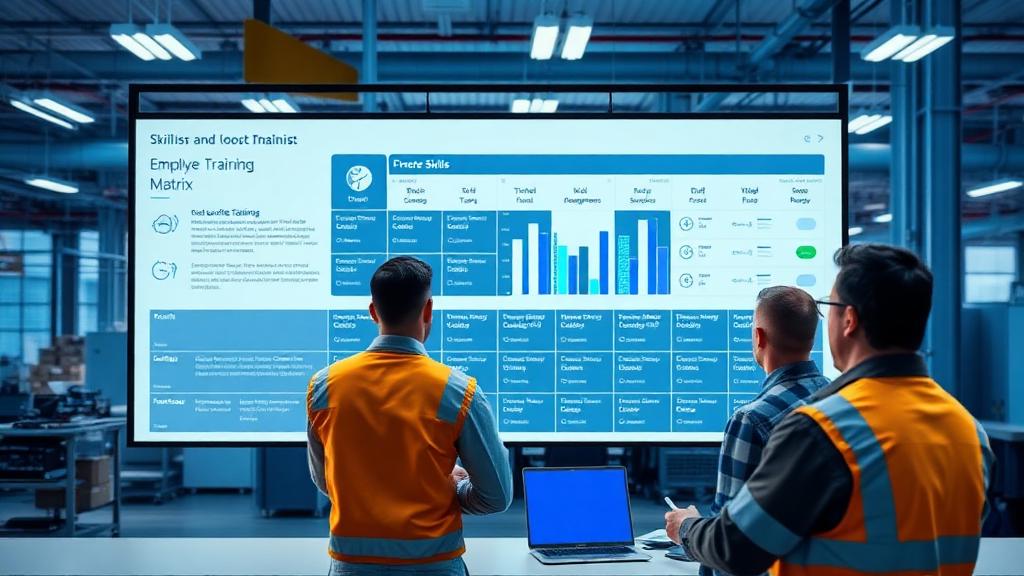
Traditional tools like the skills matrix are also enhanced. Moving from static, isolated systems to real-time reflections of employees' skills, certifications and competencies. The matrix becomes a tactical AND strategic tool, providing benefits to the entire tiered daily management framework.
Lean Skills Management Does Not Work As An Isolated 'Point Solution'
Embedding skill management as BAU requires the system to connect with, and leverage every other process within our daily activity. Systems like a Tiered Daily Management process supporting the entire PDCA loop align people with their organisational and department goals every day – that includes learning and development info.
Along with the right data, aligned to strategy, we can facilitate individual mastery, provide our people with a purpose larger than themselves and the ability to contribute to that bigger picture.
The illustration below outlines how we designed TeamAssurance as an interconnected platform that achieves these goals. One that avoids the locally optimised and disconnected 'Point solutions' (digital or analog) for skills development that do not help sustain operational efficiency or maximise individual employee potential.
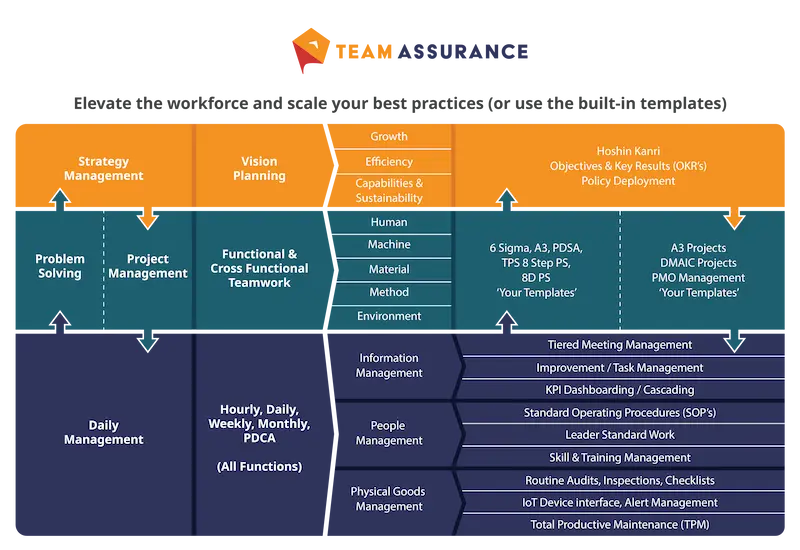
TeamAssurance enables organisations to set up Lean skills management systems that empower staff and lead to operational efficiency. If you'd like to explore the opportunities offered by digital aids to Lean tools contact us for a demonstration.