
Platform Overview
TeamAssurance is a cloud-based platform that reconnects your leaders with the frontline, aligns actions with objectives, and increases transparency from top to bottom and back again.
Begin Free Trial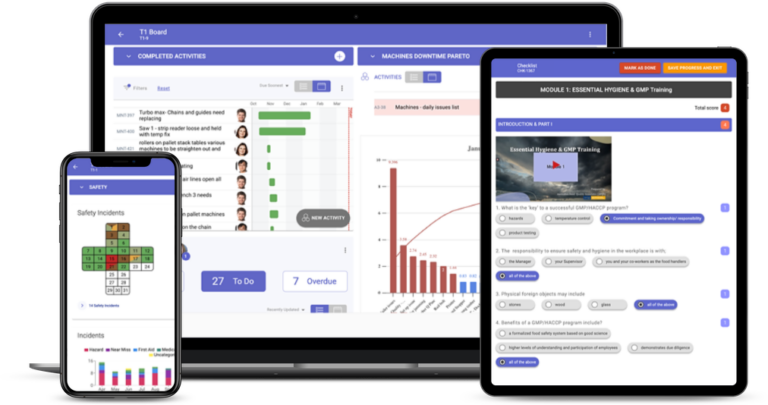
See how it connects
Connect strategy, improvement and daily operations
Select a level of the triangle to explore it, or take the short guided tour.
Up from the floor, down from the strategy
Explore examples
Choose a starting point
Bottom up· 7
Top down· 4
The whole system
Connect strategy, improvement and daily operations
TeamAssurance links the day-to-day running of your operation with longer-term problem solving, projects and business strategy.
Select a level of the triangle to explore it, or take the short guided tour.
View this as text
TeamAssurance links the day-to-day running of your operation with longer-term problem solving, projects and business strategy.
Business Strategy
The organisation's direction, priorities and strategic objectives, and the goals that turn them into work.
Strategic focus: Growth, Efficiency, Capability
- Strategic goals have clear owners and dates, and cascade so each goal contributes to its parent.
- Goals can be linked to A3s, improvement activities and measures, so leaders see what is moving them.
- A monthly status history highlights goals at risk.
Chronic Problem Solving and Project Management
The work that fixes recurring or complex problems, delivers improvements and advances strategic priorities.
Where causes are found: Human, Machine, Material, Method, Environment
- Recurring issues seen in daily management are worked through structured methods such as A3, PDCA or DMAIC.
- Improvement projects have owners, milestones and deliverables, and can be linked to strategic goals.
- Progress is tracked through tiered daily management, so the teams affected can see it.
Tiered Daily Management
The regular management of the operation, where teams monitor performance, spot abnormalities, discuss issues and act.
What teams track: Safety, Quality, Delivery, Cost, People
- People closest to the work can identify and respond to issues as they happen.
- Teams share information and coordinate action on live tier boards.
- Issues needing more support move through the tiers with their context.
- Repeated or complex issues can become problem-solving activities or projects.
- Tier 3: Site leadership (e.g. daily or weekly)
- Tier 2: Area and support teams (e.g. daily)
- Tier 1: Frontline (e.g. hourly, each shift)
- Hourly: Teams can see what is happening and spot abnormalities as the work takes place, using live measures on the board.
- Shiftly: Teams review performance, issues, actions and handovers across shifts, so nothing is lost between them.
- Daily: Teams discuss priorities, resolve issues and escalate anything needing support through the relevant tiers.
- Weekly: Teams review patterns, recurring issues, progress and improvement priorities.
Illustrative cadences. TeamAssurance supports the rhythm that suits your operation.
How the levels connect
- Tiered Daily Management. The rhythm that runs the operation, at every tier: frontline teams at Tier 1, the area and its support functions at Tier 2, and site leadership at Tier 3. Each tier reviews performance, solves what it can and escalates what it can't. Work also arrives from above: project tasks, reviews and checks that come from the strategy.
- A quality check fails. During an hourly check on Line 2, the operator finds under-filled bottles. The filler is jamming. They raise the issue on the spot from a mobile device, with a photo, and the line team responds. The people closest to the work find it first.
- Corrective action is taken straight away. The team acts within minutes: the jam is cleared, fill weights are rechecked and the affected product is held. The shift handover updates automatically with what happened and what was done, so the next shift starts fully informed and nothing depends on someone remembering to pass it on. Containment first, at the line, by the people who found it.
- The area and the quality team both see it. The stoppage, the rejects and the scrap show against Quality, Delivery and Cost on the packing area's Tier 2 board, and the quality team's Tier 2 board is updated with the same information. Maintenance and quality pick up the equipment fault at the Tier 2 meeting. Downtime, quality and waste are seen together, not in three separate reports.
- Site leadership sees the pattern. It is the third filler stoppage this week. At Tier 3 the site team sees that this is recurring rather than a one-off, and that it needs more than a quick fix.
- A project is already under way. An improvement project to reduce filler downtime and scrap is already running. The team adds what it found to that project, so the work is based on what happened on the floor, and progress is followed in the tier meetings. People decide when an issue joins a project; it is a link between ways of working, not an automatic transfer.
- And it supports a strategic goal. The project is linked to the site's efficiency goal. Leaders can follow the goal's status and the project behind it, and the goal's at-risk status reflects what is happening on the line.
- The whole picture: quality. An hourly quality check fails on the filler: raised at Tier 1, seen across the tiers, worked through improvement and tied to a strategic goal. A quality check fails Corrective action is taken straight away The area and the quality team both see it Site leadership sees the pattern A project is already under way And it supports a strategic goal
- And from the top down. The same connection works in the other direction. The strategy is delivered through strategy deployment, which cascades into projects and problem solving, and their tasks, reviews and checks land on the tier boards of the teams doing the work.
- It starts with strategy deployment. Delivery strategy deployment sits under the site's strategic plan, with goals for on-time-in-full delivery and asset reliability. Long changeovers and unplanned stops are the biggest threats to both.
- A project with a critical path. A changeover reduction (SMED) project serves the on-time-in-full goal. Its plan has a critical path: fitting quick-release change parts holds up every step after it.
- Site leadership sees the critical task. At the weekly project review, Tier 3 sees that the change-parts task is due Friday and on the critical path. If it slips, the whole project slips.
- Tier 2 makes room for it. At Tier 2, engineering and planning agree when Line 3 can stop for the fit, so the task doesn't clash with customer orders.
- It lands on the Tier 1 board. The task appears on Line 3's Tier 1 board with its due date. If it goes overdue, the team sees it in its daily meeting, and so do the project owner and Tier 3. Work from strategy deployment arrives where the team already looks every day.
- Chronic problem solving on asset reliability. Tier 2 sees short, repeated palletiser stops adding up to hours each week, so it escalates them. Under the asset reliability goal, they are worked through an A3 to root cause, the actions go back to the tiers, and the results report back into strategy deployment.
- The whole picture: delivery. Delivery strategy deployment: how it cascades into a project, problem solving and the work at every tier. It starts with strategy deployment A project with a critical path Site leadership sees the critical task Tier 2 makes room for it It lands on the Tier 1 board Chronic problem solving on asset reliability
- Up from the floor, down from the strategy. Issues travel up from Tier 1 to problem solving, projects and strategic goals. Priorities and project work travel down from strategy to the tier boards. Both meet in the same daily meetings. Strategy provides direction. Problem solving and projects turn priorities and recurring issues into improvement. Tiered Daily Management connects the work to the people running the operation. Information and learning flow back through the system.
Follow an example through the system
Standard work
- One-point lesson: A one-point lesson shared across departments and acknowledged by each person (Engineering → Production → Quality → Maintenance → Tier 1). One-point lesson (OPL)
- Action: An action from the huddle, owned by engineering and the warehouse, to done (Production → Engineering → Warehouse → Production → Tier 1). Daily huddle
- Improvement idea: An operator's changeover idea reviewed, trialled and shared with other lines (Production → Engineering → Maintenance → Quality → Production → Tier 2 → Project). Kaizen
- Hazard alert: A damaged racking upright made safe, alerted to other areas, fixed and closed (Warehouse → Safety → Production → Maintenance → Safety → Tier 2 → A3 → Strategic goal). Workplace hazards
- Behaviour observation: A planned observation with coaching, logged and trended by safety (Safety → Production → Safety → Warehouse → Tier 2). Safety observation
- Recognition: Production thanks maintenance and the warehouse for an overnight repair (Production → Maintenance → Warehouse → Tier 1)
- Escalation: A labelling fault the line can't fix, escalated to quality and resolved (Production → Quality → Warehouse → Production → Tier 2)
- Quality incident: A plastic fragment found in product, contained, investigated and closed (Production → Quality → Warehouse → Maintenance → Quality → Tier 2 → A3 → Strategic goal). Non-conformance report (NCR)
- Maintenance request: A loose guide rail, from the operator's photo to a confirmed fix (Production → Maintenance → Warehouse → Maintenance → Production → Tier 1 → A3 → Strategic goal)
- Spare parts order: A worn gearbox part requested, approved, ordered, received and fitted (Maintenance → Engineering → Warehouse → Maintenance → Tier 2)
- TPM tag: An abnormality tagged, sorted, fixed and removed, then a repeat solved (Production → Maintenance → Production → Tier 2 → A3 → Strategic goal). Autonomous maintenance
- Non-conformance report: Out-of-spec product quarantined, dispositioned, corrected and closed (Quality → Warehouse → Production → Maintenance → Quality → Tier 2 → A3 → Strategic goal). Non-conformance report (NCR)
- Centreline deviation: A sealer setting found off centreline, corrected and the standard confirmed (Production → Maintenance → Quality → Engineering → Tier 1)
- Work permit: Hot work requested, approved, handed over, done and signed off (Engineering → Safety → Production → Maintenance → Safety → Tier 2)
- Authority to work: A dock leveller repair, from the area owner's go-ahead to the area handed back (Engineering → Warehouse → Safety → Engineering → Warehouse → Tier 1)
- Quick risk predictor: A quick risk check before a non-routine job, with controls agreed first (Maintenance → Safety → Production → Maintenance → Tier 1). Risk assessment
- New product introduction: A new pack size approved by each department before its first run (Engineering → Quality → Production → Warehouse → Tier 2 → Project)
- Management of change: A new cleaning chemical, risk reviewed, approved, trained and checked (Engineering → Safety → Quality → Production → Engineering → Tier 3). Management of change (MOC)
Safety
- Near miss: A near miss at the pallet wrapper (Tiers → chronic problem solving → strategy). Near miss
- Close call: A forklift and a pedestrian meet at a blind corner (Tier 1 → Tier 2 → Tier 3). Workplace hazards
- Unsafe lifting: Unsafe lifting is spotted on a safety observation (Tier 1 → Tier 2 → Tier 3). Safety observation
- Chemical splash: A chemical splash during a cleaning task (Tiers → chronic problem solving → strategy). Workplace incident report
- Lockout skipped: A lockout step is skipped while clearing a jam (Tiers → project → strategy). Job safety analysis (JSA)
- Recordable injury: A hand laceration needing stitches, reported and recorded the OSHA way (Tiers → chronic problem solving → strategy). Incident investigation
- Safety cross amber: The safety cross turns amber after a minor injury (Tier 1 → Tier 2 → Tier 3). Safety cross
- Safety strategy deployment: From safety & compliance strategy deployment down to every tier (Strategy deployment → project → tiers). Strategy deployment
- Halve recordable injuries this year: A recordable injury target cascaded into a project and every tier (Strategy deployment → project → tiers). TRIFR and LTIFR
- Risk assessment review: The annual risk assessment review, rolled out area by area (Project → tiers). Risk assessment
- Toolbox talks: A series of working-at-height toolbox talks for every shift (Project → tiers). Toolbox talk
Quality
- Check fails: An hourly quality check fails on the filler (Tiers → project → strategy). Quality assurance and quality control (QA/QC)
- Customer complaint: A customer complaint is traced to a mislabelled batch (Tiers → chronic problem solving → strategy). CAPA
- FPY drops: First pass yield drops on the night shift (Tier 1 → Tier 2 → Tier 3). First pass yield (FPY)
- Faulty parts: Faulty supplier parts are found at goods in (Tiers → chronic problem solving → strategy). Non-conformance report (NCR)
- Unclear instruction: An operator flags an unclear work instruction (Tier 1 → Tier 2 → Tier 3). Work instructions
- Skipped check: A layered audit finds a skipped torque check (Tiers → project → strategy). Layered process audit (LPA)
- Quality strategy deployment: From quality strategy deployment down to every tier (Strategy deployment → project → tiers). Strategy deployment
- Quality strategy deployment: Error-proofing the top three defects (Strategy deployment → project → tiers). Poka-yoke
- Launch FMEA: An FMEA review before a new product launch (Project → tiers). FMEA
- Cut the cost of scrap: A scrap-cost goal broken down with a Pareto of top defects (Strategy deployment → project → tiers). Pareto chart
Delivery
- Behind plan: A long changeover puts Line 3 behind plan (Tiers → project → strategy). SMED (single-minute exchange of die)
- Material short: An empty kanban bin stops Line 1 for lack of labels (Tier 1 → Tier 2 → Tier 3). Kanban board
- Andon pulled: An andon pulled at the bottleneck case packer (Tier 1 → Tier 2 → Tier 3). Andon
- Handover missed: A priority order is lost in the shift handover (Tiers → chronic problem solving → strategy). Shift handover
- Slower than takt: Line 4 runs slower than takt and falls behind every shift (Tiers → project → strategy). Takt time
- Late truck: A late inbound truck holds up outbound dispatch (Tiers → chronic problem solving → strategy). Lean logistics
- Delivery strategy deployment: From delivery strategy deployment down to every tier (Strategy deployment → project → tiers). Strategy deployment
- Cut order lead time from 10 to 6 days: A lead-time reduction goal mapped across the value stream (Strategy deployment → project → tiers). Value stream mapping
- 95% schedule adherence on every line: A schedule adherence target added to every tier board (Strategy deployment → project → tiers). Schedule adherence
- New volume: Line 2 is rebalanced for a new customer's volume (Project → tiers). Line balancing
Cost and maintenance
- Machine fault: A compressor running hot on the hourly round (Tiers → chronic problem solving → strategy). Condition-based maintenance
- Repeat breakdowns: The case packer keeps breaking down (Tiers → chronic problem solving → strategy). MTBF (mean time between failures)
- Loose belt: A loose belt is found on the daily clean and inspect (Tier 1 → Tier 2 → Tier 3). Autonomous maintenance
- Missed PM: A preventive maintenance task is missed (Tier 1 → Tier 2 → Tier 3). Preventive maintenance
- Excess stock: Overproduction builds up excess stock (Tiers → project → strategy). 8 wastes of lean
- Weekend energy: Kit left running over the weekend (Tier 1 → Tier 2 → Tier 3). Process improvement
- Cost strategy deployment: From cost strategy deployment down to every tier (Strategy deployment → project → tiers). Strategy deployment
- Site OEE to 80% this year: An OEE goal broken into the biggest losses on each line (Strategy deployment → project → tiers). OEE (overall equipment effectiveness)
- Maintenance plan: The maintenance plan rebuilt around critical assets (Project → tiers). Planned maintenance
- Packaging kaizen: A kaizen event to cut packaging material cost (Project → tiers). Kaizen event
People
- Skills gap: No trained cover for the labeller (Tiers → project → strategy). Skills matrix
- New starter stuck: A new starter struggles to change a label reel (Tier 1 → Tier 2 → Tier 3). One-point lesson (OPL)
- Team suggestion: A team suggestion ends a daily hunt for tools (Tier 1 → Tier 2 → Tier 3). Kaizen
- Licence expiring: A forklift driver's certificate is about to expire (Tier 1 → Tier 2 → Tier 3). Competency assessment
- Huddles skipped: Huddle attendance drops on one shift (Tiers → chronic problem solving → strategy). Daily huddle
- Night fatigue: Fatigue concerns on the night rotation (Tiers → project → strategy). Panama shift pattern
- People strategy deployment: From people strategy deployment down to every tier (Strategy deployment → project → tiers). Strategy deployment
- Ready for the new filler line: A skills gap analysis before new equipment arrives (Strategy deployment → project → tiers). Skills gap analysis
- Coaching routine: A daily coaching routine for team leaders (Project → tiers). Toyota kata
- New area roles: Clear roles set for a new area structure (Project → tiers). RACI matrix
Environment
- Oil leak: Hydraulic oil leaking near a surface drain (Tiers → chronic problem solving → strategy). Workplace hazards
- Air leak: A compressed air leak is heard on a gemba walk (Tier 1 → Tier 2 → Tier 3). Gemba walk
- Mixed waste: General waste turns up in the recycling skip (Tier 1 → Tier 2 → Tier 3). Visual factory
- Chemical storage: A drum of chemical is stored away from the bunded area (Tier 1 → Tier 2 → Tier 3). Hazardous nature
- Mixer dust: Dust keeps building up around the mixer (Tiers → project → strategy). Physical hazard
- Water spike: Water use spikes whenever the cleaning system runs (Tiers → chronic problem solving → strategy). Root cause analysis
- Environment strategy deployment: From environment strategy deployment down to every tier (Strategy deployment → project → tiers). Strategy deployment
- Environmental risk review: The environmental risk review, cascaded area by area (Project → tiers). Risk assessment
- Cut energy use per unit: An energy reduction goal tracked line by line on a bowling chart (Strategy deployment → project → tiers). Bowling chart
- Cut packaging waste: Packaging waste reduction rolled out across the site (Strategy deployment → project → tiers). Muda, mura and muri
Programmes of work
- Total productive maintenance: What TPM looks like at every level, linked to reliable supply (Every level at once). Total productive maintenance (TPM)
- 5S workplace organisation: What 5S looks like at every level, linked to a safe, organised workplace (Every level at once). 5S
- Leader standard work: What leader standard work looks like at every level, linked to a steady operating rhythm (Every level at once). Leader standard work
- Management of change: What management of change looks like at every level, linked to safe, stable operations (Every level at once). Management of change (MOC)
- Layered process audits: What layered process audits look like at every level, linked to right-first-time quality (Every level at once). Layered process audit (LPA)
- Quick changeover (SMED): What quick changeover looks like at every level, linked to flexible supply (Every level at once). SMED (single-minute exchange of die)
- Kaizen events: What kaizen events look like at every level, linked to productivity (Every level at once). Kaizen event
- Gemba walks: What gemba walks look like at every level, linked to problems fixed where they happen (Every level at once). Gemba walk
- Skills and TWI: What skills and TWI look like at every level, linked to a skilled, flexible workforce (Every level at once). Training Within Industry (TWI)
- Visual management: What visual management looks like at every level, linked to abnormalities seen at a glance (Every level at once). Visual management
- Safety observations: What safety observations look like at every level, linked to zero serious injuries (Every level at once). Safety observation
- Supplier quality management: What supplier quality management looks like at every level, linked to right-first-time materials (Every level at once). Supplier quality management
- OEE improvement: What OEE improvement looks like at every level, linked to more output from existing lines (Every level at once). OEE (overall equipment effectiveness)
- Standard work and SOPs: What standard work and SOPs look like at every level, linked to every job done the same safe way (Every level at once). SOP (standard operating procedure)
Alignment on Strategy, from Boardroom to Frontline
Cascade your strategic plan into actionable goals at every level of the organisation. TeamAssurance gives leaders a real-time, visual tree view of how site-level business plans, departmental objectives, and improvement projects connect back to the overarching strategy — so every team knows exactly how their work contributes to the bigger picture.

Stop, collaborate, and listen
Tiered meetings are the foundation of your daily management system and a powerful force for AI-accelerated CI. These are structured, two-way communications forums in which leaders can educate, recognize, coach, and focus the Team. Team members may in turn share thoughts, voice ideas, and provide feedback.

Stronger visuals, stronger performance
Our visual management boards can be used in infinite ways. Often employed to run agendas in tiered meetings, they're also perfect for visualizing data and distributing information to individuals, departments, and teams – automatically and in real time.

On the Job Skill Development
Create a culture of continuous learning and step-changes and keep track of each employee's training and development progress with our skills matrix. Get a quick view of any employee's compliance and training gaps or access a detailed and auditable training history of your organization. It's also a great retention tool, allowing you to show employees you have a constructive plan for their energies and talents.

Clear and present maintenance
TeamAssurance provides a single view of everything related to an asset: breakdowns, preventative maintenance, autonomous maintenance. Unlike traditional CMMS platforms, which are often only visible to those in maintenance, we enable data and information to flow to where it's needed automatically and in real time. This transparency allows for a lowest cost, highest reliability asset care model.

Autonomy to solve issues
Empowered and enabled workers are happy workers. Instilling your employees at all levels with the confidence and autonomy to solve problems boosts engagement and job satisfaction. TeamAssurance helps you provide the structure for teams to harness their diverse range of knowledge and experience and for individuals to contribute more using their core strengths and talents.

Where TeamAssurance can uncover your potential
Operational excellence at every level
AI-accelerated CI
Add an AI-accelerated CI specialist to every role in the business, at every level
Strategy & Execution
Keep every employee focused on the big, strategic business goals to ensure you get there faster
Daily Management
Solve problems out loud to accelerate completion of tasks and enable shared, real-time learning
Safety
Reduce risk and save lives through deep, honest, supported, and guided problem solving
Quality
Build quality into the process by bringing employees' rich experience and knowledge to the fore
One platform, endless benefits
Shift from order takers to opportunity makers
By removing the physical, and operational barriers to information sharing and participation, TeamAssurance empowers your team to solve problems and identify opportunities to improve.
Improve transparency so that nothing is overlooked
With defined processes, fewer silos, and open communication, TeamAssurance increases transparency from top to bottom and back again, ensuring nothing is overlooked or misunderstood.
Close the loop between strategy and execution
By giving all employees access to a clear view of the big picture strategy and the confidence to act accordingly, TeamAssurance closes the loop between strategy and execution.

"Engagement of the factory team has grown to new levels and tasks are completed much faster with more visibility."
— General Manager, Operations
FAQ
Platform FAQ
What is the TeamAssurance platform?
A cloud platform for daily management in operations. It connects strategy deployment, tiered daily management, continuous improvement, safety, quality, skills and asset management in one system, so leaders and frontline teams work from the same live tier boards, goals and actions.
How do the parts of the platform fit together?
Strategic goals cascade into projects and measures; those measures sit on the tier boards that Tier 1, 2 and 3 meetings review each day; issues raised in those meetings move into structured problem solving; and the safety, quality, skills and asset modules feed the same boards. The guided tour above walks through one example end to end.
Does it work on phones and tablets on the shop floor?
Yes. Checklists, issue reporting, actions and tier boards are built for phones and tablets as well as meeting-room screens, so frontline teams update items where the work happens.
Which systems does TeamAssurance integrate with?
ERP, MES, CMMS and HRIS systems, so measures on tier boards, assets in maintenance and people in the skills matrix come from the systems of record. Live spreadsheets and Power BI reports can also be embedded on tier boards.
What role does AI play in the platform?
AI agents work inside the daily management system: spotting patterns across incidents, risks and improvements, preparing teams before meetings and suggesting actions, while accountability stays with people. TeamAssurance can connect to your own LLM.
Learn more about the platform
Definitions
Ready to transform your operations?
See TeamAssurance in action and discover how it can help your organization.
Begin Free Trial