
Introduction
Factories get noisy when the opaerating system is weak.
Not noisy in the literal sense. Noisy in the management sense.
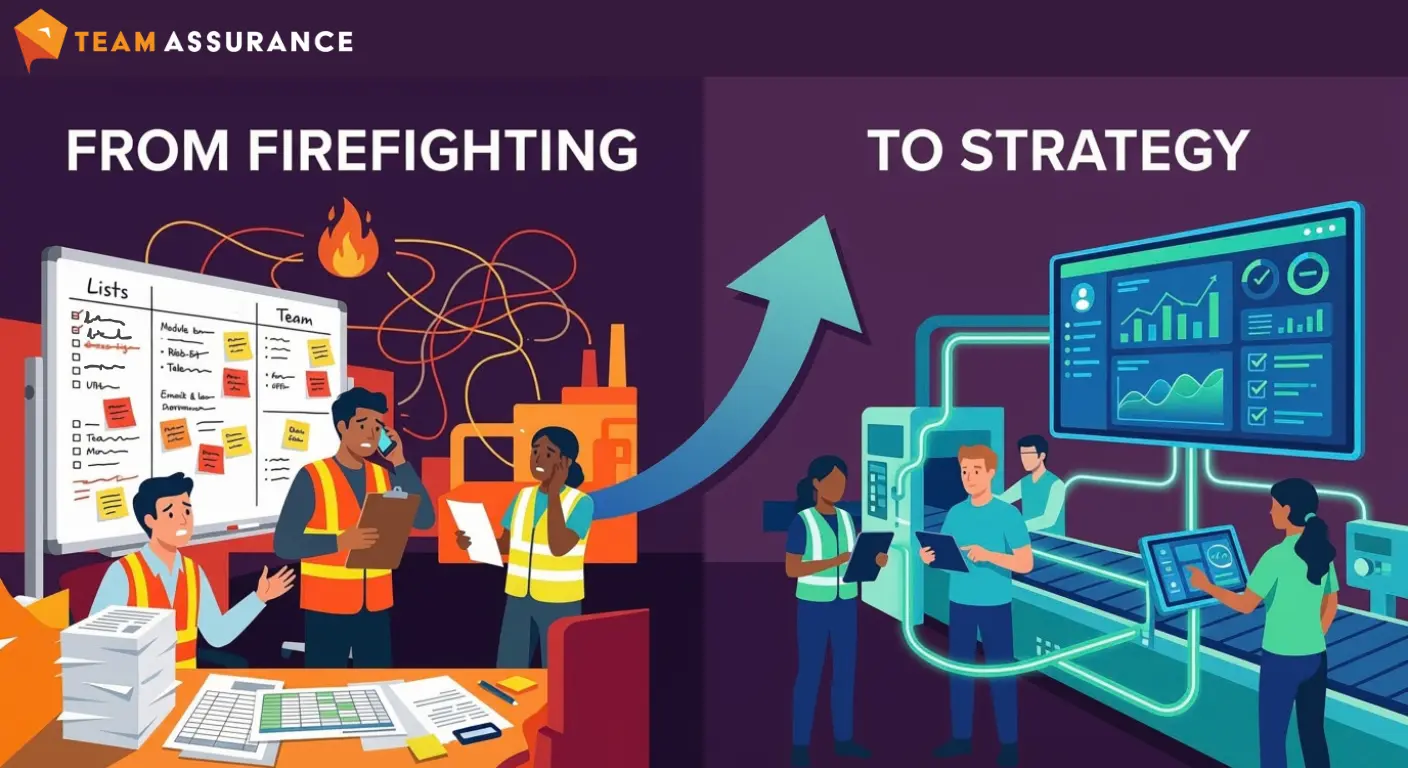
Information sits in spreadsheets. Maintenance has one list. Safety has another. Quality has another. Supervisors have notebooks, emails and whiteboards. People spend half the day finding out what happened before they can decide what to do about it.
That is how leaders end up running from fire to fire.
One TeamAssurance customer described it simply: when he first arrived at the site, there were effectively no connected systems. He spent hours walking around the factory looking for information and trying to piece together what was happening from spreadsheets and conversations.
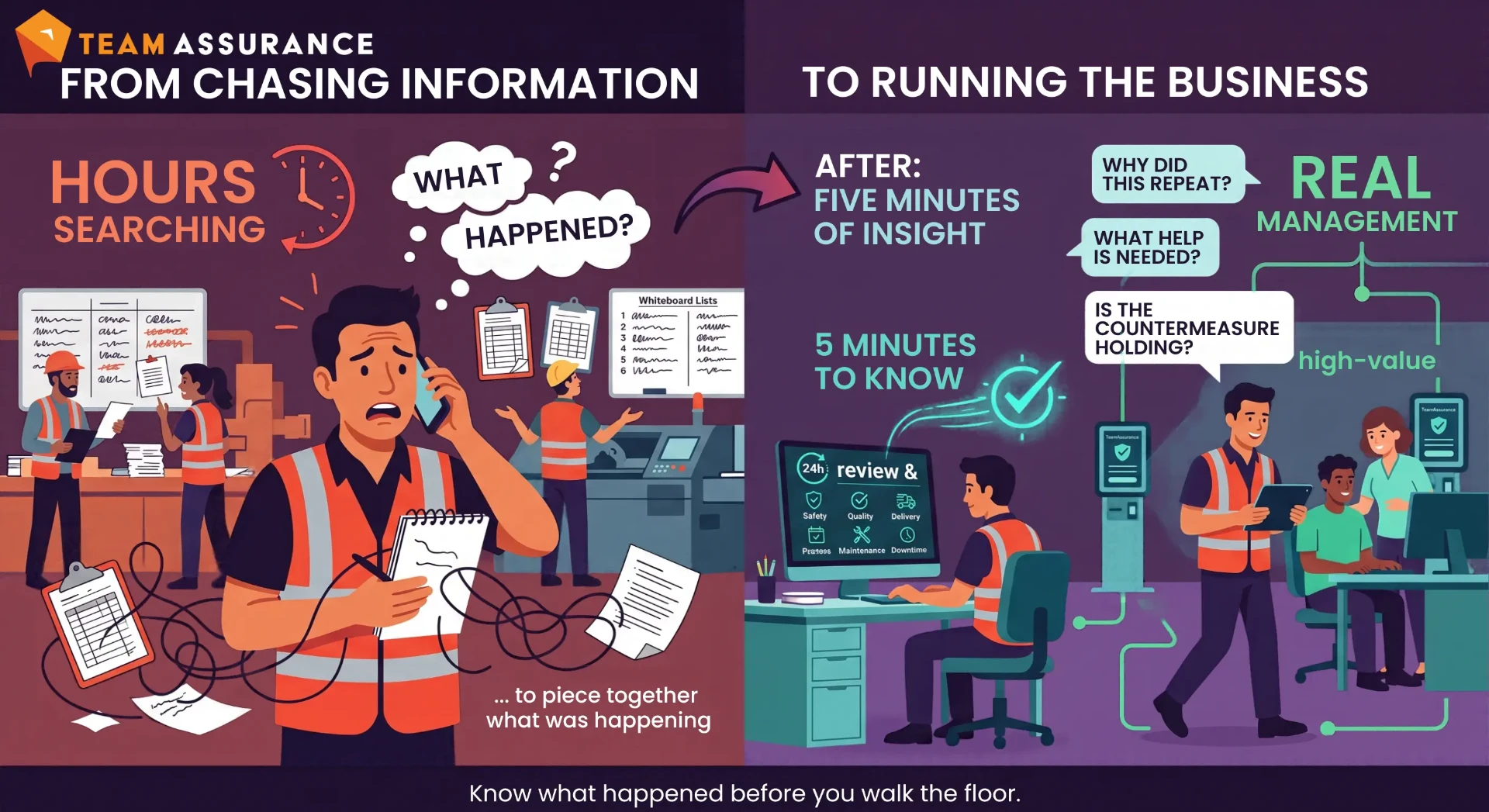
A few years later, the same leader starts his morning differently. He opens TeamAssurance, reviews the previous 24 hours across Safety, Quality, Delivery, Maintenance and downtime, and within about five minutes has a pretty good picture of what happened.
The difference is not a prettier dashboard. It is having an operating system around the work.
The Real Cost of Firefighting
When Finding the Information Becomes Half the Job
Most factory leaders know the routine.
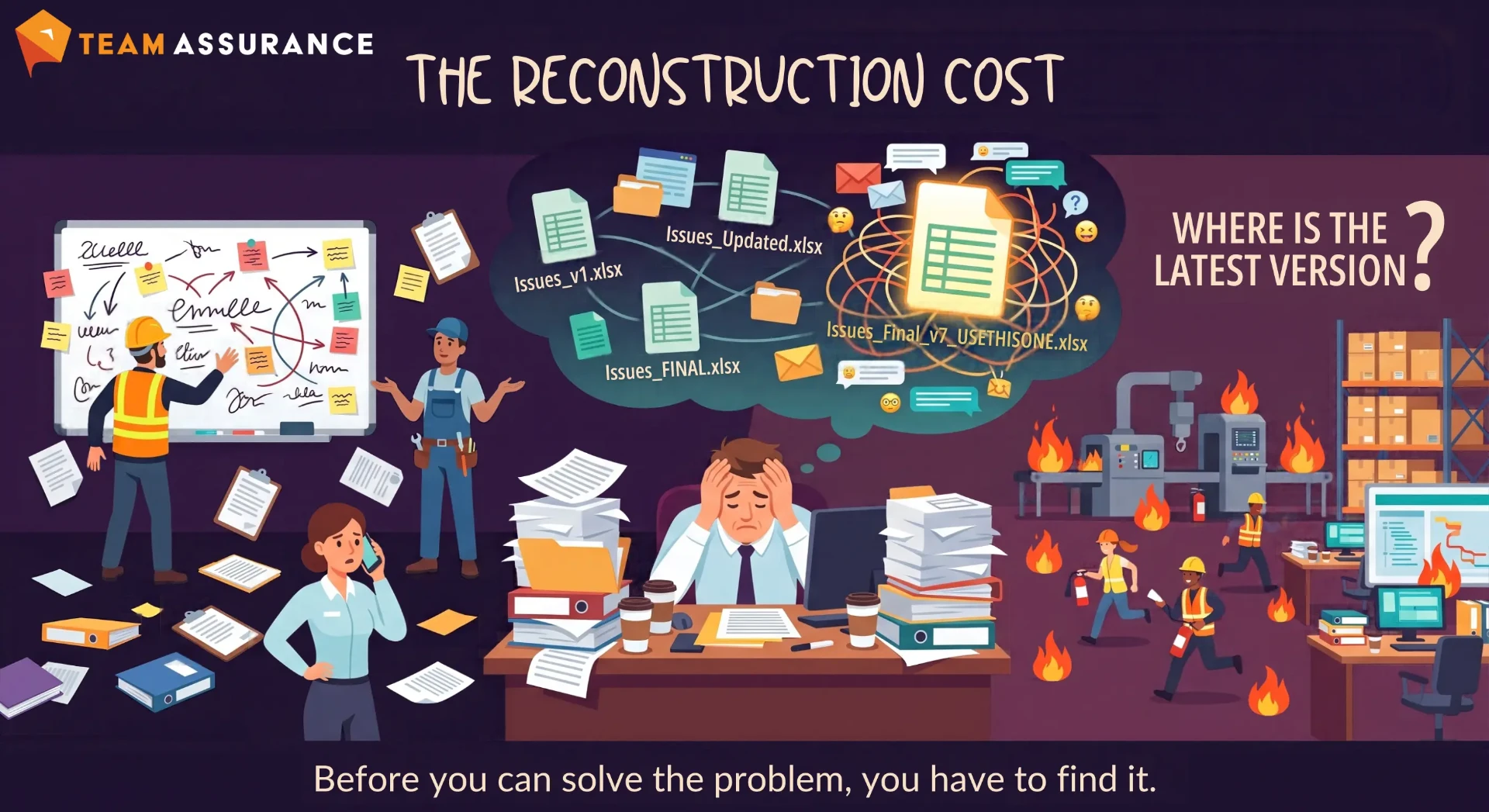
Something happened on night shift. Production knows part of the story. Maintenance knows another part. Quality has a record. Somebody mentioned it in handover. There may be an email somewhere, and if things are going particularly well, there is a spreadsheet called something like Issues_Final_v7_USETHISONE.xlsx.
The problem is not necessarily a lack of information. Quite often, there is plenty of it.
The issue is that the information is scattered across departments, systems and people. Before anyone can manage the problem, they have to reconstruct it.
That has a cost.
Supervisors chase updates. Managers walk the floor asking the same questions. Maintenance responds without the full operating context. Leadership spends time gathering information rather than making decisions.
When the organisation is busy enough, this becomes normal. People get very good at firefighting and increasingly poor at stepping back to understand why there are so many fires.
Firefighting Steals Time From Strategy
One of the most telling comments in the customer story is not about software at all.
The site leader said that previously he spent most of his time fighting fires and trying to find information. Today, he can spend more time on strategy.
That is the point.
Plant leaders should be dealing with capability, reliability, customer performance, improvement, people and the direction of the site. If the operating system requires them to spend their morning performing information archaeology, something underneath them is not working properly.
Good visibility creates management capacity.
That capacity can then be spent improving the business rather than simply discovering what happened to it yesterday.
Start With Real Work, Not a Software Rollout
The company's use of TeamAssurance did not begin with a grand plan to digitise everything.
It began with a major project at a facility involving ten different workstreams aimed at improving productivity across the site.
TeamAssurance was used to manage the activities and keep the project on track. According to the customer, the project was delivered on time and within budget during an already busy period for the factory.
That experience created the next question: if the platform could coordinate a complicated improvement project, could it also manage the everyday operating work of the site?
The answer was to extend it across the business.
From Project Management to Daily Operations
The useful thing about a successful project is that it exposes what a management system actually needs to do.
People need to see the work. Ownership needs to be clear. Actions need dates. Problems need escalation. Different workstreams need to stay connected. Leaders need enough visibility to know where intervention is required without sitting inside every conversation.
Daily operations are not terribly different.
The volume is higher and the rhythm is faster, but the management problem is similar.
Safety issues, quality concerns, downtime, maintenance activities and improvement actions all need to move from observation to ownership to completion. Some need escalation. Some need verification. Some become recurring themes. Some need leadership help.
Once that work is managed through one connected rhythm, the factory starts behaving differently.
Five Minutes to Understand the Last 24 Hours
A Better Start to the Morning
The site leader now begins his day in TeamAssurance.
He reviews activities raised over the previous 24 hours across Safety, Quality, Delivery, Maintenance and downtime. Within around five minutes, he has a useful view of what happened.
That is a very different management experience from walking the factory looking for information.
It does not replace going to the floor. Leaders should still go and see the work.
What changes is the reason for going.
Instead of walking around asking, "What happened?", the leader can arrive already knowing the major issues and ask better questions: Why did this repeat? What help is needed? Has Maintenance seen it? Is the customer exposed? Has this happened before? Is the countermeasure holding?
The floor visit becomes management rather than information collection.
Tiered Daily Management Works Better With Shared Context
This is where Tiered Daily Management earns its place.
Tier 1 should understand what is happening close to the process. Tier 2 should coordinate the help needed across departments. Tier 3 should see the issues that require leadership attention, additional resources or broader intervention.
That only works properly when the same operational reality can travel through those tiers.
If Safety, Maintenance, Quality and Production are all carrying different versions of the day, the tier system slowly becomes a reporting exercise. Each function arrives with its own slide, spreadsheet or update and everybody spends the meeting synchronising reality.
A connected system does that work beforehand.
The meeting can then be about what needs doing.
What Happens When You Make It Easy for Operators to Raise Problems
One of the biggest changes at the site came from the people on the factory floor.
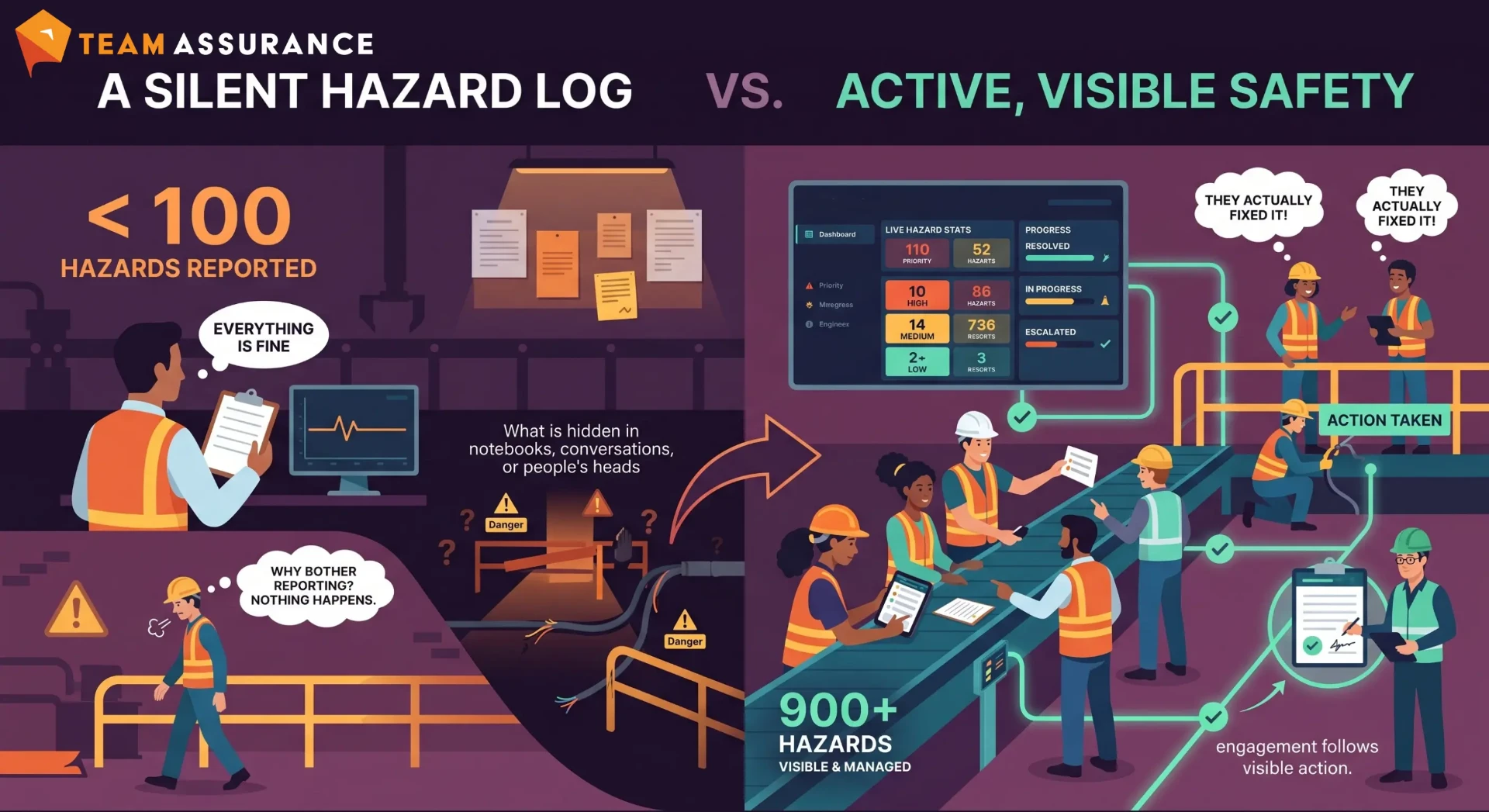
TeamAssurance gave operators a way to raise hazards and identify work requiring Engineering intervention. The site went from fewer than 100 recorded hazards to around 900 in a relatively short period.
At first glance, 900 hazards sounds worse than 100. It probably is not.
More Reporting Can Mean Better Visibility
A factory does not suddenly become nine times more dangerous because people are given a better way to report problems.
Quite often, the problems were already there. What changed was visibility.
Operators could raise what they were seeing. Issues that previously stayed in conversations, notebooks or people's heads became part of the management system.
The site could then review the hazards, identify the highest risks, deal with those first and progressively work through the remainder.
That is a much healthier safety conversation than congratulating yourself because the hazard log is pleasantly empty.
A low number of reported issues can mean the process is under control. It can also mean nobody believes anything useful happens after they report one.
The difference is what happens next.
Engagement Follows Visible Action
The customer described a significant increase in engagement from people on the factory floor.
That makes sense.
People are much more likely to participate when they can see that their input moves somewhere.
An operator raises an issue. Someone owns it. Action is taken. The result is visible. If it requires Engineering, Engineering becomes involved. If it requires escalation, it moves through the management rhythm.
That cycle gradually changes the relationship people have with the system.
Reporting stops feeling like paperwork done for somebody else and starts becoming part of improving the place where they work.
Maintenance Works Better When Suppliers and Contractors Are Connected
The customer also extended TeamAssurance beyond the factory walls.
Suppliers and contractors were brought into the system so that when a breakdown occurred, the relevant external party could be notified immediately.
That gave them time to begin their own response process before arriving on site.
The reported outcome was less downtime because the supplier or contractor was better prepared.
The Breakdown Should Not Begin With a Phone Tree
This sounds obvious, but many factories still manage breakdown communication through a chain of calls, emails and forwarded messages.
The machine stops. The operator tells the supervisor. The supervisor contacts Maintenance.
Maintenance diagnoses enough of the problem to decide external support is required.
Someone finds the contact details. The contractor gets a call. Then somebody explains the story from the beginning.
Twenty or thirty minutes can disappear before useful work even starts. A connected maintenance process shortens that gap.
If the equipment, symptom, photos, downtime impact and activity history are visible, the contractor or supplier receives more than a message saying, "Machine down. Please call."
They get context. Prepared people fix problems faster.
Better Systems Change Culture Because They Change the Work
The customer also described a substantial improvement in site culture. That is worth paying attention to because culture is often discussed as if it is a separate management project. It is not.
Culture is heavily influenced by what happens to people when they try to get something done. If raising a problem means filling in paperwork and hearing nothing back, people learn not to bother.
If getting Engineering support requires finding the right person in the corridor, people learn to work around the system.
If improvement ideas disappear into a spreadsheet, people stop offering them.
If strategy is visible only at management level, operators quite reasonably assume it has little to do with them.
Change the operating mechanisms and some of the culture changes with them.
People Can See Where the Business Is Going
The customer described strategy and actions becoming visible for everyone to see.
That creates a much clearer connection between the work on the floor and the direction of the business.
People can see what matters, what is being worked on and where their own activities fit.
This is a much stronger form of engagement than another values poster.
A team becomes more aligned when people can see the work, contribute to it and watch it move.
Language Should Not Be a Barrier to Participation
The site also employs people who speak different languages.
TeamAssurance's translation capability allowed workers to read information in their own language, and the customer described being able to see the difference in understanding when people could do that.
This matters more than it might first appear.
Manufacturing businesses often talk about frontline engagement while distributing operating information in a language some of the frontline only partly understand.
People become dependent on supervisors or colleagues to interpret what is happening. Nuance gets lost. Participation becomes harder.
If an operator can read an activity, issue or instruction in their own language, they are in a much better position to understand it, contribute and act.
For a genuinely connected operating system, accessibility is not cosmetic. It determines who gets to participate.
A Management System Should Give Time Back
The common thread through this customer story is not digitisation. It is time.
Less time looking for information. Less time reconstructing yesterday. Less time waiting for suppliers and contractors to understand a breakdown. Less time chasing actions. Less time carrying problems between disconnected departments. That time moves somewhere else. Into improvement. Into coaching. Into reliability. Into customer performance. Into strategy.
That is one of the better tests of an operational management system: does it give capable people more time to do the work only they can do?
If it simply turns the old paperwork into electronic paperwork, the factory has achieved very little.
From Frontline Signal to Management Action
The value of TeamAssurance in this example came from connecting the layers of the organisation.
An operator notices something and raises it. A supervisor sees it. Engineering or Maintenance becomes involved where required. The issue moves through Tiered Daily Management. Leadership sees the themes rather than waiting for a monthly report. Suppliers and contractors can join the process where their involvement is needed.
The history remains visible, so the organisation can learn rather than repeatedly reconstructing what happened. That is what a connected operating system should do.
It should make the path between seeing a problem and doing something useful about it shorter.
What This Looks Like in Practice
A good test is to ask a few fairly ordinary questions. Can a site leader understand the significant events from the previous 24 hours in a few minutes?
Can an operator raise a Safety, Quality or equipment issue without needing to understand the organisation chart? Can Maintenance see what Production is seeing? Can a contractor receive useful context before arriving at a breakdown? Can the business distinguish the highest-risk issues from the merely noisy ones? Can people working in different languages participate properly? Can leadership see whether daily actions are actually supporting the strategy? Can the people running the site spend more time improving the business than searching for information about it?
If the answer to most of those questions is no, the factory probably has a collection of systems rather than an operating system.
Conclusion
The Aim Is Not More Software
Most factories already have enough software. What they often lack is a management layer that connects what people are seeing, what needs to be done, who owns it and how that work moves through the organisation.
The customer in this story started with scattered information and leaders spending hours trying to understand what was happening. TeamAssurance was first used to coordinate a major ten-workstream productivity project, then expanded across daily operations.
The result was a very different operating rhythm: a leader able to understand the previous 24 hours in minutes, significantly more frontline reporting, clearer prioritisation of risk, better engagement with suppliers and contractors, stronger participation from operators and more time available for strategy.
From Firefighting to Running the Business
Factories will always have problems. Machines break, quality issues appear, customers change their minds and something unexpected will inevitably happen at 4:45 on a Friday afternoon.
The goal is not to eliminate every fire.
It is to build an organisation that sees problems early, moves information quickly, brings the right people together and learns enough that leaders do not spend their entire careers carrying the extinguisher.
This is where TeamAssurance helps: by connecting the frontline with Maintenance, Engineering, Quality, Safety and leadership through one visible operating rhythm, so the business can spend less time finding out what happened and more time deciding what happens next.
Want to move your factory from firefighting to proactive management? Explore how TeamAssurance’s Daily Management, Tiered Meetings and Continuous Improvement capabilities connect frontline issues, actions and operational performance in one system. Help your teams improve visibility, respond faster and spend less time chasing information and more time executing strategy. Learn more about TeamAssurance’s capabilities by booking a demo to see it in action.