
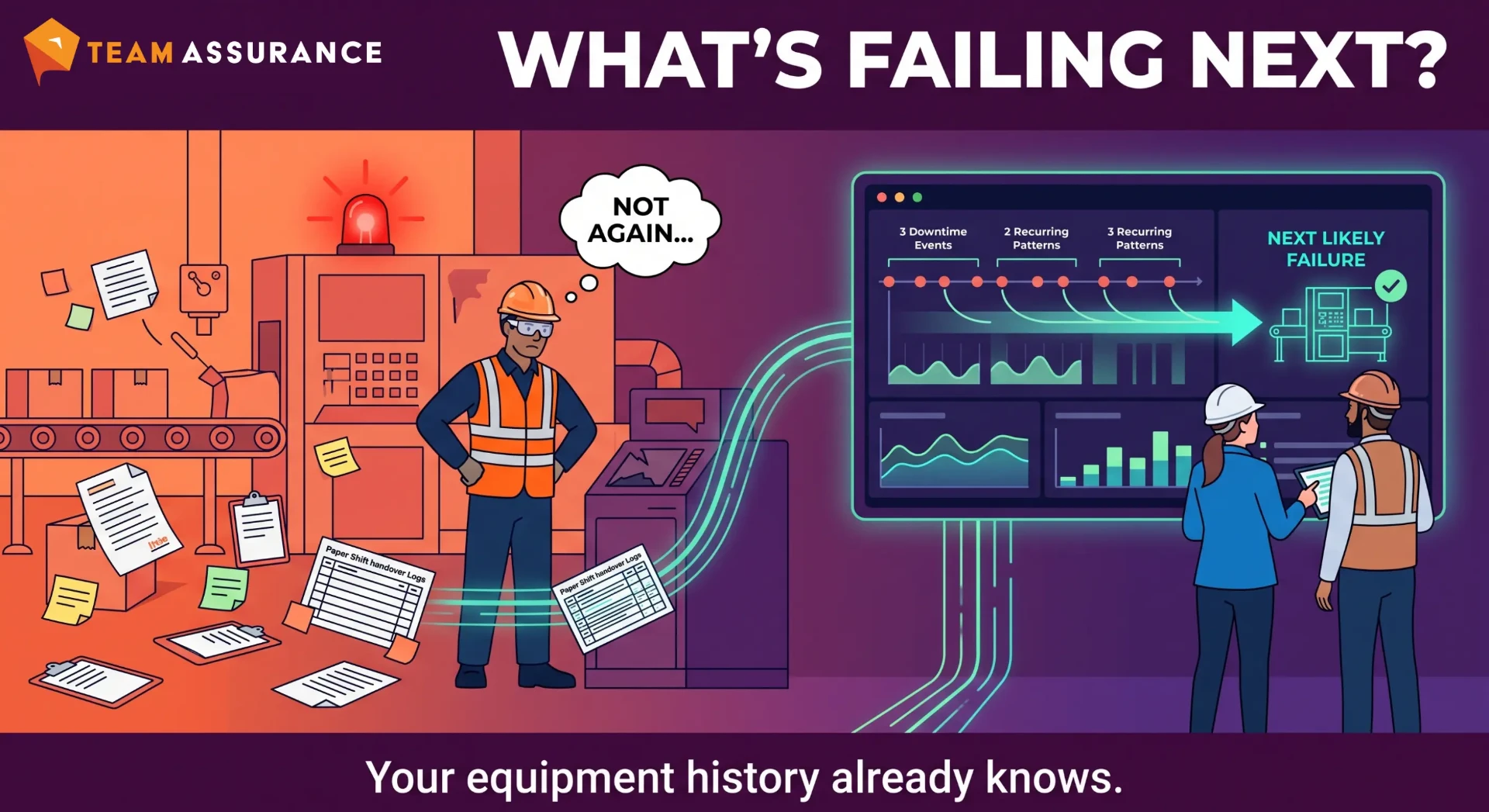
An equipment failure record should capture which asset and component failed, when it stopped, when repair started and when it ran again, the failure mode, the cause, the fix and what the failure cost. With those fields, MTBF, MTTR, OEE availability and reliability-centred maintenance decisions can all be worked out from the same data.
At a glance
- What it is: one structured record per failure event, linked to an asset in your equipment list.
- Minimum fields: asset, start time, restart time, failure mode, cause, action taken and a short note.
- What it feeds: MTBF and MTTR, the availability factor of OEE, failure Pareto charts and maintenance strategy reviews.
- Rule: record the times and the symptom at the machine, then add the cause after the repair, when it is known.
- Related: equipment downtime analysis covers how to read the records once you have them.
What is an equipment failure record?
An equipment failure record is the entry made each time an asset stops doing what it is meant to do, or does it badly. It is not the same as a work order. The work order describes the job maintenance did. The failure record describes the event: what failed, when, how it showed up, why it happened and what it cost. One failure can have several work orders, and some small stops have none.
A data model is simply the agreed list of records, the fields on each one and how they link. Agreeing it before you collect data is what makes the figures comparable between shifts, lines and sites.
Which fields should every equipment failure record have?
| Group | Field | Why it is needed |
|---|---|---|
| Identity | Event ID, site, area, line | Makes each failure countable once and reportable by area |
| Asset | Asset ID and the component or sub-assembly that failed | MTBF is calculated per asset, and repeat failures show up per component |
| Timing | Failure start, repair start, repair end, back in production | Gives waiting time, repair time and total downtime as separate figures |
| Classification | Planned or unplanned, and breakdown, minor stop or reduced performance | Only unplanned failures count towards MTBF, and each type lands in a different OEE loss |
| Failure mode | What was observed, chosen from a short list (jam, leak, overheating, will not start) | Lets you count like with like, and is the starting point for FMEA and RCM |
| Detection | How it was found: operator, alarm, inspection or planned check | Shows whether inspections and condition checks find faults before they stop the line |
| Cause | Cause code and failure mechanism (wear, contamination, misalignment, set-up error) | Points to the fix and to the right maintenance task |
| Action | What was done, parts used, labour hours | Supports repair time analysis and spares planning |
| Consequence | Lost production time, units scrapped, any safety or environmental effect | Ranks failures by what they cost, not only by how often they happen |
| Context | Shift, product or job running, operating hours or cycle count at failure | Shows patterns such as failures after changeover or at a certain age |
| Note | Free text in the operator's or fitter's own words | Carries the detail the codes cannot |
| Follow-up | Linked work order, linked problem-solving record, date the fix was verified | Shows whether the failure was closed out or only patched |
What is the minimum record that still works?
If the full list is too much to start with, record seven things every time: the asset, the start time, the restart time, the failure mode, the cause, the action taken and a short note. That is enough to calculate MTBF, total downtime and availability, and to build a Pareto chart of causes. Add repair start and end times next, because without them you cannot tell slow repairs from slow response.
How do the records link to the rest of your data?
The failure record sits between four other sets of data:
- Asset register. Each asset has one ID and a place in a hierarchy: site, area, line, machine, component. Failures are recorded at the lowest level the team can identify and rolled up from there.
- Production calendar. Planned production time by line and shift. This supplies the operating time that MTBF and availability are measured against.
- Code lists. Short, controlled lists for failure mode, cause and action. Ten to twenty entries per list is usually workable. Keep an "other" code and review what lands in it each month.
- Maintenance and improvement records. Work orders, preventive maintenance tasks and problem-solving records link back to the failure by its event ID.
How do failure records feed MTBF and MTTR?
Both measures come straight from the count of failure records and their timestamps.
- MTBF = operating time ÷ number of unplanned failures. The count is the number of failure records for the asset in the period. Operating time is planned production time less downtime.
- MTTR = total repair time ÷ number of repairs. Repair time is repair start to repair end. If you only record one stop time and one restart time, you are measuring mean downtime, which also includes waiting for a fitter or a part.
This is an illustrative example, not a customer result. A filler is planned to run 400 hours in a month. It has five unplanned failures with ten hours of downtime in total: four hours waiting and six hours under repair.
- Operating time = 400 − 10 = 390 hours
- MTBF = 390 ÷ 5 = 78 hours
- MTTR = 6 ÷ 5 = 1.2 hours
- Mean downtime = 10 ÷ 5 = 2 hours
- Availability = 390 ÷ 400 = 97.5%
The separate timestamps show that 40% of the downtime was waiting, which is a response problem and not a repair problem. A single "downtime minutes" field would have hidden that. The MTBF glossary entry covers the formula and its limits in more detail.
How do failure records feed OEE?
OEE needs every stop sorted into the right loss, and the classification fields do that. This page does not define OEE; see what is OEE? for the definition and formula.
| Record type | OEE factor affected | Fields that matter |
|---|---|---|
| Unplanned breakdown | Availability | Start and restart times, planned or unplanned flag |
| Minor stop or reduced speed | Performance | Failure type, duration or count, line and product |
| Scrap or rework at restart | Quality | Units scrapped, linked to the failure event |
If planned stops such as changeovers and scheduled maintenance are mixed in with failures, availability and MTBF are both wrong. The planned or unplanned flag is the field that keeps them apart.
How do failure records support reliability-centred maintenance?
Reliability-centred maintenance (RCM) chooses a maintenance task for each failure mode based on its consequences. The first analysis is done from engineering knowledge, and failure records are what keep it honest afterwards. They answer four questions RCM asks:
- Which failure modes really occur? The failure mode field shows which ones happen on your equipment, and how often.
- What are the consequences? The consequence fields separate failures that matter for safety, quality or output from those that are only a nuisance.
- Is the failure related to age or use? Operating hours or cycle counts at failure show whether a component wears out at a predictable point or fails at random.
- Did the chosen task work? If a failure mode keeps appearing after a preventive task was introduced, the task or its interval needs to change.
The answers decide the task. A wear-out pattern suits scheduled replacement under preventive maintenance. A failure that gives a warning suits condition-based maintenance. A random failure with low consequences may be left to run to failure, and a serious one with no workable task calls for redesign. The same failure modes and effects feed an FMEA.
What are the common mistakes?
- Free text only. Notes without codes cannot be counted. Codes without notes cannot be understood. Record both.
- One timestamp. A single "time lost" figure cannot give MTTR or show waiting time.
- Failures logged against the line, not the asset. Line-level records give line availability but no MTBF for any machine.
- Cause entered when the stop is reported. The person reporting sees the symptom. The cause is known after the repair, so the record needs to be finished then.
- Too many codes. A list of 200 causes gets "other" chosen every time. Keep the lists short and review them.
- Small stops left out. Short, frequent stops rarely get a work order, yet they are often the largest performance loss.
- No check that the fix held. Without a verification date, the same failure is recorded again and again as if it were new.
How do you put the record to use?
- Agree the asset list and hierarchy before anything else.
- Agree the code lists with operators and maintenance together, using the words people already use on the floor.
- Record the start time, asset, failure mode and note at the machine when the stop happens.
- Complete the cause, action and times when the repair is finished.
- Review open failures at the daily tier meeting, and MTBF, MTTR and the top causes each week.
- Send repeat failures to root cause analysis, and confirm later that the fix held.
Reporting needs a rule as well as a record. The equipment malfunction and near-miss policy template sets out who reports a fault, when to stop and how controls are updated. For the wider programme, see total productive maintenance and why autonomous maintenance is a management system.
In TeamAssurance
TeamAssurance records breakdowns and small stops against each asset with cause codes and notes, so MTBF and MTTR can be measured per asset and the causes behind them ranked. Downtime shows on the same tier boards as safety, quality and delivery, repeat causes move into structured problem solving, and preventive work is scheduled and tracked in Asset Management. The OEE software page shows the OEE view, or you can request a demo to see it with your own lines.
Equipment failure record FAQs
What should be recorded for each equipment failure? The asset and component, the start, repair and restart times, whether the stop was planned, the failure mode, the cause, the action taken, the consequences and a short note. Link the record to the work order and to any problem-solving record.
What is the difference between a failure mode and a failure cause? The failure mode is what was observed, such as a jam, a leak or a motor that will not start. The cause is why it happened, such as a worn guide, a failed seal or a wrong setting. Record them in separate fields.
Do failure records need to be in a CMMS? No. A spreadsheet or a digital form works if the fields and code lists are the same on every shift. What matters is that each failure is one record, linked to one asset, with real timestamps.
How many failure records do you need before MTBF is reliable? MTBF is an average, so a handful of failures can swing it. Treat the figure with care until an asset has a reasonable history, and compare each asset with its own trend over months and not with other equipment.
Should minor stops be recorded as failures? Record them, but classify them separately from breakdowns. They count as a performance loss in OEE and are usually left out of MTBF, yet they often point to the next breakdown.
Sources
- ISO 14224: Collection and exchange of reliability and maintenance data for equipment. Written for the petroleum, petrochemical and natural gas industries, and widely used as a model for equipment, failure and maintenance data.
- EN 13306: Maintenance terminology, including failure, failure mode and failure cause.
- SAE JA1011: Evaluation criteria for reliability-centered maintenance (RCM) processes.
- ISO 22400: Automation systems and integration, key performance indicators for manufacturing operations management.
- Nakajima, S. (1988). Introduction to TPM: Total Productive Maintenance. Productivity Press.