
Introduction
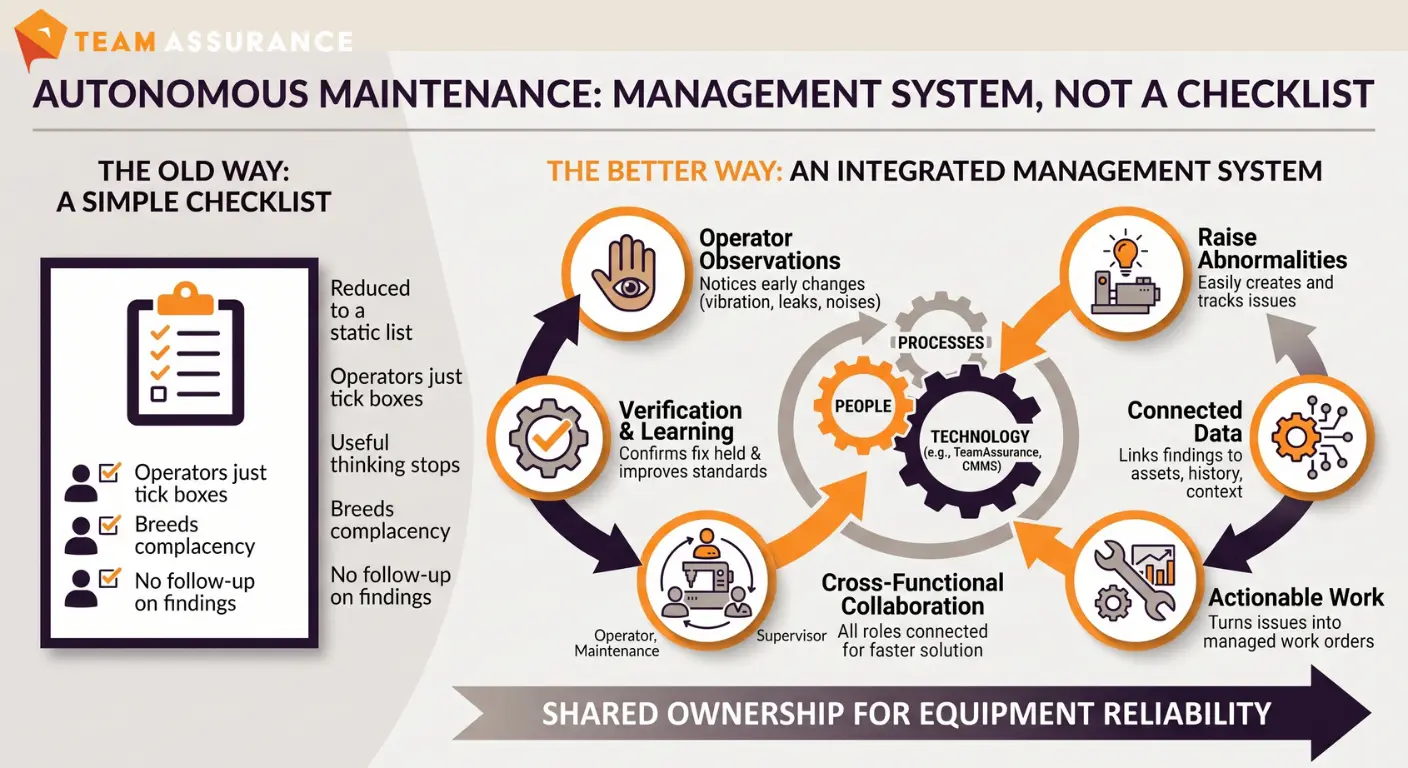
Autonomous Maintenance works when operators become part of the equipment care system, rather than people who simply run the machine until something unpleasant happens.
The idea is straightforward. Operators spend more time with the equipment than almost anybody else. They hear the new rattle, notice the small leak, feel the change in vibration, see the loose guard, notice the pressure creeping, and know when a machine takes three attempts to start instead of one. Those little changes are often visible long before the breakdown arrives with its flashing lights and ruined production plan.
A good maintenance management system captures those signals, turns them into managed work, and connects operators, supervisors, maintenance and engineering around the condition of the asset.
Autonomous Maintenance belongs inside that system. Once it gets reduced to a laminated checklist hanging beside the machine, most of the useful thinking has already left the building.
What Is a Maintenance Management System?
A maintenance management system is the way an organisation manages the health, reliability and improvement of its assets.
It includes preventive maintenance, corrective work, breakdown response, inspections, asset history, spare parts, condition monitoring, operator care, planning, scheduling, actions, escalation, root cause analysis and reliability improvement.
The software matters, but the management rhythm matters more. A strong system tells people what needs attention, who owns it, what can wait, what needs escalation, what keeps repeating and whether the last fix actually held. It connects the work being done today with the history of the asset and the lessons already paid for.
Why Autonomous Maintenance Gets Reduced to a Checklist Poster
Autonomous Maintenance usually begins with good intent.
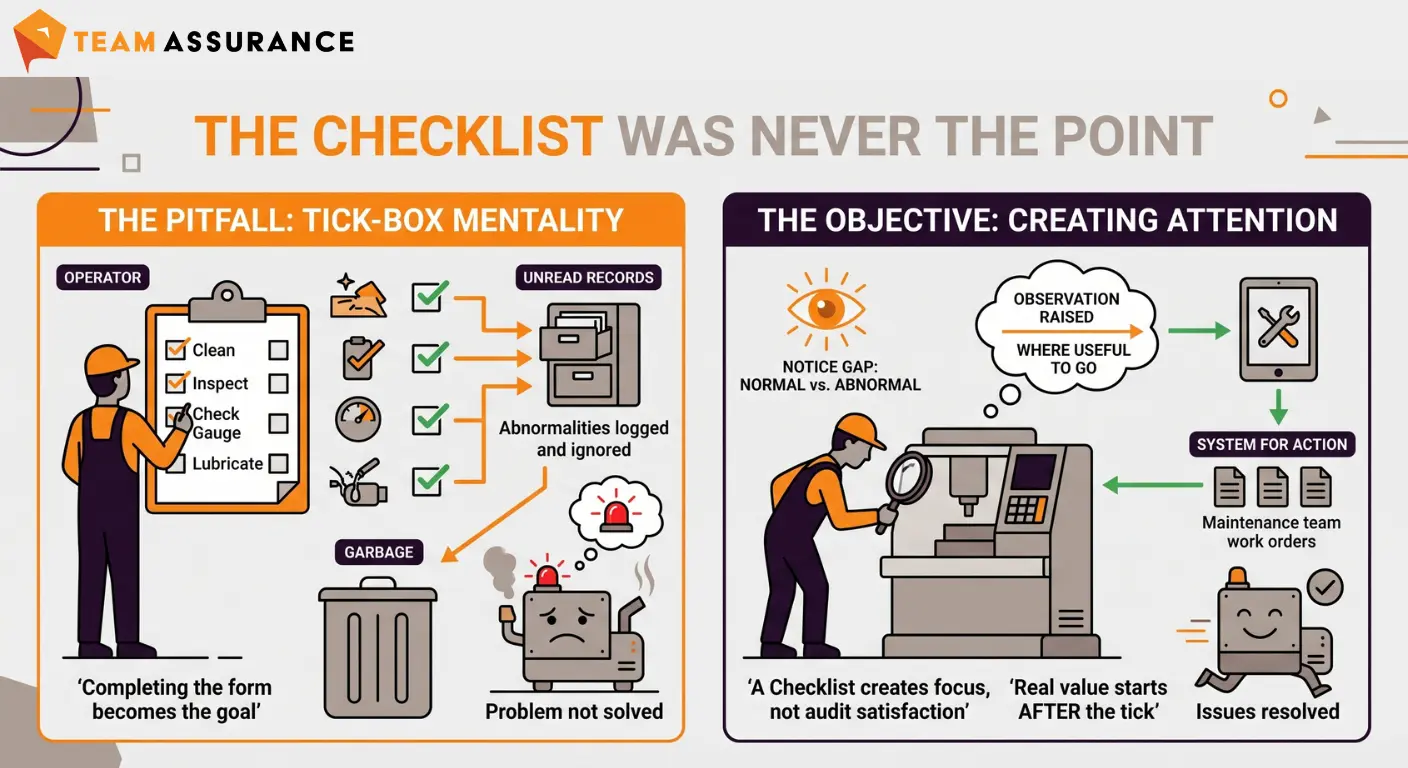
Operators are given a set of routine checks. Clean here. Inspect there. Check this gauge. Look for that leak. Lubricate this point. Record the result.
Nothing wrong with any of that.
Trouble arrives when completing the checklist becomes the objective. Ten boxes get ticked, one abnormality gets written in the comments field, and everybody carries on. The form is complete, although the bearing still sounds horrible.
A checklist should create attention. It should help an operator notice the difference between normal and abnormal, then give that observation somewhere useful to go. The real value begins after the tick.
Understanding Maintenance Management Systems
A modern factory already has plenty of maintenance information. Work orders, preventive maintenance schedules, breakdown history, spare parts records, manuals, alarm codes, downtime data, operator checks and perhaps condition-monitoring systems as well.
The useful question is whether these things behave as one management system.
Maintenance becomes much stronger when the operating floor can see equipment condition, when operators can raise abnormalities easily, when maintenance can respond with context, and when recurring problems find their way into Tiered Daily Management before another shift loses another three hours to them.
The Difference Between a CMMS and a True Maintenance Management System
A CMMS is an important tool. It can manage assets, work orders, planned maintenance, labour, spare parts and maintenance history. A good one is worth having.
There is a trap, though. Some CMMS implementations unintentionally build a wall around Maintenance. Operators identify the problem, somebody raises a request, and the issue disappears over the wall into a specialist maintenance system. Production waits. Maintenance works its queue. Eventually the work order comes back as complete.
That runs almost directly against the intent of Total Productive Maintenance, or TPM.
TPM recognises that equipment reliability belongs to the people operating, maintaining and improving the asset together. Operators are intimately involved because they live with the machine. They inspect it, clean it, care for basic conditions, notice abnormalities and see the small changes that precede failure. Maintenance brings the deeper technical expertise. Engineering improves the asset. Supervisors connect its condition to the production plan.
A maintenance management system needs all of that to behave as one system.
For some organisations, TeamAssurance can perform the CMMS role itself. Assets, maintenance activities, inspections, recurring work, abnormalities, actions and verification can all sit inside the same connected management system. This works particularly well where the business has the freedom to build maintenance around the operating rhythm rather than inherit a large existing technology stack.
Other organisations are already deeply invested in an established CMMS, and there is little sense in ripping out a system that is doing its specialist job well. In that case, TeamAssurance can connect to it, mirroring the relevant activities back and forth so the formal maintenance work remains governed in the CMMS while the operational work becomes visible to the people who need to collaborate around it.
That distinction matters. The maintenance technician can continue working in the CMMS. The operator can raise and follow abnormalities through TeamAssurance. Production can see the impact. Engineering can contribute to the countermeasure. Supervisors can manage the issue through Tiered Daily Management. Updates move between the systems rather than relying on somebody to retype the story into another spreadsheet or explain it again at the next meeting.
The broader maintenance management system can then answer the questions that matter at the asset. How does an operator raise an early warning? Who sees it? How is urgency decided? How does an equipment problem move from Tier 1 to specialist support? Can the operator see what happened next? How are repeat failures identified? Who verifies the repair? How does a lesson from one machine reach another line or another site?
This is an important role for TeamAssurance. It can be the connected maintenance system itself, or it can break down the functional wall around an existing CMMS. Either way, operator observations, Autonomous Maintenance checks, specialist maintenance work, actions and Tiered Daily Management become part of the same operating conversation.
Where Autonomous Maintenance Fits Inside the Bigger System
Autonomous Maintenance creates a first line of equipment care close to the asset.
Operators perform defined routine tasks, maintain basic conditions, clean and inspect equipment, identify abnormalities and raise problems early. This is more than housekeeping. Cleaning a machine properly is also inspection. A loose bolt becomes visible. A small oil leak appears. Wear is noticed. A damaged cable is found. A fitting that has begun moving is picked up before it becomes tomorrow afternoon's breakdown.
Maintenance technicians retain the deeper technical work, specialist inspections, repairs, planned maintenance and reliability responsibilities. Engineering brings another layer of asset knowledge and improvement.
Done well, those responsibilities overlap intelligently rather than disappearing into functional silos. The operator knows the machine in use. Maintenance knows the machine technically. Engineering understands design and improvement. The supervisor understands production risk. Tiered Daily Management gives all of them a common rhythm for deciding what needs attention, and TeamAssurance gives those observations somewhere to travel.
Where TeamAssurance is being used as the maintenance system, that flow can happen natively from operator observation through to maintenance action and verification. Where an existing CMMS remains the specialist system, the relevant work can move between the two systems so the operator does not disappear from the conversation the moment a maintenance request is created.
Autonomous Maintenance becomes powerful when those roles remain connected from the first sign of an abnormality through to the verified repair.
Why Operator Care Is Tiered Daily Management, Not Compliance
Operator care is a daily operating activity. Treat it like one.
The machine condition at 8:00 this morning matters to today's plan. A loose fitting, unusual vibration or recurring sensor fault has operational consequences now, not when somebody produces the monthly checklist-compliance chart.
This is why Autonomous Maintenance belongs in Tiered Daily Management. Equipment abnormalities should become visible alongside Safety, Quality, Delivery, Cost and People because equipment condition affects all five.
A leaking hydraulic line can become a safety issue. A worn fixture can become a quality issue. A recurring stop becomes delivery loss. Excessive scrap becomes cost. A difficult machine consumes the attention of the people trying to run it. Same asset, five consequences.
What Operators Actually Notice Before a Breakdown
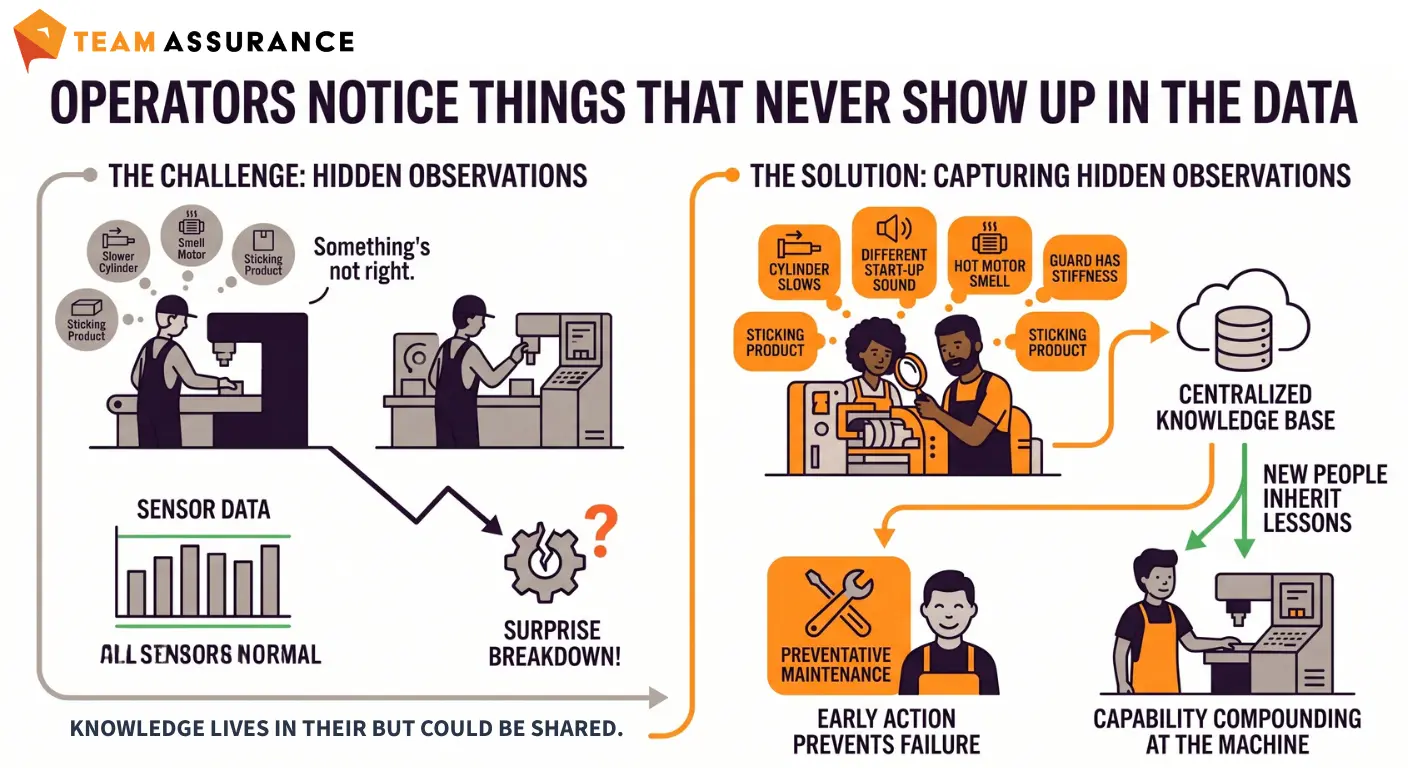
Operators notice an enormous amount that never appears in machine data.
The start-up sounded different. The cylinder is moving a little slower. The guard needs a shove to close. Product is beginning to stick where it never used to. The sensor needs wiping twice per shift now. That motor smells hotter. The same alarm appeared yesterday, disappeared after reset, and has just appeared again.
None of these observations necessarily justify stopping production immediately. Together, over time, they can tell quite a story.
Experienced operators build an intimate sense of normal condition. A good maintenance management system captures that knowledge before it disappears at shift change.
This also helps newer operators learn faster. Instead of waiting years to develop the same scar tissue, they inherit known watch-points, previous abnormalities and lessons from the people who ran the asset before them. That is capability compounding at the machine.
Why a Checklist Alone Doesn't Prevent Failures
A checklist can remind somebody where to look. It cannot manage what they find.
If an operator identifies an abnormal condition, the system needs to carry it somewhere. The issue needs context, ownership, priority, action and follow-up. If technical help is needed, escalation should be easy. If the same issue appeared last month, that history should be visible.
Otherwise the checklist becomes a recording system for problems everybody is learning to live with, which is a strange hobby for a factory.
The best Autonomous Maintenance routines teach operators what normal looks like, make abnormal conditions easy to raise and connect those abnormalities directly to the people who can help.
Building a Maintenance Management System That Actually Works
A useful maintenance management system connects detection, response, repair, verification and learning.
The sequence starts close to the equipment. Something changes. Somebody notices. The condition is captured while the evidence is fresh. Maintenance receives enough context to respond properly. The work is prioritised against operational risk. The repair is completed. The asset is observed afterwards to confirm the condition has actually improved.
Then comes the part factories often leave lying on the floor: the lesson.
Why did it happen? Has it happened before? Does another machine have the same exposure? Should the PM change? Should the operator check change? Does a spare need to be stocked? Was the previous repair weaker than expected?
That is where maintenance becomes learning rather than repeated intervention.
Connecting Operator Observations to Maintenance Action
Operator observations should be easy to raise and useful when they arrive.
A good report might include the asset, location, abnormal condition, photo, sound, current production impact and any immediate action taken. Nobody needs War and Peace because a hose has started leaking.
From there, the issue should find the right pathway.
A small operator-care item may be handled at the line. A technical abnormality may become maintenance work. A recurring issue may need reliability engineering. An equipment risk affecting production may need Tier 2 or Tier 3 support.
The important part is continuity. The person raising the issue should be able to see where it went. Maintenance should see the original observation. The supervisor should understand the impact. Leaders should see the recurring problems consuming capacity.
Doing the work and reporting the work should increasingly become the same thing, rather than two separate administrative jobs.
Verifying That a Maintenance Fix Actually Held
Maintenance suffers from the same seductive green tick as every other management system.
The technician completed the work order, production restarted and the job was closed. That is a good start, but the machine still gets the final vote.
Did the vibration disappear? Has the leak returned? Is the alarm frequency lower? Did the repeated stop vanish? Is cycle time stable? Does the operator agree the machine is back to normal? Has the repair held through enough production to be meaningful?
A completed repair describes an activity. Verification tells us whether the condition changed.
This matters particularly with chronic failures. Temporary repairs are sometimes necessary; pretending they are permanent is where the fun starts.
Define the verification requirement according to the failure. Some repairs can be checked immediately. Others need several shifts, batches or production cycles. The system should make that expectation visible so the repair does not vanish from collective memory five minutes after restart.
Making Maintenance Part of the Tiered Daily Management Rhythm
Maintenance belongs in the normal rhythm of operations because equipment condition shapes the normal rhythm of operations.
At Tier 1, operators and supervisors should see abnormalities affecting today's work. At Tier 2, Production and Maintenance can coordinate support, priorities, planned intervention and recurring issues. At Tier 3, leaders can see chronic losses, resource constraints, larger reliability risks and problems requiring investment or cross-functional help.
This keeps the conversation close to the rate at which reality changes. A monthly reliability report still has value, but the machine is unlikely to wait for the PowerPoint.
Why Maintenance Shouldn't Live Alone in a Disconnected System
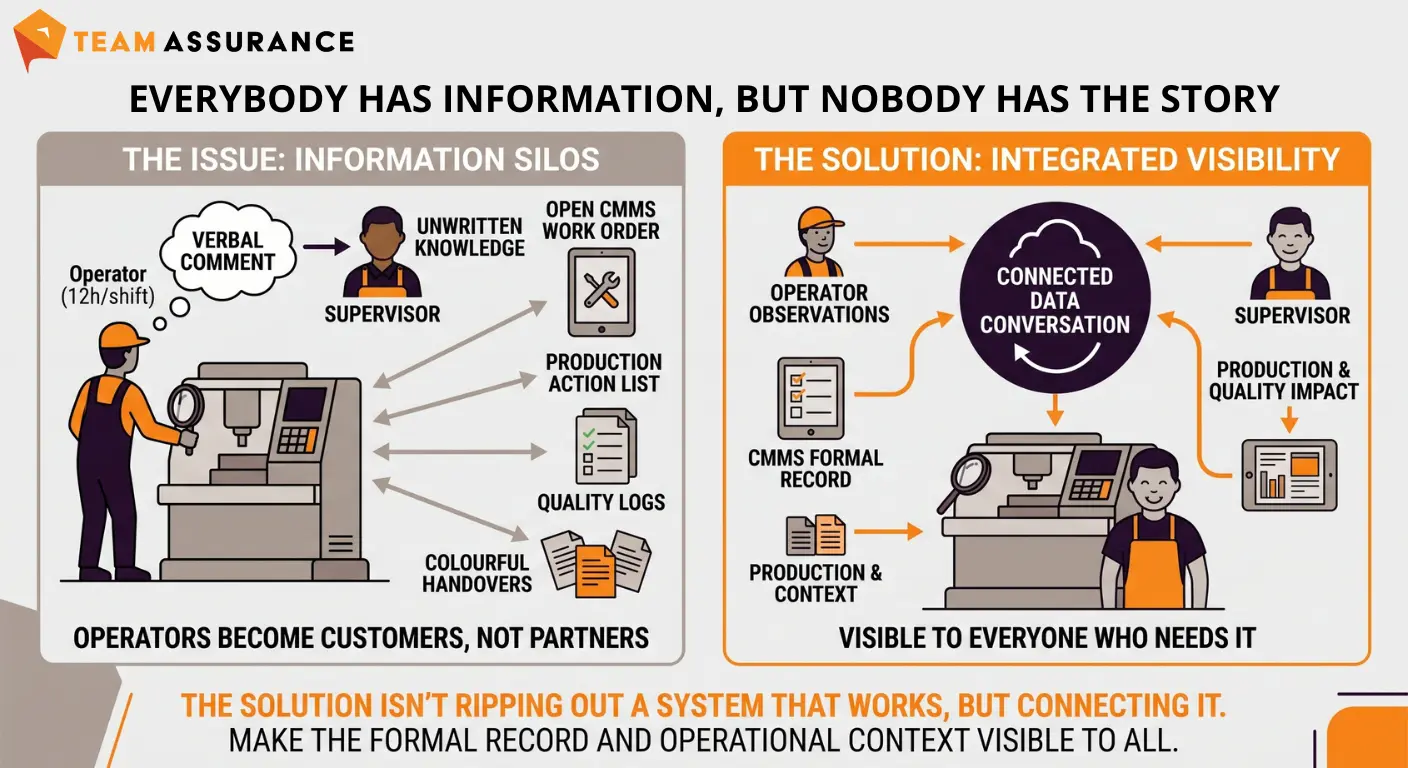
The CMMS may remain the system of record for formal maintenance work, and for many organisations that is exactly where it should remain. The operational conversation still needs to connect with Production, Quality, Safety, Engineering and leadership.
A recurring machine stop may have an open work order in the CMMS, an operator observation somewhere else, a production action on another list, a quality concern in another system and three increasingly colourful comments in the shift handover. Everybody has information, but nobody quite has the story.
This is where a badly siloed CMMS can work against TPM. The maintenance department becomes the owner of equipment reliability while the people standing beside the equipment for eight or twelve hours a day gradually become customers of Maintenance. That wastes one of the best condition-monitoring systems in the factory: the operator.
TeamAssurance breaks down that barrier in two ways. For organisations wanting one connected maintenance and operational management system, it can perform the CMMS role and keep the asset, operator, maintenance work and management rhythm together. For organisations committed to an existing CMMS, TeamAssurance can mirror the relevant activities back and forth in a governed way, leaving the formal maintenance record where it belongs while making the work visible and collaborative across departments.
An abnormality found during cleaning or inspection can become visible immediately. The maintenance activity can be created or mirrored into the CMMS, the status can flow back, the issue can appear in Tiered Daily Management, Production can see what is happening, and the operator can remain connected through to completion and verification.
Nobody has to choose between a capable CMMS and Total Productive Maintenance. The specialist system can keep doing what it does well while TeamAssurance connects it to the people, roles and operating rhythm around the asset. That is the direction TPM was always meant to travel: shared ownership of equipment condition, with Maintenance, Production and operators working from the same reality.
Surfacing Equipment Issues in Tier Meetings Before They Repeat
Tier meetings become far more useful when the system prepares the conversation instead of asking everybody to reconstruct yesterday from memory.
Which equipment abnormalities were raised? Which remain unresolved? Which have repeated? Which caused downtime? Which repairs need verification? Which assets are accumulating small signals that deserve attention?
Those are good Tier 1 and Tier 2 questions.
A recurring ten-minute stop can easily hide beside a dramatic four-hour breakdown. One gets everybody's attention. The other quietly takes twenty hours over the year and keeps asking for a reset button to be pressed.
Tiered Daily Management helps keep both visible.
Speed matters here as well. If the time between operator observation, maintenance response and verified correction improves by 5% or 10%, the result can be much larger than the percentage sounds. Less waiting means less degraded running, fewer repeated stops, less production disruption and more time spent under stable conditions. Across hundreds of abnormalities and dozens of assets, that compounds.
How AI Strengthens a Maintenance Management System
Maintenance data has a familiar problem: there is plenty of it, and much of it speaks different dialects.
Operators describe symptoms one way. Technicians use another. Alarm systems use codes. CMMS records have work-order descriptions. MES or machine systems hold downtime and cycle information. OEM manuals contain troubleshooting knowledge. Experienced tradespeople have another layer living mostly inside their heads.
AI can help bring those pieces closer together.
Give it governed access to the right operational context and it can compare symptoms, search asset history, surface previous fixes, relate downtime to operator observations, find relevant manual information and identify recurring patterns humans would struggle to hold across hundreds of assets.
The mechanic still needs to know what they are doing. AI has not yet learned to crawl behind a machine with a torch at 2:00am, which may be for the best. Its useful role is giving the human a stronger starting point.
Spotting Recurring Symptoms Across Equipment and Sites
One operator writes "pump noisy." Another writes "high vibration." Maintenance records "bearing inspection." A second site logs "intermittent drive-end noise."
Those descriptions may be unrelated, or they may belong to the same failure mode.
AI can help cluster them using the asset type, symptoms, operating conditions, repair history, alarms and previous actions. This becomes especially useful across multi-site businesses where similar equipment may exist in twenty factories and nobody has enough spare time to read every work order produced by all of them.
When one site solves a problem, the system should make that learning discoverable elsewhere.
A technician facing a familiar symptom can see the earlier diagnosis, repair, parts used and whether the fix held. They still inspect their own machine, but they do not have to begin life from birth every time. That is organisational memory applied to maintenance.
Surfacing Downtime Patterns Before They Escalate
The large breakdown is easy to notice. Smaller losses are more cunning.
Five minutes here. Twelve minutes there. A reset every second shift. A nuisance alarm after changeover. Cycle time slowly creeping up. An operator compensating manually because they know how to keep the line moving.
Taken separately, these events may never rise above the noise. AI can scan downtime, cycles, operator observations, actions and asset history and show where small losses are becoming a pattern.
That gives the maintenance team a chance to intervene while the equipment is still talking politely.
This is where connection to MES, machine data or platforms such as InTouch becomes interesting. The system can see the operating signal alongside the human observation and maintenance history. One gives the numbers, one gives the context, and the maintenance management system gives the business somewhere to act on both.
Maintenance Management System Checklist
A practical test of the system is whether the work can move cleanly from the asset to the people who need to act:
- Can operators identify and raise abnormal conditions easily?
- Do they know what normal equipment condition looks like?
- Are operator-care checks connected to actions when something is found?
- Can Maintenance see the operating context behind an issue?
- Can Production see the status and expected response?
- Are repeated symptoms visible across work orders, shifts and assets?
- Are repairs verified after completion where the failure warrants it?
- Do recurring failures move into root cause analysis rather than endless repair?
- Can lessons change PM routines, standards, spare-parts strategies or operator checks?
- Are equipment issues part of Tiered Daily Management?
- Can similar sites discover repairs and lessons from each other?
- Can machine data, maintenance history, OEM knowledge and operator observations be brought together?
- Can TeamAssurance perform the maintenance management role where appropriate, or connect cleanly to the existing CMMS where that investment should remain?
- Is the organisation getting faster at moving from abnormal condition to verified fix?
If those things are happening consistently, Autonomous Maintenance has moved well beyond the poster.
What Is the Difference Between a CMMS and a Maintenance Management System?
A CMMS is software for managing maintenance information and work. It commonly handles assets, work orders, schedules, labour, parts and maintenance history.
A maintenance management system is broader. It includes the CMMS, but also the operating routines, responsibilities, escalation, planning, verification, operator involvement, reliability improvement and management rhythm around the assets.
In some organisations, TeamAssurance can perform both roles in one connected system. In others, the CMMS remains the specialist system and TeamAssurance provides the collaborative operating layer around it. The point is to keep the maintenance record governed while keeping the people who operate, maintain and improve the asset connected.
What Is Autonomous Maintenance?
Autonomous Maintenance is an approach in which operators take defined responsibility for basic equipment care, inspection and early identification of abnormal conditions.
The word "autonomous" can be slightly misleading. It does not mean operators become maintenance technicians or begin dismantling gearboxes between batches. It means equipment care starts closer to the machine, with clear standards for what operators inspect, clean, lubricate, tighten, observe and escalate.
That gives Maintenance better early warning and gives operators greater ownership of the condition of the equipment they use every day.
Conclusion
Autonomous Maintenance Works When It's a System, Not a Poster
Autonomous Maintenance becomes valuable when operator knowledge, maintenance expertise and management discipline operate as one system.
The operator sees the early signal. The issue becomes visible. Maintenance receives useful context. The repair is prioritised and completed. The result is verified. Chronic symptoms are analysed. Standards and PM routines improve. Lessons move to similar assets and sites.
Over time, the plant becomes better at hearing what its equipment has been saying all along.
This is also where standardisation matters. A multi-site manufacturer should not invent a completely different Autonomous Maintenance method at every factory. Core checks, escalation logic, verification expectations and Tiered Daily Management routines can be standardised while still allowing the equipment and local operating conditions to differ.
That gives the business a common maintenance language and makes learning transferable.
Learn More
Most manufacturers already have the ingredients: operators who know their equipment, maintenance people who know how to fix it, a CMMS containing years of history, machine data, OEM manuals and a Tiered Daily Management rhythm of some kind. The opportunity is to connect those ingredients so abnormalities move faster, fixes are verified and lessons remain available after the people involved have moved on. This is where TeamAssurance helps, either by providing the connected maintenance management system itself or by connecting an established CMMS to operator care, cross-functional collaboration and Tiered Daily Management so the whole plant can work from the same reality.
Interested in making maintenance more connected, proactive and collaborative? Explore how TeamAssurance's Maintenance Management capabilities connect operator care, maintenance actions, asset abnormalities, verification and Tiered Daily Management in one operational system. Combined with AI Assisted Workflows, TeamAssurance can help teams identify recurring equipment patterns, surface previous fixes and turn maintenance history into practical operational learning. Learn more about TeamAssurance's Maintenance Management and AI Assisted Workflows, or book a demo to see it in action.