
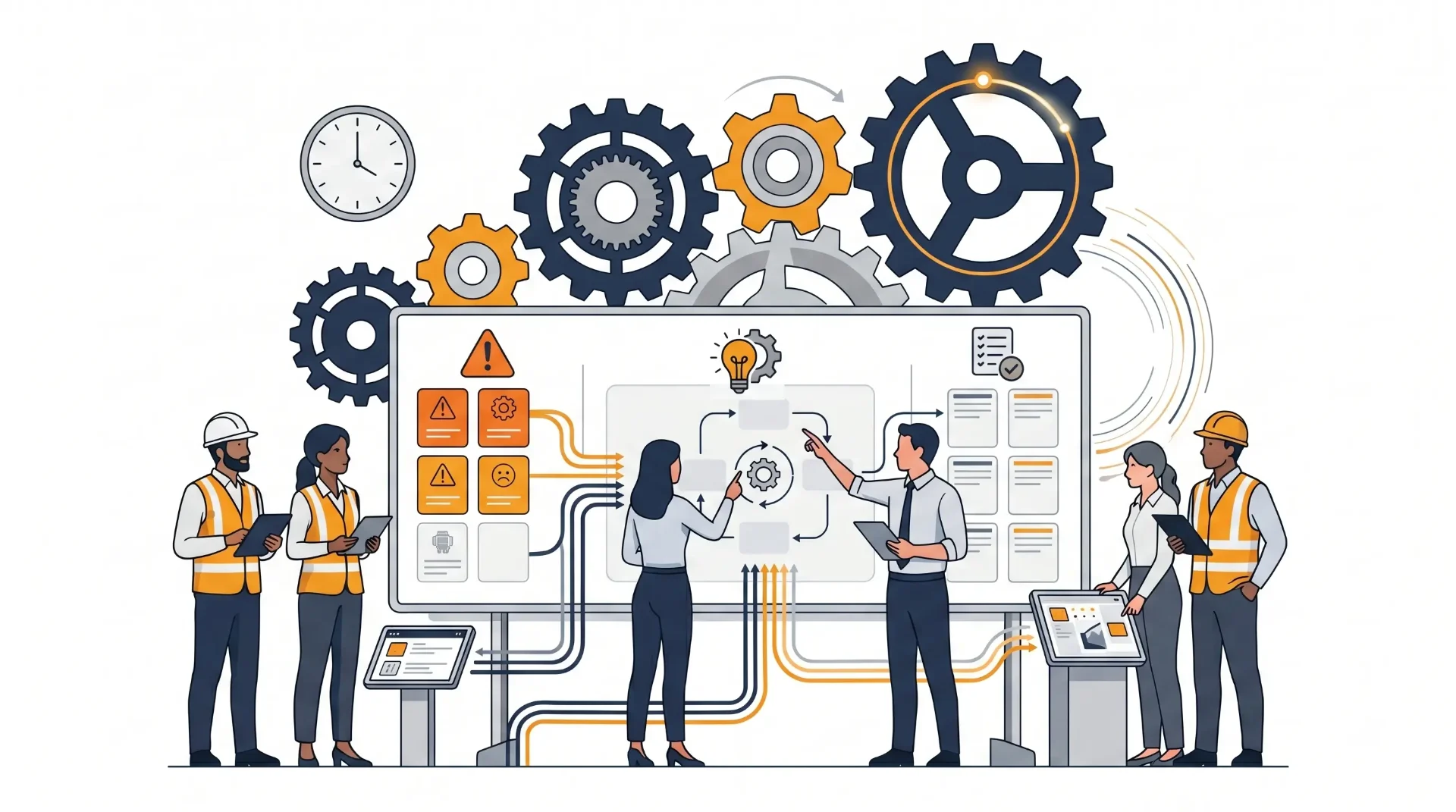
There are few concepts in operations that have been copied more widely and misunderstood more thoroughly than Daily Management.
Walk through enough factories, warehouses, hospitals or service operations and you'll eventually find a daily management board. There will be KPIs, colours, magnets, action lists, trend charts and meeting schedules. Somebody has usually invested a considerable amount of effort building it. In many cases, consultants have been involved. Templates have been shared. Best practices have been benchmarked.
Yet despite all of this activity, many daily management systems produce remarkably little performance improvement.
The board exists. The meetings occur. The metrics are reported. The actions are discussed. Everybody appears busy. Yet somehow the operation feels much the same six months later. The same frustrations persist. The same recurring issues continue to appear. The same conversations continue to circulate through the business.
I've seen organisations spend enormous amounts of time discussing performance without materially improving it. I've also seen relatively simple daily management systems transform the way an operation learns, solves problems and improves.
The difference is rarely the board.
The difference is usually the management system sitting behind it.
The Purpose Of Daily Management
The first mistake many organisations make is assuming that daily management exists to review performance. That's understandable because most daily management systems spend a great deal of time discussing performance. Yesterday's results are reviewed. Targets are compared. Variances are highlighted. Actions are assigned.
But performance review is really a by-product, not the purpose.
The real purpose of daily management is to help an organisation learn, adapt faster and support continuous improvement.
A good daily management system should help people understand what is happening, what is abnormal, why it is happening, what should be done about it and, perhaps most importantly, what has been learned. Most organisations do a reasonable job of answering the first question. Many struggle with the remaining four.
This is where daily management often drifts away from its original purpose. Instead of becoming a mechanism for learning, it becomes a mechanism for reporting. People attend meetings, exchange information, review metrics and move on to the next task. Information is transferred, but capability doesn't necessarily improve.
The distinction matters because reporting activity doesn't automatically improve performance.
Learning does.
Daily Management Is A PDCA Engine
I've become increasingly convinced that the best way to think about daily management is as a structured PDCA engine operating inside the business every day.
Every shift, every department and every function is constantly planning work, executing work, evaluating outcomes and adjusting based on what is learned. Whether people recognise it or not, they are already running PDCA cycles. The quality of those cycles largely determines the quality of organisational performance.
The role of daily management is not simply to display information about those cycles. Its role is to accelerate them.
Unfortunately, many organisations slowly drift away from PDCA and into something else. Over time, the cycle becomes Plan, Do, Plan, Do, Plan, Do. New actions are assigned before previous actions have been evaluated. New initiatives are launched before anyone determines whether earlier initiatives actually worked. Corrective actions are completed and attention immediately shifts elsewhere.
Everybody remains busy.
Learning begins to weaken.
I've seen organisations that are exceptionally good at generating activity and surprisingly poor at extracting learning from that activity. They launch projects, complete actions and hold meetings with impressive discipline, yet many of the same frustrations continue to return year after year.
The missing ingredients are usually the Check and Act phases.
The Check phase is where reality confronts assumptions. The Act phase is where learning becomes capability. When either of those stages are weak, organisations can remain highly active while learning very little.
A daily management system that works protects those stages. It creates the discipline required to stop, reflect, evaluate outcomes and deliberately incorporate learning back into the way the organisation operates.
The First Component: Visualising Reality
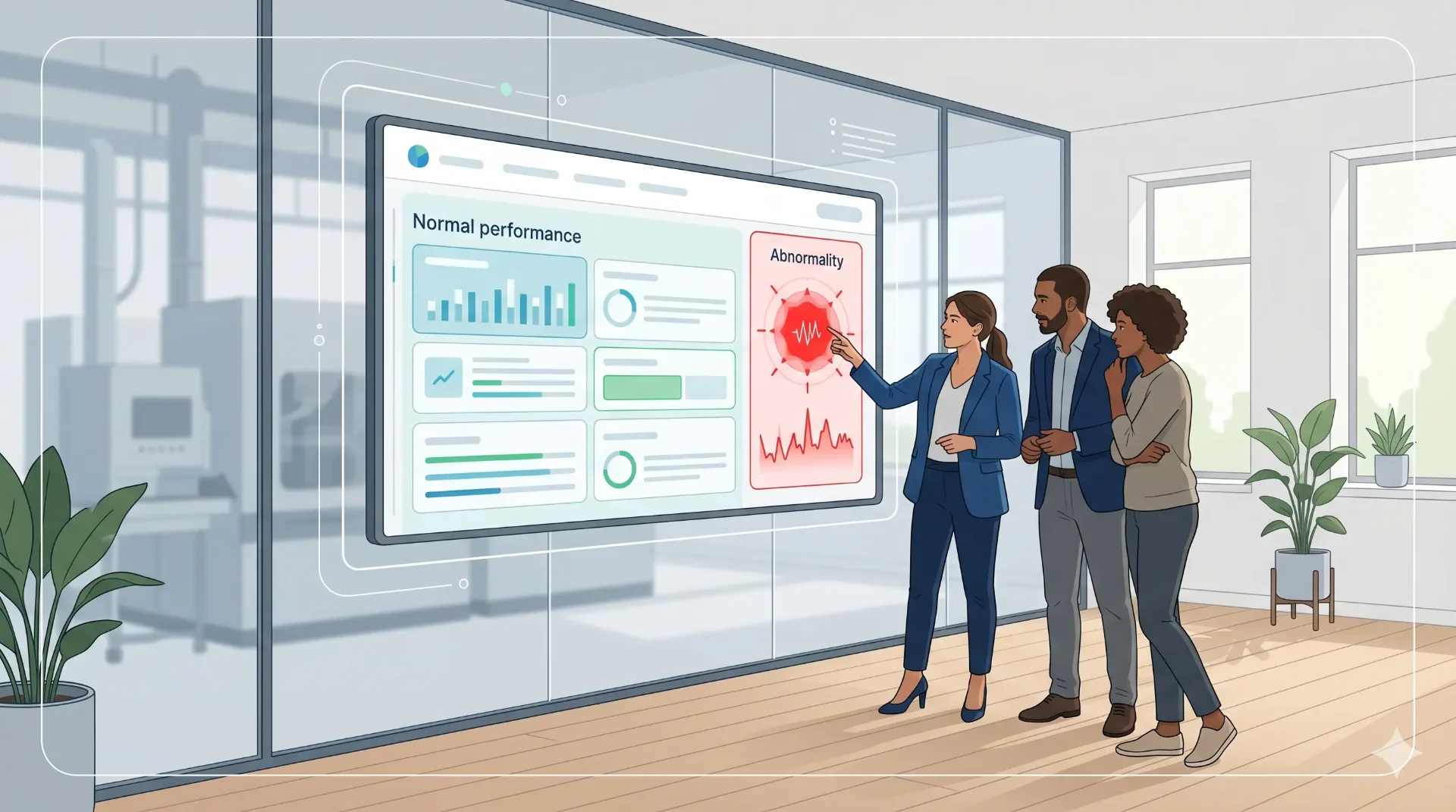
A good daily management system makes reality visible.
That sounds obvious, but it is far more difficult than it appears. Many boards contain large amounts of information but very little insight. Metrics are displayed because they have always been displayed. Reports are reviewed because they have always been reviewed. New measures are occasionally added, but very few are removed.
The result is often a wall of information that nobody truly understands.
The purpose of visual management is not to make information visible. The purpose of visual management is to make abnormalities visible. People should be able to walk up to a board and quickly understand what is normal, what is abnormal and where attention is required.
Just as importantly, visual management should drive action in real time.
One of the misunderstandings that creeps into many daily management systems is the idea that problems wait for meetings. An abnormality occurs at 9:00am and somehow survives untouched until the afternoon review meeting. Everyone gathers around the board, discusses the issue and then decides what should happen next.
By then valuable time has already been lost.
High-performing operations don't wait for meetings to respond to abnormalities. The moment something falls outside the expected condition, action begins. Operators respond. Supervisors become involved. Support functions engage where necessary. The problem-solving process starts immediately.
The role of the board is not to trigger action.
The role of the board is to make sure action is visible, coordinated, supported and escalated appropriately.
In that sense, the board should reflect reality rather than create it.
The best visual management systems operate much like the dashboard in a vehicle. They don't exist so the driver can discover a problem several hours later. They exist so abnormalities become visible early enough to influence behaviour while there is still time to respond.
When visual management is working properly, problems become difficult to ignore. When visual management is working poorly, problems become easier to hide inside a sea of metrics.
The board should help people see reality more clearly, respond more quickly and learn more effectively. It should never become a substitute for action.
The Second Component: Escalating Problems Quickly
One of the strongest predictors of operational performance is how quickly abnormalities move through the organisation.
In struggling operations, problems tend to linger. People work around them. Temporary fixes become permanent. Issues wait for the next meeting. Frustrations become accepted as part of normal life.
Over time, the abnormal becomes normal.
High-performing operations behave differently. Problems surface quickly. Ownership becomes clear. Support arrives early. Escalation is viewed as responsible behaviour rather than failure.
This is one of the reasons many organisations struggle with daily management despite having good boards and good meeting structures. The technical system exists, but the behavioural system does not. People are reluctant to raise issues because escalation is interpreted as incompetence rather than transparency.
A daily management system should reduce the time between recognising a problem and responding to it. The shorter that delay becomes, the more responsive the organisation becomes.
The Third Component: Structured Problem Solving
Not every issue deserves a major investigation.
Some abnormalities can be resolved quickly. Others require deeper analysis. The challenge is knowing the difference.
One of the weaknesses of many daily management systems is that every problem receives roughly the same treatment. Small issues consume excessive attention while significant issues receive superficial solutions. Teams become overwhelmed by activity while recurring problems continue to circulate.
A strong system creates pathways. Simple issues are resolved quickly. Recurring issues receive structured investigation. Systemic issues receive systemic solutions.
The objective is not simply to close actions.
The objective is to reduce the likelihood that the problem returns.
That sounds obvious, yet many organisations measure activity far more effectively than they measure learning.
The Fourth Component: Organisational Learning
This is where many daily management systems quietly fail.
The meeting happens. The problem is solved. The action is closed. Everyone moves on.
The learning disappears.
I've always found this strange because learning is where most of the value sits. Every breakdown, quality issue, customer complaint, near miss and improvement opportunity contains information that can strengthen the organisation.
The question is whether that learning remains local or becomes organisational.
Does another team benefit from the lesson? Does another shift benefit? Does another site avoid paying for the same mistake? Has the organisation become more capable than it was yesterday?
If the answer is no, there is a good chance the lesson will need to be purchased again in the future.
Most recurring operational problems are not failures of problem solving.
They are failures of organisational learning.
The Fifth Component: Leadership Behaviour
Most daily management systems fail because of leadership behaviour rather than technical design.
A beautifully designed board cannot compensate for leaders who don't engage with it properly. If abnormalities are punished, people stop raising them. If escalation attracts criticism, people stop escalating. If meetings focus on blame, people stop being honest.
The consequences are predictable.
Over time, the board becomes increasingly green while reality becomes increasingly red.
I've sat through meetings where every KPI was green and everybody in the room knew the operation was struggling. The board wasn't technically wrong. It was simply incomplete. People had learned which parts of reality were safe to discuss and which parts were better left unsaid.
A daily management system only works when leaders create an environment where reality can be discussed honestly. Without that, visual management becomes theatre.
The Sixth Component: Connecting Learning Across Levels
Most operations already have daily meetings.
Operators discuss issues. Supervisors discuss issues. Managers discuss issues. Leaders discuss issues.
The problem is that many of these conversations operate as isolated islands.
Learning generated at one level rarely influences decisions at another. Frontline observations fail to reach management. Management insights fail to influence frontline behaviour. The organisation accumulates information but struggles to accumulate capability.
This is where daily management becomes connected to the broader concept of the PDCA Stack.
Learning generated at one level should strengthen decision-making at another. Patterns observed by supervisors should influence management priorities. Systemic issues identified by managers should influence frontline improvement efforts. Strategic decisions should be informed by operational reality.
When these learning loops become connected, daily management stops being a meeting system and starts becoming a learning system.
What Good Looks Like
A daily management system that actually works does not necessarily look impressive.
In fact, some of the best systems I've encountered are surprisingly simple. Their effectiveness comes not from the sophistication of the board but from the quality of the conversations occurring around it.
Problems surface early. Abnormalities are discussed honestly. Escalation happens quickly. Problem solving is disciplined. Learning is captured. Knowledge spreads. Capability grows.
Over time, the organisation becomes better at recognising issues, adapting to change and improving performance which are the foundations of sustainable operational excellence.
That's the real purpose of daily management.
Not to report what happened yesterday.
But to help the organisation become smarter tomorrow.
The Future Of Daily Management
The next evolution of daily management is unlikely to be another board.
Most organisations already have boards.
What they lack is the ability to connect, retain and apply organisational learning at scale.
This is where technology and AI become increasingly relevant. Not because they replace people. Not because they automate leadership. But because they help organisations identify patterns, retain knowledge and accelerate learning across teams, shifts, sites and functions.
The organisations that pull ahead over the next decade will not necessarily be those with the most sophisticated dashboards or the most attractive visual boards.
They will be the organisations that learn fastest from their daily experience and turn that learning into sustained continuous improvement.
And that has always been the real purpose of daily management.
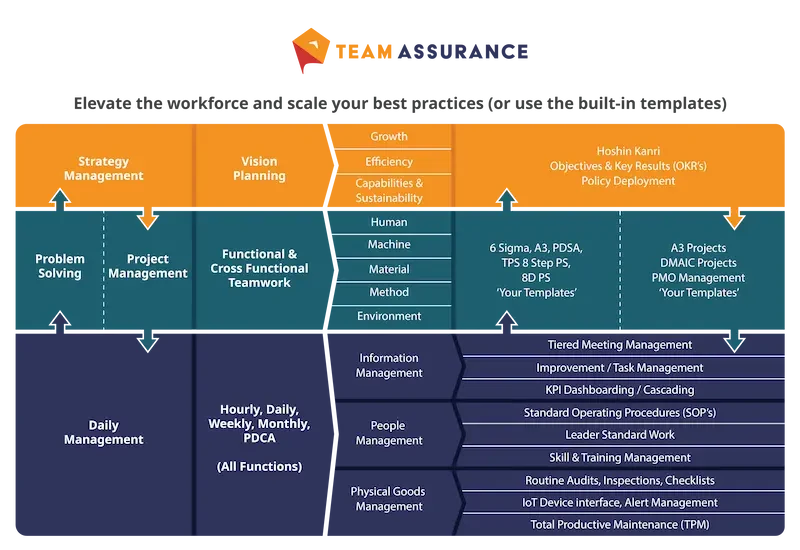
The illustration below shows how TeamAssurance connects the core elements of daily management into a single, integrated management system. TeamAssurance brings them together to help organisations respond faster, learn continuously and improve Operational Performance every day.
If you're looking to build a daily management system that drives action, accelerates learning and supports sustainable operational excellence, contact us to arrange a demonstration of the TeamAssurance platform.