
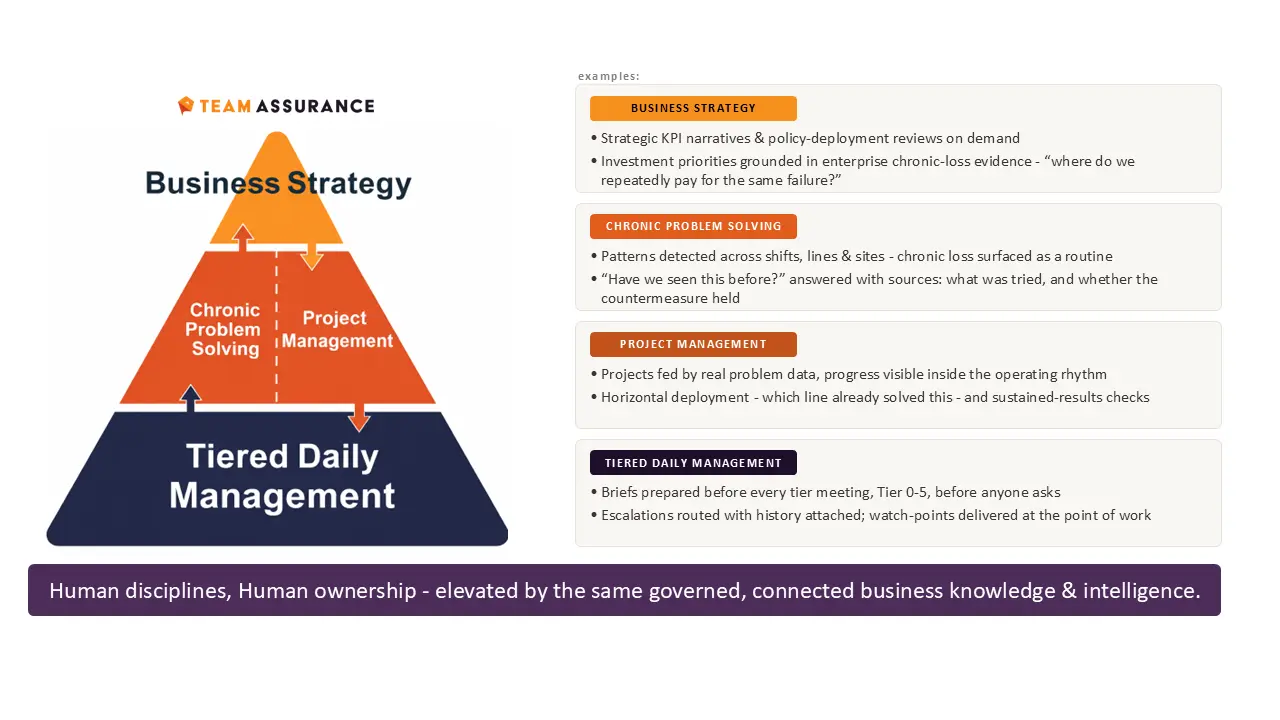
What Happens When AI Joins Your Daily Management System?
AI is moving into operations whether people are ready or not. The better question is not whether AI will be used, but where it will sit. If it sits outside the management system, it becomes another helpful tool that a few people use well and most people ignore. If it joins the daily rhythm of the business, it becomes far more useful.
That is the practical opportunity. AI should not live as a separate novelty, waiting for someone to ask a clever question. It should support the way work is already managed: pre-starts, handovers, tier meetings, escalations, problem solving, audits, standards, actions, skills, projects and strategy deployment. That is where the work lives, so that is where the intelligence should appear.
The best use of AI in operations will not feel like a magic trick. It will feel like better management, closer to the work, with less delay between seeing something and doing something useful about it.
AI Is Becoming Part of Every Operation
Every operation is already surrounded by information. Safety observations, quality defects, downtime events, production misses, maintenance history, audit findings, open actions, training gaps, customer complaints and improvement projects. The facts are usually somewhere in the business. The harder task is getting the right fact to the right person while the decision is still alive.
That is where AI can help. It can summarise, compare, search, connect, question and prompt. It can help leaders see a pattern earlier, help supervisors prepare for the shift better, help operators understand a recent watch-point, and help managers see which actions are moving and which ones are only ageing politely.
And let's be honest, shadow AI is already happening. People are exporting data, using their own tools, working inside or outside policy, then bringing the answer back into the formal system. Not ideal, but also not surprising. These are usually the people trying to move the work forward, and when the business introduces a sanctioned version, they are often the natural champions. They have already seen the value. The job is to make it governed, connected and useful for everyone.
AI Without a Management System Is Just Another Assistant
AI can be a clever assistant. Nothing wrong with that. It can write emails, tidy notes, summarise meetings and produce a decent first draft. Useful enough, but hardly a revolution in operational management.
The stronger version is different. AI joins the management system and supports the actual flow of work. It helps the team before the meeting, during the meeting, after the meeting, and in the moment when a decision has to be made. It does not replace ownership. It makes ownership easier to see. It does not replace leadership. It gives leaders better ground to stand on.
The distinction matters. A summary is not improvement. A better action, properly owned, followed through, checked and learned from, is improvement.
Where AI Fits Into Daily Management
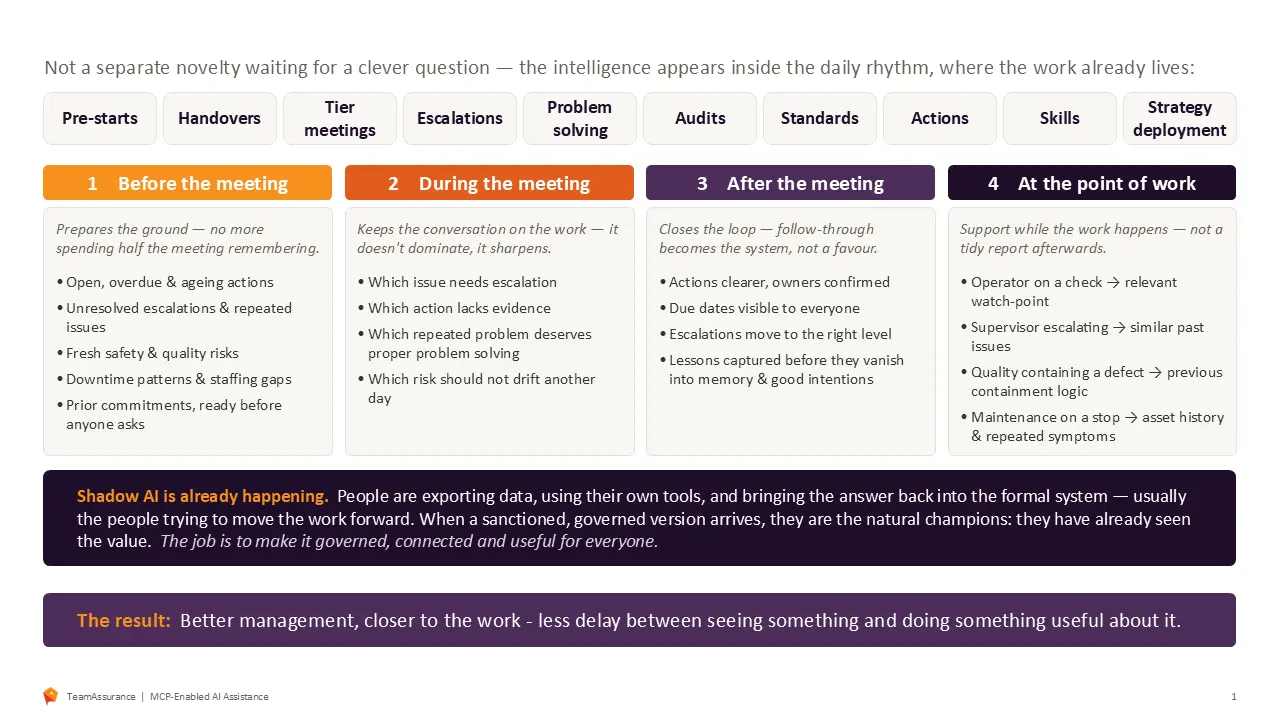
Before the meeting, AI can prepare the ground. It can review open actions, overdue items, unresolved escalations, repeated issues, fresh safety or quality risks, downtime patterns, staffing gaps and prior commitments. The team should not spend the first half of the meeting trying to remember what happened. Spare us. The system should already have the useful facts ready.
During the meeting, AI can help keep the conversation on the work. It can suggest which issue needs escalation, which action lacks evidence, which repeated problem deserves proper problem solving, and which risk should not be allowed to drift another day. Used well, it does not dominate the meeting. It sharpens it.
After the meeting, AI can help close the loop. Actions are clearer, owners are confirmed, due dates are visible, escalations move to the right level, and lessons are captured before they vanish into the usual swamp of memory and good intentions. The follow-through becomes part of the system, not a favour performed by the most organised person in the room.
And beyond meetings, which is the important bit, AI should support the work while it is happening. An operator completing a check can receive a relevant watch-point. A supervisor raising an escalation can see similar past issues. A quality team containing a defect can see previous containment logic. Maintenance responding to a stop can see asset history and repeated symptoms. That is AI at the point of need, not AI arriving later with a tidy report about what went wrong.
Why Operational Context Changes Everything
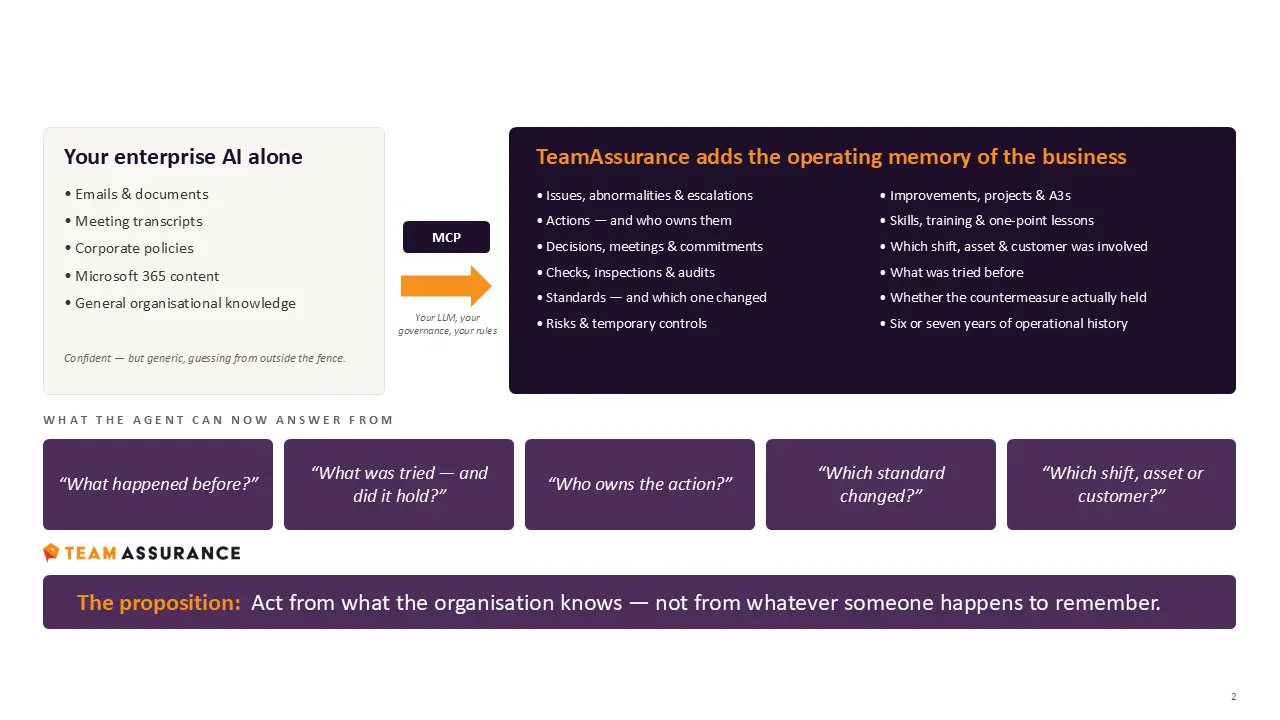
AI needs operating context to become useful in a factory, warehouse or plant. It needs to know what happened before, what was tried, who owns the action, which standard changed, which shift saw the issue, which asset is involved, which customer was affected and whether the previous countermeasure actually held.
Without that context, AI can still sound confident. That is not enough. Operations has no shortage of confident commentary. It needs grounded support.
This is where TeamAssurance matters. The system holds the operating memory of the business: issues, actions, decisions, meetings, checks, risks, escalations, improvements, standards, skills and lessons. When AI works from that memory, it can help the organisation act from what it knows, not from whatever someone happens to remember.
That is a much better starting point.
AI-Assisted Workflows Turn Insight Into Action
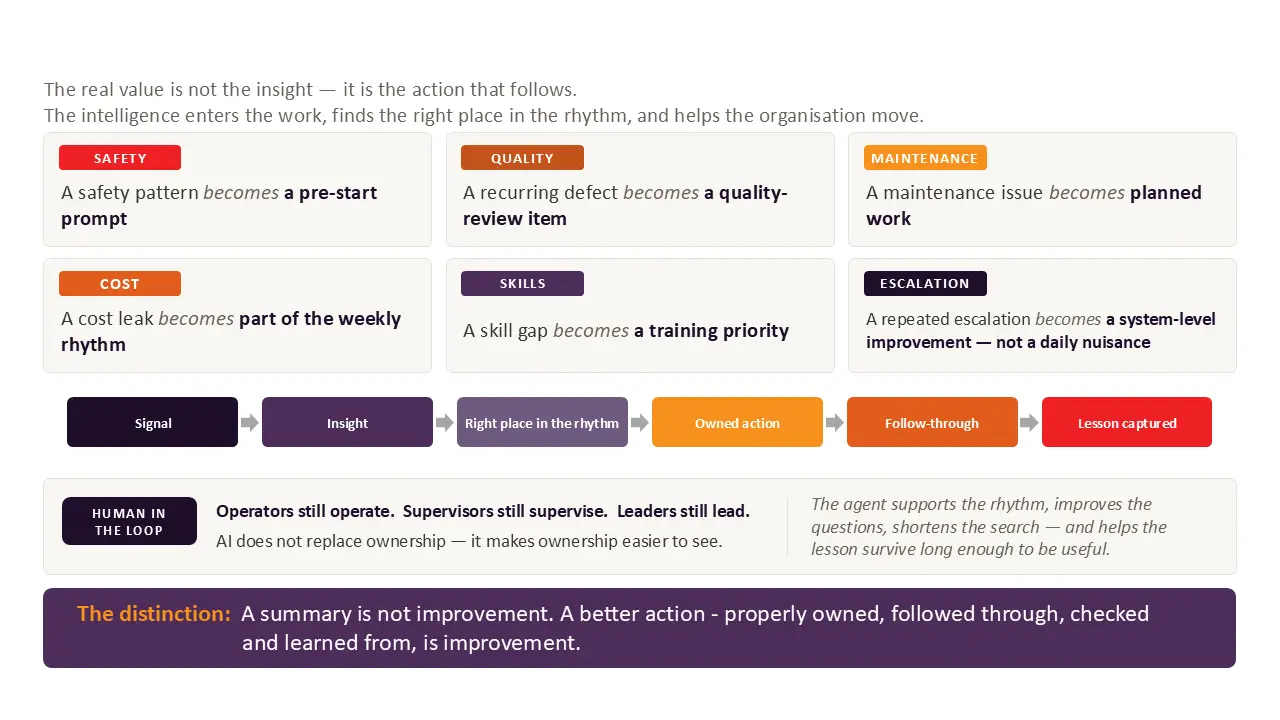
The real value is not the insight. It is the action that follows.
A safety pattern becomes a pre-start prompt. A recurring defect becomes a quality review item. A maintenance issue becomes planned work. A cost leak becomes part of the weekly rhythm. A skill gap becomes a training priority. A repeated escalation becomes a system-level improvement rather than another daily nuisance.
That is how AI-assisted workflows should work. The intelligence does not sit beside the operation looking clever. It enters the work, finds the right place, and helps the organisation move.
The human stays in the loop, as they should. Operators still operate. Supervisors still supervise. Leaders still lead. AI supports the rhythm, improves the questions, shortens the search, and helps the lesson survive long enough to be useful.
Why MCP Connectivity Matters
MCP connectivity matters because many organisations already have their preferred AI environment. They may be using Microsoft Copilot, OpenAI, Anthropic, Gemini or another approved model. They have governance, security, access rules and IT direction already in place.
Fine. Use it.
The point is not to force another AI kingdom into the business. The point is to connect the customer's chosen AI to the operational context inside the management system. MCP gives a structured way for that to happen, so the LLM can work with approved operational data rather than guessing from outside the fence.
That means the customer keeps their LLM, their governance and their rules, while TeamAssurance provides the working memory of the operation. Good arrangement. Less theatre. More value.
AI Does Not Replace the Daily Management System
AI makes a good daily management system sharper.
The meeting still matters. The leader still matters. The standard still matters. The action still matters. The escalation still matters. The check still matters. The learning still matters.
AI can help prepare, prompt, connect, summarise and suggest, but the business still has to act. That is not a weakness. That is operations.
The machine runs or it does not. The shipment leaves or it does not. The control holds or it does not. The action changes the condition or it only changes the status. AI can help the organisation see this sooner and respond better, but it cannot remove the need for disciplined management.
Nor should it.
The Future of Operational Management
The future of operational management is not people wandering around asking AI random questions. That might be useful here and there, but it will not move the whole organisation.
The better future is quieter and stronger. AI becomes part of the daily management rhythm. It helps before the meeting, during the meeting, after the meeting and at the point of work. It gives new people access to the memory of the operation. It gives supervisors better support. It gives managers cleaner visibility. It gives plant leaders a better view of what is moving, what is stuck and what keeps coming back.
The best operations will not use AI as a decoration. They will use it to strengthen the management system they already rely on.
That is what happens when AI joins daily management. The work gets clearer, the signals move faster, the actions get stronger, and the learning has somewhere to live.
That is the point. Better management, closer to the work, while better action is still possible.
Bring your preferred AI into your operational management system. Explore how TeamAssurance's AI Assisted Workflows use secure, governed connectivity to help your chosen LLM support daily management, problem solving and operational learning. Learn more about AI Assisted Workflows or book a personalised demo to discover how it works in practice.