
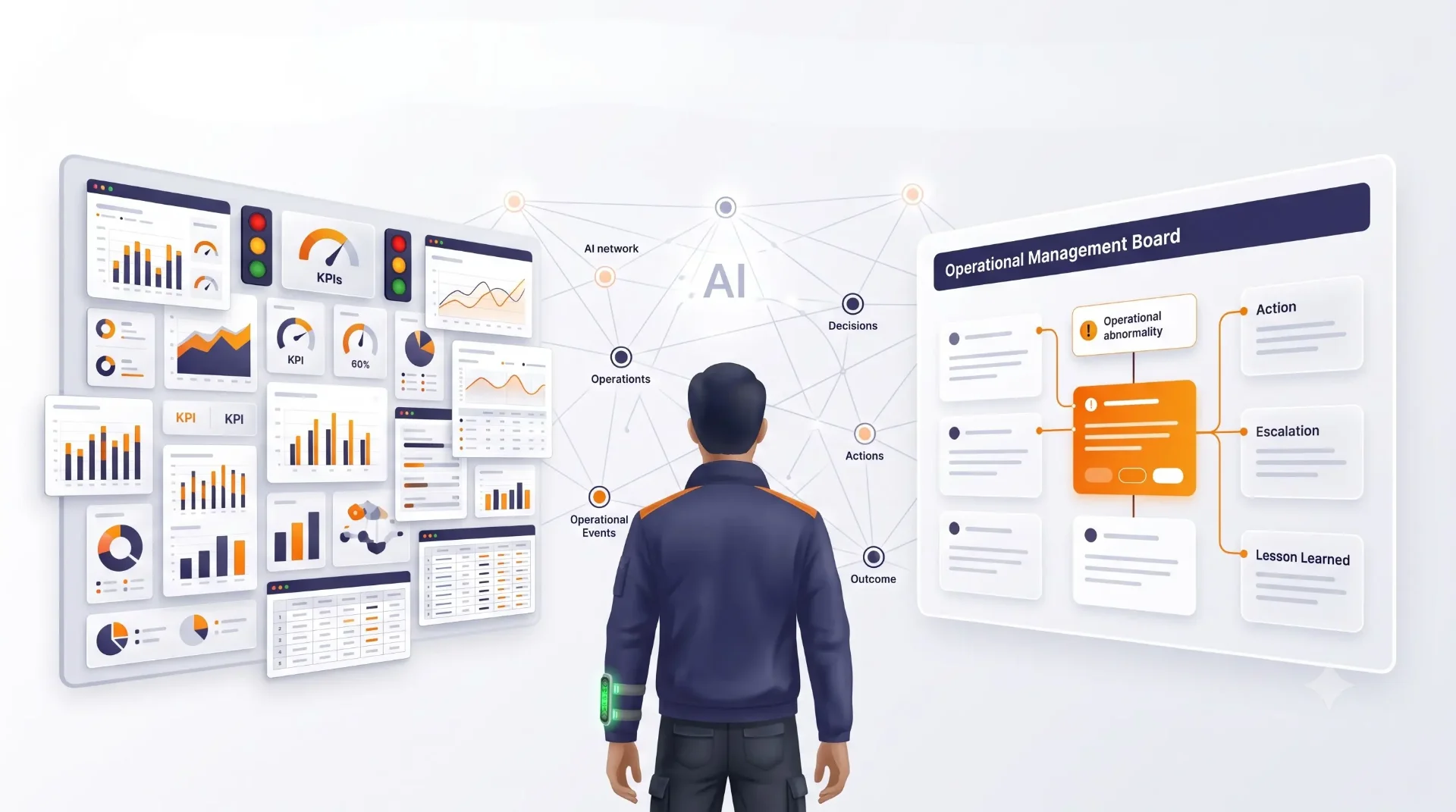
Visibility is not attention. That's why effective Daily Management relies on more than dashboards.
Good dashboards earn their keep when they support Visual Management and help people focus. They show the few things that matter, make abnormality obvious, and help leaders move quickly from "what happened?" to "what needs attention?" Used properly, they reduce noise rather than add to it.
The intent is good. Leaders want visibility. They want problems seen early. They want fewer surprises. Nothing wrong with that. The trouble starts when visibility gets mistaken for understanding.
A dashboard can show you a lot and still help you see very little. It can give you twenty charts, fifty metrics and a neat set of traffic lights, while nobody in the room is any clearer on what needs attention right now. That is not intelligence. That is reporting with better graphics.
Good dashboards point. Bad dashboards decorate.
A useful dashboard should separate signal from noise, but the signal is different at each level of the business. Examples:
Tier 1: What is abnormal right now?
Tier 1 should show what is happening this hour. What is abnormal? What is stopping the team? What needs support before the next hour of production is damaged? This is not the place for big strategy. It is the place for protecting today's work.
Tier 2: What patterns and barriers are emerging?
Tier 2 should show the pattern behind the noise. What abnormalities are repeating? Which issues are moving between shifts? What barriers are stopping teams from getting back to standard? What decisions, resources or support are needed to restore flow?
Tier 3: What system-level improvement is needed?
Tier 3 should show the system problem. This is where continuous improvement and operational excellence are driven. What is getting better? What is getting worse? Which problems keep returning across departments, lines or sites? What standards, capabilities, processes or leadership routines need to improve so the same issue does not keep coming back?
That is the job of a dashboard. Not to impress visitors. Not to fill a review pack. Not to create another colourful layer between management and reality. Each tier should help the organisation see the right problem at the right level, then act before it becomes another expensive lesson.
Doing the same thing at every level is not tiered management. That is not effective daily management. It is tunnel ball reporting. Tier 1 passes everything to Tier 2. Tier 2 passes everything to Tier 3. Eventually the highest level gets buried in noise that should have been filtered, solved or understood much earlier.
More data is not more judgement.
This is where businesses fool themselves. They think another view, another filter, another chart or another export will somehow create better decisions. Usually it just creates more discussion.
A dashboard can tell you that performance moved. It often cannot tell you why it moved, whether it matters, who already knows, what was tried last time, or whether the same issue is quietly repeating somewhere else.
That is where the operating system matters. Daily management matters. Escalation matters. Action tracking matters. Organisational memory matters. The dashboard should support that system. It should not pretend to be the system.
The better approach is Daily Management built around attention management
The best organisations are not trying to see everything. They are trying to notice the right things early enough to act. That is a very different discipline.
They want abnormalities to surface early. They want weak signals connected before they become bin fires. They want recurring issues recognised instead of rediscovered. They want actions closed in reality, not just in a status column. They want lessons from one team to reach the next team before the same mistake gets bought twice.
That is what good visibility is for. It should accelerate action and learning. If it does not, it is just wallpaper.
AI is the so what.
This is where AI starts to matter in TeamAssurance. Not as another shiny dashboard. Spare us. The point is not to give leaders one more screen to stare at while the same problems come back wearing a different shirt.
Without the context of how the business actually runs, AI gets reduced to drafting emails, summarising meetings and polishing reports. Handy, but not exactly revolutionary.
The real value comes when AI can work against the operating memory of the business: the issues, actions, decisions, escalations, lessons, risks, patterns and repeated failures that explain what is really going on.
TeamAssurance already holds the work. The meetings, actions, decisions, issues, escalations, improvements, risks, lessons and patterns are not floating around in someone's inbox or buried in last quarter's review pack. They become part of the organisation's Operational Learning and Organisational Memory.
That gives AI something useful to work with. It can help spot repeated failures, connect today's issue to last month's action, find weak signals, compare teams and sites, surface lessons that were already learned, and remind the business that it has seen this movie before.
That is not more reporting, it's organisational memory starting to work.
Dashboards should serve the work.
Dashboards are useful when they help people understand faster, act sooner and learn properly. They are dangerous when they become a substitute for thinking.
The goal is not to see more. The goal is to know where to look, what to do next, and what the organisation should learn from it.
Most businesses already have enough visibility to know they have problems. What they need now is sharper attention, faster escalation, better action, and a memory that stops the same issues coming back dressed in different clothes.
That is the role AI should play inside TeamAssurance. Not decoration. Not noise. Not another dashboard.
A smarter management system that improves operational performance and supports operational excellence.
The chart below illustrates how dashboards, visual management, daily management and organisational learning work together within a connected management system. Rather than simply reporting performance, this integrated approach helps organisations focus attention, accelerate action and turn operational data into meaningful improvement.