
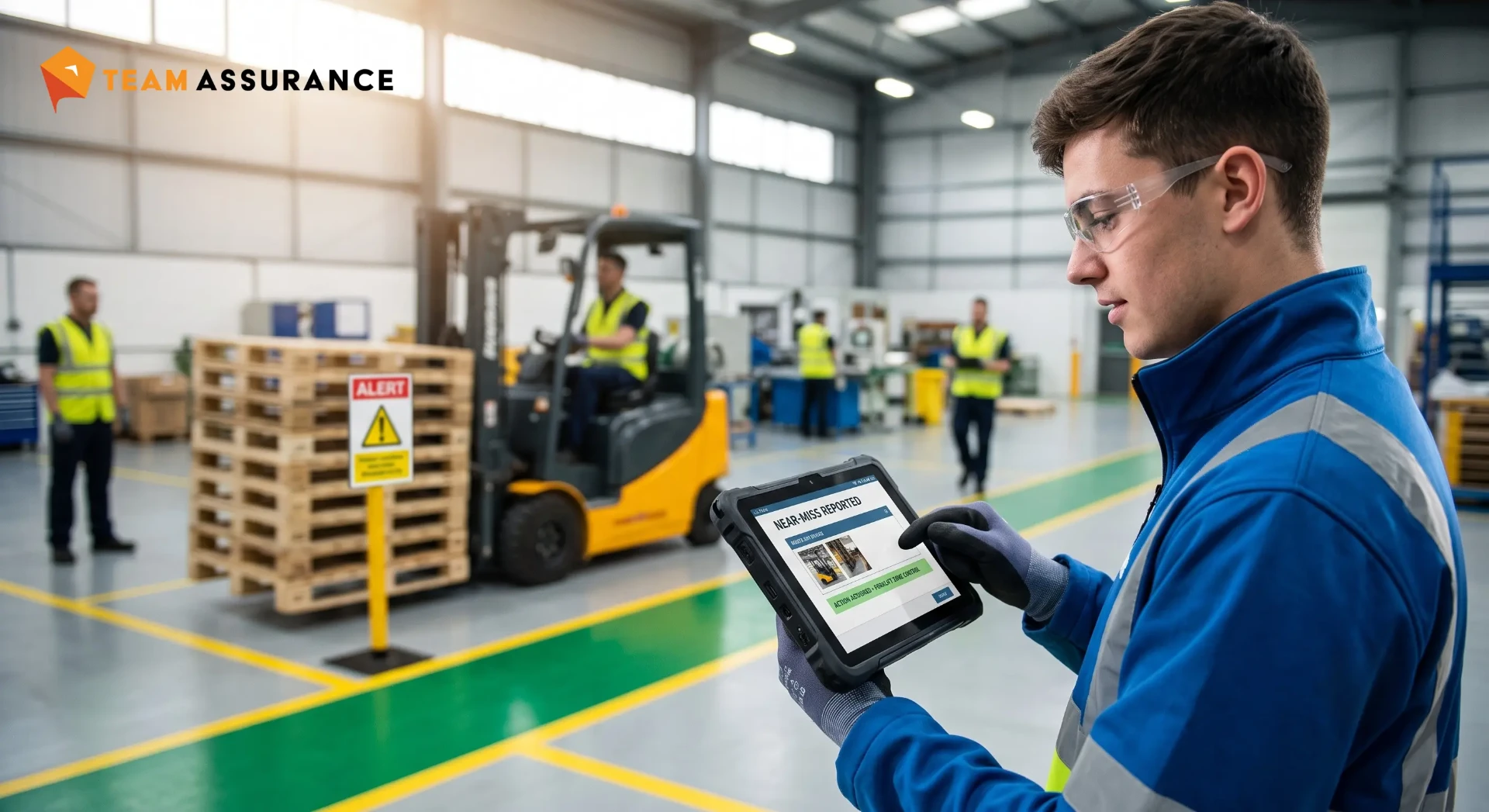
A near-miss is a gift, provided the business knows what to do with it.
No injury or damage. No regulator or customer call. Just a warning, handed over before the impact arrives. That is a very useful thing and a serious operation treats it with respect.
The best safety systems don't just record near-misses, they actually do one or more of Elimination, Isolation, Substitution, Admin Controls & PPE - all adding up to an improved chance that the next person does not get hurt. This is the gold standard.
The Near-Miss That Went Nowhere
Every operation has seen this. An operator notices something wrong, a pallet nearly tips, a guard is left off, a contractor walks through the wrong area, a forklift gets too close, a chemical container is not labelled properly, a hand tool is used the wrong way because the right one is missing.
Someone reports it, which is great - then nothing much happens.
Maybe it is logged, maybe it gets discussed briefly or maybe someone writes "remind team" as an action, which is usually code for "we are not really changing anything." The near-miss gets filed, the dashboard gets updated, and the business convinces itself it has a reporting culture. Of course, this is not good enough.
A near-miss should not be treated as a reporting task, but as a live signal from the work to improve the system while the warning is still fresh.
Understanding Safety Management Systems
What Is a Safety Management System?
A safety management system is the way an organisation manages safety deliberately, not hopefully. It includes risk assessments and hazard identification, inspections, audits, controls, Standard work procedures, training, leadership routines, and data driven continuous improvement. Finally, it records work incidents, near-misses, and manages all Safety related actions prioritised through to completion.
The useful version is not a folder of policies or simply a once-a-month committee meeting. It is not a compliance shrine built for auditors.
A real safety management system helps people see risk, control risk, respond to risk, learn from risk, and improve the way work is done. It makes safety part of the operating rhythm, not a special activity performed when someone has time, which of course means not often enough.
The system should make the right thing easiest to do. This is the point.
Why Near-Misses Are the Real Test of One
Near-misses test whether the system is alive. After an injury, the organisation usually pays attention. There is noise, pressure, investigation, management interest, and a stronger chance that something will move. After a near-miss, the business has a choice - it can learn early, or it can wait for a worse version of the same thing.
The better organisations use near-misses to find weak controls before they fail fully. They ask what almost happened, why it made sense at the time, what condition allowed it, who else might face the same risk, and what needs to change in the work.
Why Reporting Culture Dies Quietly
The Gap Between Reporting and Compliance
People keep reporting when they believe something useful will happen.
A reporting culture lives in follow-through not in slogans and policies. When someone raises a concern and the system responds with support, action and visible learning, people will do the reporting again. When they raise a concern and it disappears into a database, they learn quietly not to bother again.
The best safety systems protect reporting by closing the loop. The person who reports should be able to see what happened next. The team should understand the learning. The control should improve. The standard should move where needed. Trust is strenthened alongside the business improvement.
What Regulations Require vs. What Good Practice Requires
Regulations set the minimum standard, while good practices build the culture.
Legal requirements matter, obviously. Organisations need proper records, investigations, consultation, risk controls, training and evidence that hazards are being managed, but a strong safety culture uses compliance as a base and builds operating discipline (which in most cases is discretionary effort) on top. It asks better questions, it learns faster and it shares lessons across shifts and sites. It checks whether actions changed the condition, not just whether the status changed from open to closed.
The Role of Incident Reporting Software
How Incident Reporting Enhances Safety Management
Good incident reporting software gives near-misses somewhere useful to go.
It should make the discretionary part - ie. the reporting easy, fast and close to the work. It should help classify the event, attach photos, link hazards, assign actions, escalate support, track completion and capture learning. It should also help leaders see patterns across areas, shifts, equipment, tasks and sites.
This is where software does the heavy lifting. Not by becoming another admin burden, but by helping the organisation see what is happening and respond while the signal still has value.
A near-miss reported at 9am should not wait for the monthly safety meeting to become useful. If the risk matters today, it should appear in today's management rhythm.
Best Practices for Incident Reporting
The best reporting systems are simple enough for frontline use and strong enough for management follow-through.
Make the report easy to raise, the ownership clear and link actions to the risk. Escalate when support is needed, and then show what changed. Share the lesson and check whether the countermeasure held.
Do not make reporting feel like punishment or bury the team in forms. Do not confuse a long investigation with a good one. The aim is better safety, not better paperwork.
A good near-miss report should help the next person, not just satisfy the last review.
Building a Safety Management System That Actually Closes the Loop
Step-by-Step Implementation Guide
Start with the work. Identify where risks are raised today, where they stall, and where learning is missed.
Then make near-miss reporting easy at the point of work. If people need to find a laptop, remember a form, ask three people and write an essay, they will report less often.
Next, define the response path. What gets handled at Tier 1? What moves to Tier 2? What goes directly to site leadership? What needs safety, maintenance, engineering, quality or production support? Escalation should be a way to bring help to the problem, not a way to pass blame upward.
Then connect actions to control improvement. A good action changes the condition. It removes a hazard, strengthens a control, improves a standard, updates training, changes layout, fixes equipment, or prevents the same situation from being repeated.
Finally, make learning visible. If one shift learns something useful, the next shift should not have to learn it again the hard way. If one site sees a pattern, similar sites should know. That is not complicated, it is just rarely done with the dwindling amounts of discretionary effort that exist in a noisy/busy environment.
Training and Communication Strategies
Training should teach people how the system helps them, not just how to submit a form.
Frontline teams need to know what to report, how to report it, and what will happen next. Supervisors need to know how to respond well, how to ask better questions, and how to turn a near-miss into useful action. Managers need to know how to spot patterns, remove barriers and support proper escalation. This is standard work that should feel easy and routine.
Communication should be practical. Show examples of near-misses that led to better controls. Share the before and after. Recognise useful reporting. Explain and recognise what changed because someone spoke up.
That is how reporting becomes normal. Not by begging people to report, but by proving the system does something useful with what they raise.
The Future of Safety Management Systems
Innovations in Safety Management System Software
The next generation of safety management software will do more than hold records.
It will help identify repeated hazards, weak controls, overdue actions, similar incidents, recurring tasks, common equipment risks and lessons worth spreading. It will support supervisors before a pre-start, during a leader standard work walk, at the moment a high-risk task begins, and after a near-miss is logged.
AI will help here, but only where it has operational context. It needs to know the work, the history, the actions, the standards, the controls and the patterns. Otherwise it is just guessing politely.
Used properly, AI with human's in the loop can help a safety management system become sharper, surface the near-miss that looks small but belongs to a larger pattern and remind a supervisor that a similar event happened on another line. It can suggest the right control check before the work begins and that is useful.
Trends in Occupational Safety and Health
The better trend is safety becoming more connected to daily management.
Safety should not sit off to the side as a separate system with its own meetings, its own reports and its own language. Safety belongs in the work. Pre-starts, handovers, tier meetings, maintenance planning, change management, skills, audits and improvement routines. That is where risk lives, so that is where safety management has to live.
The strongest organisations will use near-misses as early learning signals. They will connect reporting to action, action to control improvement, control improvement to standards, and standards to training. They will make safety learning travel faster than the next incident. That is how a safety management system earns trust.
Closing the Loop
A near-miss is a clear warning. No harm or damage yet. No apology required yet. The system has been given a chance to learn before paying a higher price.
The best safety management systems catch that chance. They make reporting easy, action visible, escalation useful and learning hard to lose. They help teams act sooner, leaders support better, and the organisation improve before the warning becomes an injury.
That's what a real safety management system is built for, catching the near-miss before it becomes something worse, and making sure the lesson actually goes somewhere. Check out TeamAssurance's Safety Management capability, or book a demo to see how it closes the loop in your operation.