
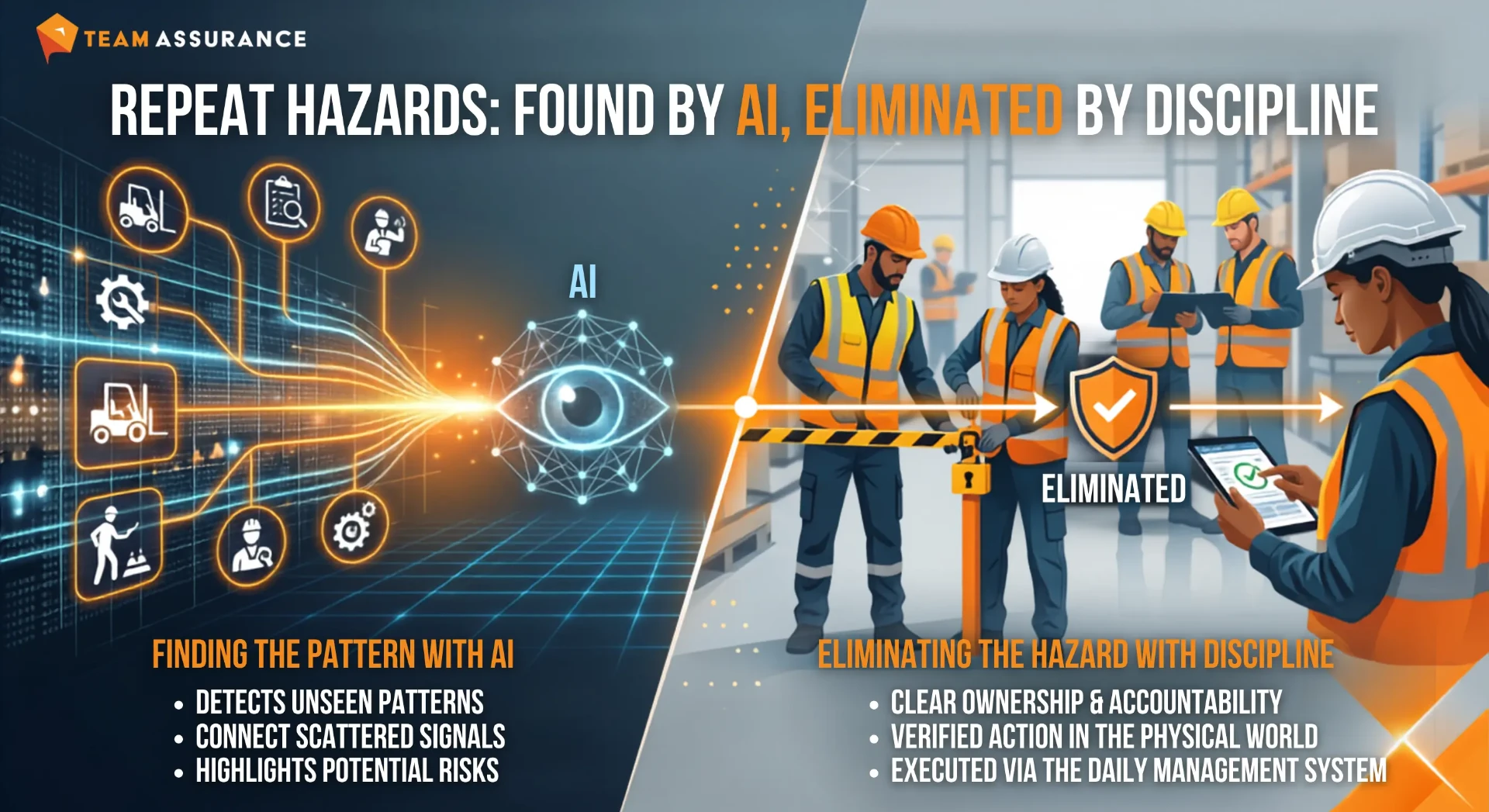
Repeat hazards are expensive little messengers. They keep arriving with the same basic message: something in the work is trying to tell the business the truth, and the business has been a bit slow to listen.
The good news is that repeat hazards are also one of the best places to improve safety quickly. They are not invisible, they leave tracks. They show up in near-misses, inspections, observations, audits, incidents, maintenance notes, shift handovers, pre-start conversations and the quiet comments people make when they have seen the same nonsense for the third time. AI can help find the tracks but discipline eliminates the hazard.
That combination is important. Pattern detection without action becomes clever reporting and action without pattern detection becomes busy follow-up on whatever shouted loudest this week. But put them together and the safety system gets sharper, hazards surface earlier, controls improve faster, and lessons travel before someone gets hurt. That is the main prize.
Introduction: Why the Same Hazards Keep Coming Back
Hazards repeat because work repeats - same tasks, same equipment, same materials, same handovers, same shortcuts, same pressure points, same awkward layouts, same missing tools, same weak controls. Nothing mystical going on here, the operation is simply showing its habits.
A good safety management system pays attention to those habits and does not wait for the big event. It studies the small warnings - a forklift getting too close to a pedestrian walkway, a guard left open after a clean, a manual handling strain near the same pallet location, a contractor confused by the same access rule, an operator reaching around the same awkward fixture. These are not random annoyances, they are signals.
The strongest organisations treat repeat hazards as improvement work. They do not need more drama, they just need a clean line from reporting to pattern detection, then from pattern detection to verified action. AI helps with the first part, discipline and a daily management system that involves everyone does the rest.
What Is Safety Culture, Really?
Safety culture gets spoken about as though it lives in posters, slogans, banners and occasional speeches from leaders wearing clean hi-vis. Fine, have the posters if you must, but real culture is easier to see. Watch what happens after someone reports something small. This is the test.
Does the system respond? Does the supervisor get support? Does the action change the condition? Does the team hear what was learned? Does the same hazard appear somewhere else next month, pretending to be new?
Safety culture is the sum of what the organisation repeatedly allows, rewards, notices, fixes and learns from. It is built through ordinary management behaviour. The pre-start that talks about the real risk. The escalation that brings help instead of blame. The action that changes the work instead of changing the status. The leader who treats a near-miss as a useful warning rather than an inconvenience.
That is culture. Less glamorous than a campaign. Much more useful.
Why Hazards Repeat: The Anatomy of a Broken Safety Culture
Repeat hazards usually have a few familiar ingredients. A weak standard. A control that looked good in a risk assessment but behaves badly in real work. An action that was closed too early. A hazard that was treated locally when the pattern was wider. A supervisor carrying too much noise. A team that reported once, saw nothing change, and became understandably selective with future effort.
This is rarely about bad people. People are usually trying to get the job done with the system around them. If the safest way is hard, slow, unclear or unsupported, the work will drift. Not in one grand act of rebellion. Quietly. One small adjustment at a time.
A strong safety culture makes the safe way the normal way. It makes weak signals visible. It makes escalation useful. It makes action follow-through visible. It makes learning travel.
That is how repeat hazards start losing ground.
Rule-Breaking Normalization and the Slow Erosion of Standards
Standards rarely collapse in one day. They soften.
A shortcut gets used because the right tool is missing. A walkway gets blocked because "it will only be there for a minute." A guard is left open during a clean because the job is awkward. A manual handling control is ignored because the work has to keep moving. Everyone knows it is not ideal, but the shift gets through.
Then the workaround becomes the norm.
This is where good safety management earns its keep. It does not simply shout "follow the standard" from a distance. It asks why the standard is hard to follow, what condition is driving the drift, and what control needs to change so the right way becomes easier.
That is adult safety management. Less sermon, more improvement.
Reduction in Repeat Incidents Starts With Reporting
Repeat incidents reduce when people report early and the system responds well.
Reporting is not the finish line, but the starting point. The report tells the business where to look. It gives the system a chance to learn while the cost is still low. It turns something observed by one person into something the organisation can act on.
The best safety systems make reporting easy, fast and close to the work. They also make the response visible. People should see what happened next. The action should be clear and the learning should come back to the team. If the risk exists elsewhere, the lesson should move.
That is how reporting becomes normal. People report because reporting helps the work improve. No surprises there!
How AI Finds the Pattern Humans Miss
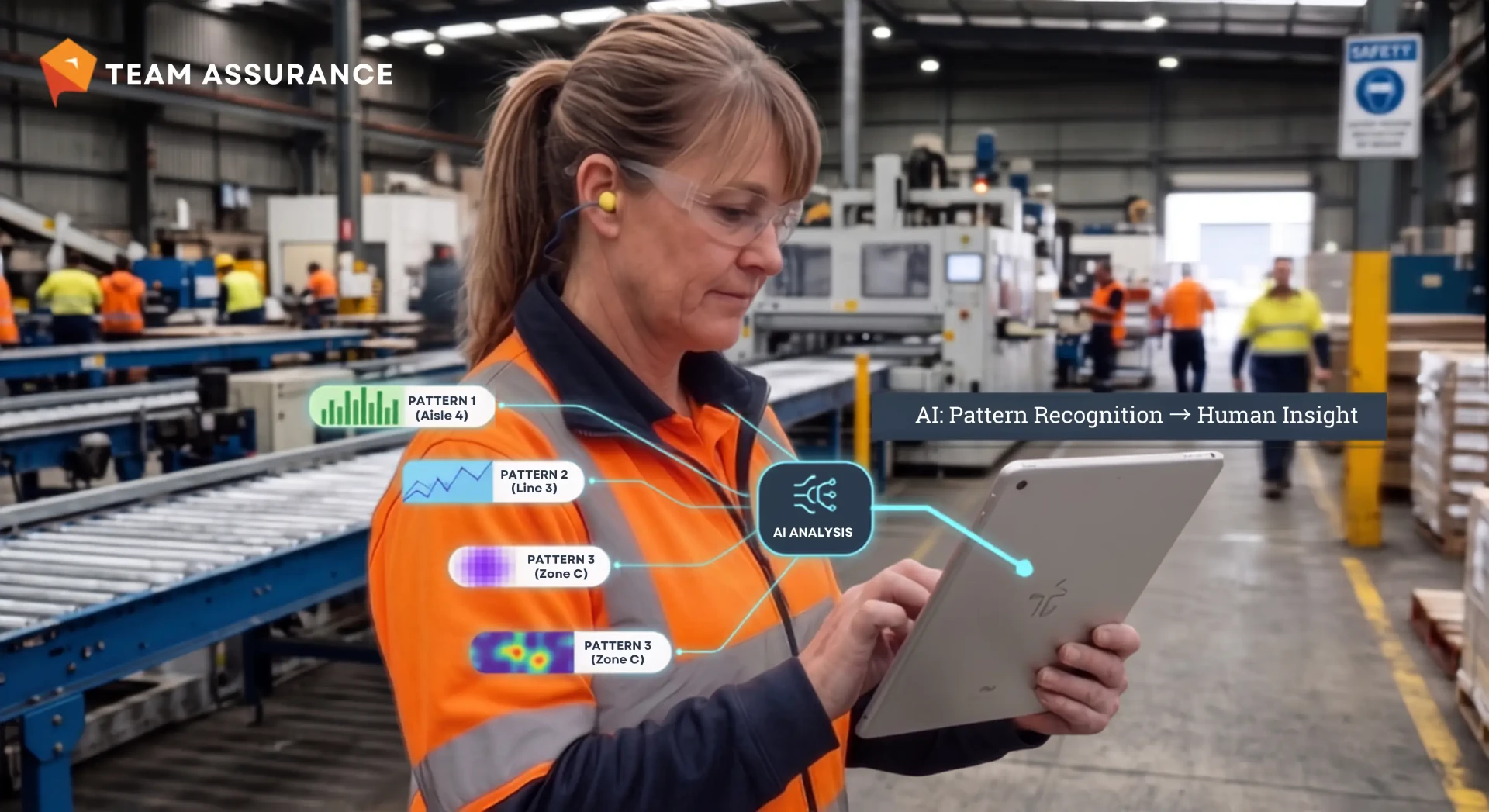
Humans are good at noticing what is in front of them. We are less reliable at spotting slow patterns spread across shifts, sites, reports, actions, audits and months of small warnings. This is where AI can add capabilities not currently posessed.
It can read across many small records and see that the same hazard is turning up under different names. "Blocked access", "poor housekeeping", "trip hazard", "temporary storage", "materials left near line three" may all point to the same underlying issue. A supervisor may see three reports but AI can see thirty across six months and five areas - and this is useful because it does not get tired of looking.
AI Hazard Detection: Turning Scattered Reports Into Signals
Good AI hazard detection turns scattered safety information into useful signals. It can group hazards by task, area, equipment, shift, control type, contractor activity or work phase. It can identify repeat locations, repeat behaviours, repeat failed controls and repeat action types.
The value is practical. A safety leader can see where the same manual handling concern keeps appearing. A department manager can see where forklift-pedestrian interactions are increasing. A supervisor can see that today's "small" issue resembles three earlier near-misses. A plant manager can see which hazards keep escaping local action and need system-level support. That helps leaders put effort where it belongs as part of the routine Daily Management System - not through heroics or opinion.
Predictive Safety Analytics and Leading Indicators
Predictive safety analytics does not need to sound mystical. At its best, it uses leading indicators to show where risk may be building before an injury appears.
Open hazards, Overdue actions, Repeat near-misses, Failed inspections, Weak critical control checks, Training gaps, Maintenance issues, Workarounds, Temporary fixes that have become strangely permanent. These are all leading indicators, and they are sitting in the business today. AI can help combine them into a clearer picture. Not a crystal ball, just a better early warning system.
Why Pattern Detection Alone Isn't Enough
Finding the pattern is only useful if the organisation does something with it.
A repeated hazard should move into the management rhythm. It should appear in the right tier meeting, with the right owner, the right support, and the right expectation for control improvement. The question should not be, "Did we record it?" The question should be, "What changed in the work?"
AI can raise the signal. The daily/weekly/monthly safety management system has to carry the signal into action.
The Limits of AI Without Verified Action
AI can suggest that a hazard is repeating. It can show where, how often, and under what conditions. It can even suggest possible causes or controls. This is helpful but the action still needs to be owned, tested and verified in the real work.
A closed action should mean the risk has been reduced, not that someone updated the status. This distinction matters. The action might remove a hazard, isolate the risk, substitute the method, strengthen an engineering control, improve the standard, change the layout, update training or make PPE use clearer and easier where it is genuinely required.
Verified action is where the hazard is eliminated. Not in the report and not in the dashboard - only in the work.
Why Discipline Alone Isn't Enough Either
Discipline matters, but discipline needs good aim. A team can follow up every visible issue and still miss the wider pattern. A supervisor can close actions quickly and still never see that the same type of hazard is appearing in another area. A site can be diligent locally and still fail to learn across departments or shifts.
This is where AI helps discipline become better directed.
It shows where attention should go. It helps separate one-off noise from recurring signals. It helps leaders see the difference between a local fix and a system weakness. It gives the management system sharper eyes.
The Limits of Manual Follow-Up Without Pattern Detection
Manual follow-up works well when the issue is obvious and local. It struggles when the pattern is spread out. Different words, different shifts, different departments, different owners, different time periods. The human brain is not built to hold all of that cleanly while also running the day. That is not a criticism, it's just reality.
AI can do the dull comparison work. It can scan, group, connect and surface. Then people can do the human work: judgement, conversation, decision, support, coaching and verification. This is a good arrangement.
Pattern Detection + Verified Action: Why the Combination Works
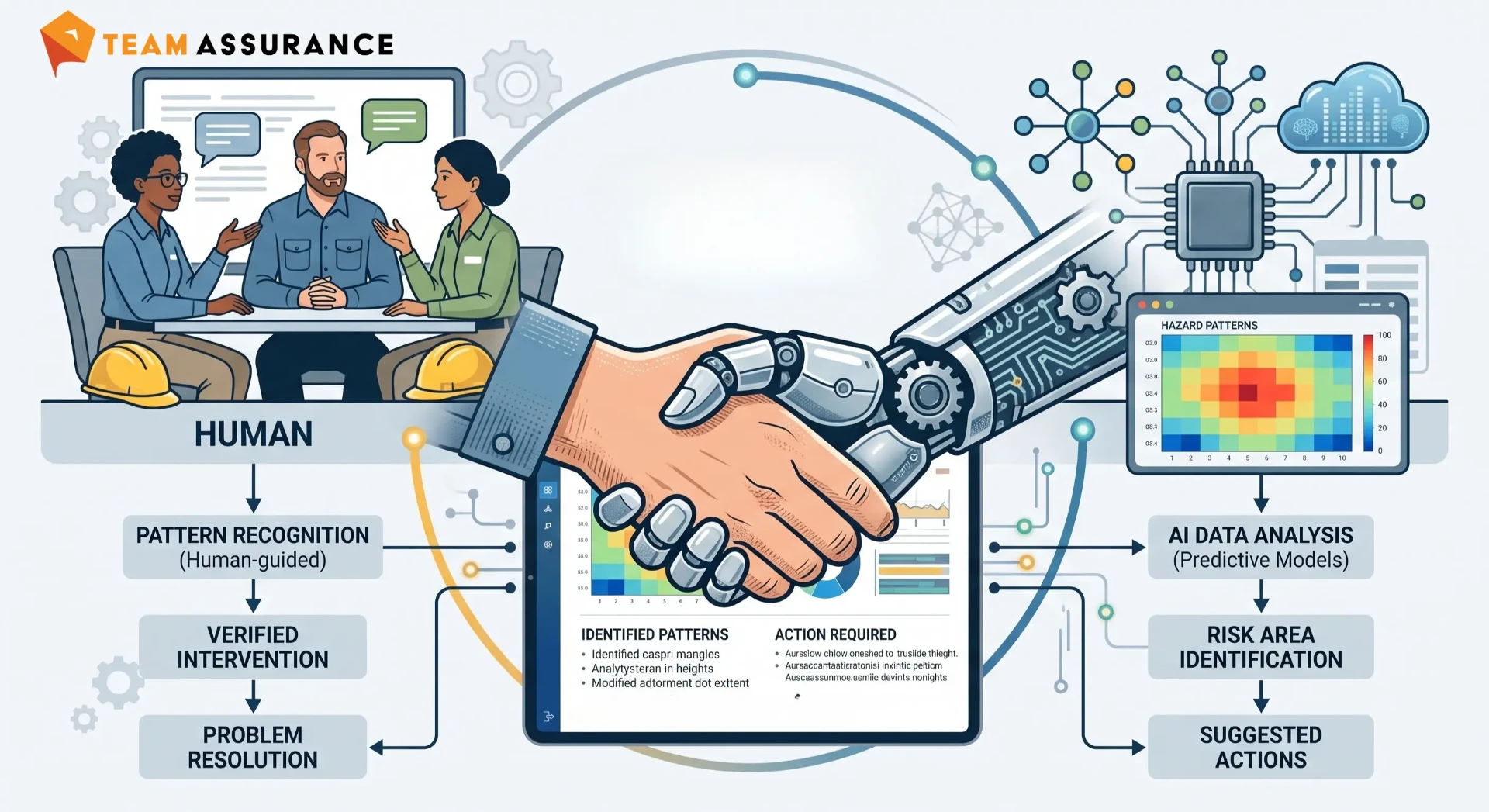
The strongest safety systems use AI and discipline together. AI finds the pattern and the management system gives it a path. Leaders assign ownership, Teams improve the control, actions are verified, lessons are shared. The Standards are updated as needed, similar areas are checked and finally the original reporter sees that the system listened. That is how trust grows in equal measure to the system becoming stronger.
It is also how repeat hazards reduce. Not through one heroic campaign, but through a steady operating rhythm that catches weak signals and turns them into better work.
From Insight to Action: Closing the Loop on Repeat Hazards
Closing the loop means the hazard moves through the system properly.
It is reported close to the work. It is classified clearly. It is compared with similar events. It is escalated if support is needed. The action is linked to the risk. The control improvement is verified. The lesson is shared. The standard is updated. The result is checked later to confirm the hazard has not quietly returned in another guise.
It is not complicated. It just needs to be done properly, repeatedly, without relying on leftover discretionary energy at the end of a noisy week.
Key Components of a Safety Management System That Sticks
A safety management system that sticks has a few essentials. Reporting is easy, ownership is clear, escalation is useful and actions are connected to controls. Verification also matters. Leaders visibly use the same system. Lessons move across shifts and sites. AI helps surface patterns. The daily / weekly / monthly management rhythm gives those patterns somewhere to go.
The system should make good safety management easier to practise and conserve energy to make the action rubber hit the road. That is the standard. If the safest way is also the clearest way, the supported way and the normal way, the culture improves without needing another slogan or short term overtime.
Customer Insight: What Repeat-Hazard Detection Looks Like in Practice
Imagine a packaging site where small forklift-pedestrian concerns are being raised across different areas. Nothing major. A near-miss near dispatch. A blocked walkway near materials. A temporary storage issue near a line. A contractor route confusion during maintenance work. Each one looks manageable on its own.
AI scans the hazard reports, near-misses, inspection findings and actions. It sees the pattern: pedestrian separation is weakening during peak changeover and dispatch windows, particularly when temporary materials are staged in overflow zones.
The insight appears in the Tier 2 safety review. Actions are assigned to operations, logistics and safety. The site updates staging rules, improves visual controls, adjusts contractor access guidance and adds a focused pre-start prompt for the affected areas. Leaders verify the controls during standard work. The same pattern is checked at similar sites.
That is repeat-hazard detection working properly. Not clever for the sake of clever but actually useful.
The Long-Term Benefits of a Strong Safety Culture
A strong safety culture compounds. Reporting improves because people see action. Leaders get better signals because people report early. Controls improve because hazards are studied before injuries occur. Standards become more practical because they are shaped by the real work. New people learn faster because the system carries the memory.
This is how safety becomes part of operational excellence rather than a separate compliance exercise with its own language and its own lonely folder.
Enhanced Employee Well-being
People feel the difference when safety management works.
They see concerns taken seriously. They see practical changes. They see leaders respond with support. They see learning shared rather than hidden. They see that reporting is not a nuisance, but a way to make the work better.
That creates confidence. Confidence matters. People do better work when they know the system is paying attention and that their voice has somewhere useful to go.
Improved Organizational Reputation
A strong safety system also strengthens reputation: as safety performance goes, so does quality and delivery performance, and so follows business reputation—in that order.
The business learns early, acts visibly, verifies controls and shares lessons. That is credible. It says the organisation is serious about people and serious about performance. Good safety is good management. Always has been.
Conclusion
Repeat hazards are not just safety issues. They are learning opportunities with the clock running.
AI can find the pattern faster than humans working from scattered reports and memory. Discipline and a Daily Management System turns that pattern into verified action. Together, they give the safety system sharper eyes and stronger hands. That is where the value sits.
Find the repeat hazard. Improve the control. Verify the action. Move the lesson. Strengthen the standard. Then do it again.
This is how repeat hazards stop repeating.
Interested in turning safety data into earlier action? Explore how TeamAssurance Safety Management helps teams capture hazards, strengthen controls and close the loop on actions, alongside AI Assisted Workflows that help surface recurring patterns and operational risks before they become bigger problems.
Learn more about Safety Management and AI Assisted Workflows, or book a demo to see TeamAssurance in action.