
Safety Management Software for WHS and EHS
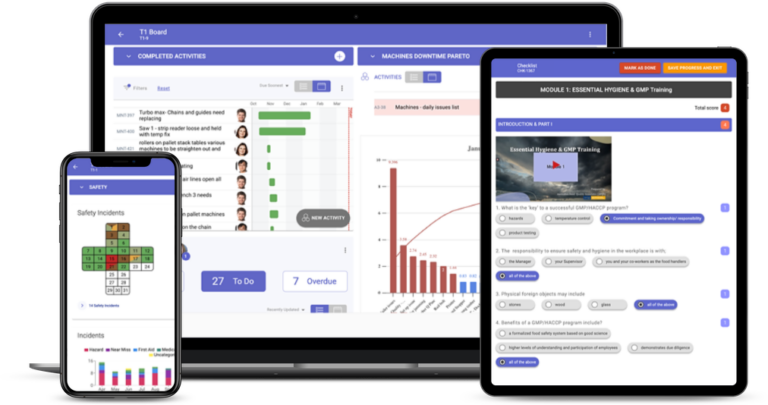
TeamAssurance runs safety as part of daily management rather than in a separate system: hazards, near misses and observations are raised from the floor on a phone, safety walks and audits are scheduled through leader standard work, and every finding becomes a corrective action on the team's tier board, reviewed in the same huddle as quality, delivery and cost.
The basics
What is safety management software?
Safety management software records hazards, incidents, near misses, observations, inspections and corrective actions, and reports on them. In Australia it is usually called WHS software, for work health and safety; elsewhere EHS software, when environment is included, or health and safety software. Most of it runs as a standalone system owned by the safety team, which is why findings so often stop at the report: the people who can fix a hazard run their day from a different board.
The alternative is safety inside the daily management system. The same tier boards that carry quality, delivery and cost carry safety; the same action list carries the corrective actions; the same leaders walk the floor with a safety checklist in the same app as their gemba walk. Safety stops being a department's system and becomes part of how every team runs its day.
That is what safety management system software should do: support the safety processes the organisation already depends on, from hazard reporting and risk assessment to incident management, audit management and corrective action, and make them part of the daily routine at every level. A safety management system that lives in daily management gets reviewed every shift, so safety performance is managed as closely as output, and teams continuously improve the work environment instead of waiting for the monthly safety report.
What it does
WHS software that runs inside daily management
Hazards and near misses from the floor
Anyone raises a hazard, near miss or observation on a phone with a photo; it lands on the team's tier board the same shift.
Safety walks, audits and Take 5s
Toolbox talks, safety observations, Take 5s, layered audits and extinguisher checks run as scheduled checklists with results on the board.
Corrective actions tracked to closure
Every finding becomes an action with an owner, a due date and a hierarchy-of-control level, with a verification step before it closes.
Escalation with context
A hazard the team cannot control moves to Tier 2 with its photo and history; decisions come back down the same way.
Leading and lagging measures together
Hazards raised, observations done and actions closed on time beside TRIFR, LTIFR and days since last recordable, on the same board.
Incidents into problem solving
Repeat hazards and serious events move into five whys, fishbone or A3, and the countermeasure updates the standard and the checklist.
Incident reporting and investigation
Report incidents and near misses on structured digital forms that trigger an investigation and corrective actions automatically.
Audit-ready records across sites
Complete digital records of hazards, audits, incidents and actions help ensure compliance with safety regulations at every site.
Compared
Standalone EHS software or safety inside daily management?
| Capability | Standalone EHS software | Spreadsheets and paper | TeamAssurance |
|---|---|---|---|
| Hazards and near misses raised from a phone with photos | |||
| Safety inspections and audits as scheduled checklists | |||
| Corrective actions on the same board as quality and delivery actions | |||
| Escalation to the next tier with context | |||
| Safety walks scheduled through leader standard work | |||
| Incidents linked to A3 and PDCA problem solving | |||
| Leading indicators beside production measures in the daily meeting |
How it works
Bringing safety into the daily management system
- 01
Put safety first on the board
The S in SQDCP: days since last recordable, open hazards and overdue safety actions at the top of every Tier 1 board.
- 02
Make raising easy
Hazards, near misses and observations from any phone, with a photo, in under a minute.
- 03
Schedule the routines
Toolbox talks, Take 5s, safety observations, audits and inspections as checklists in leader standard work.
- 04
Close the loop
Corrective actions with owners, hierarchy-of-control levels and verification; repeat hazards into problem solving.
Use cases
Where safety runs inside daily management
- Manufacturing sites running Tier 1 huddles with safety as the first agenda item
- Mining and quarry operations with Take 5s and shift handovers on one board
- Food and beverage plants combining GMP, quality and safety checks
- Utilities crews managing permits, isolations and toolbox talks in the field
- Warehouses and logistics operations with forklift and pedestrian safety programs
- Multi-site operations comparing leading indicators across sites
FAQ
Safety management software FAQ
Is TeamAssurance safety software?
TeamAssurance is a daily management platform. Safety management is one of its capabilities: hazards, near misses, observations, audits and corrective actions run on the same tier boards and action lists as everything else the team manages.
How is this different from a standalone safety app?
A standalone app is owned by the safety team and its findings stay in it. Here the corrective action from a hazard sits on the same board, with the same owner and the same daily review, as a quality or delivery action, so it gets done.
Can frontline workers raise hazards and near misses?
Yes, from any phone or tablet with a photo and a few words. The hazard appears on their team's tier board for the next huddle and escalates to the next tier if the team cannot control it.
Does it track TRIFR and LTIFR?
Yes. Lagging measures such as TRIFR, LTIFR and days since last recordable sit on the board beside the leading indicators: hazards raised, observations completed and actions closed on time.
What safety routines can run as checklists?
Toolbox talks, Take 5s, safety observations, layered audits, fire extinguisher and first aid checks, pre-start inspections, JSAs and permits, each scheduled to the right people at the right frequency.
How are corrective actions verified?
Each action has an owner, a due date and a verification step; it closes when the control is confirmed in place, and a repeat of the hazard reopens the problem for structured problem solving.
What is the difference between WHS software and EHS software?
Mostly the name. WHS software is the Australian term, after the work health and safety laws; EHS software adds environment and is the common term in the US and Europe. Both cover hazards, incidents, audits and corrective actions.
Does it work across multiple sites?
Yes. Audits and checklists are scheduled and tracked across sites from one platform, and leading indicators can be compared site by site so leaders see where safety culture and safety performance differ.
Guided tour
See how safety management fits the connected operation
A five-minute walkthrough of strategy, improvement and daily management on one system: the tier boards, the actions, the escalations and the problem solving, with worked examples from the floor up.
Learn more
Definitions
Guides
- Making Your Safety System Stack Up With Digital Tools
- The Near-Miss That Went Nowhere: What a Safety Management System Should Actually Catch
- Repeat Hazards: Found by AI, Eliminated by Discipline
- Verification: The Step Your Safety & Quality System Skips
- Safety Case Study: How the Davey Team Reduced Injuries by 20%
See safety run inside the daily management system
Book a demo and we will raise a hazard from a phone, watch it land on a tier board, escalate it and close it with a verified corrective action.
Request a Demo