
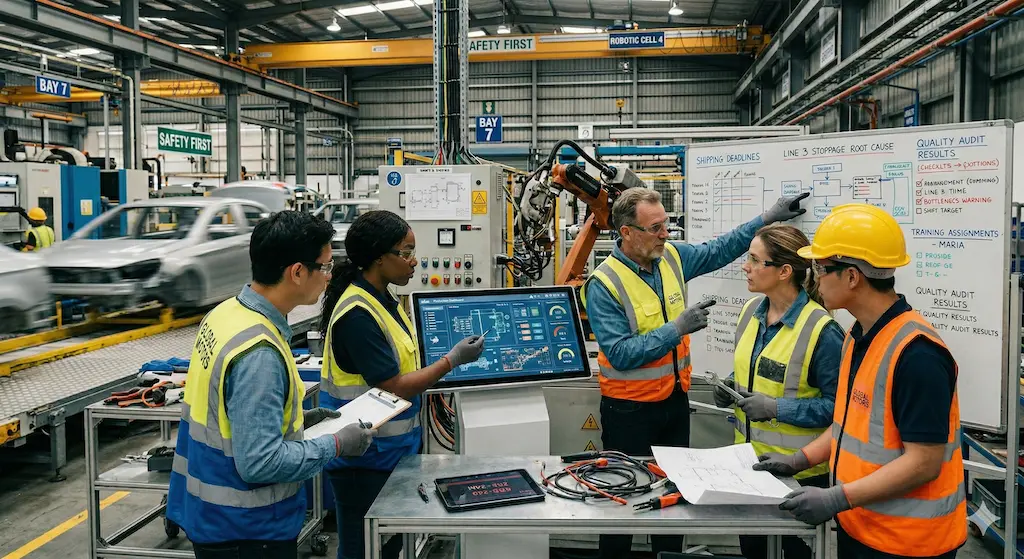
Embracing lean across all functions means using its principles in every part of the business: value, flow, waste, standards and daily improvement. That covers maintenance, quality, safety, planning, HR and finance as well as production. One daily management rhythm links those functions. Lean that stays on the shop floor cannot fix problems that start elsewhere in the business.
At a glance
- What it is: applying lean principles in maintenance, quality, safety, planning, HR and finance as well as production.
- Why it matters: lean confined to the shop floor cannot solve problems whose causes sit elsewhere in the business.
- How functions connect: through tiered meetings that bring functional leads around the same picture, and shared problem solving.
- Related: what is lean management? and what is operational excellence?.
This article features takeaways from our recent webinar on embracing lean across all functions of an organisation. You can watch the webinar recording on-demand.
Efficiency and continuous improvement are more than goals. No business can last without them. Lean started in the factory, but its ideas are now vital in every business function.
Lean is most often tied to the Toyota Production System. It is a full approach that seeks the most value for the customer. It gets there by removing waste and making processes and resources work better.
Lean does not stop at the production floor or the frontline. Every corner of a business needs it; from HR to Finance, Marketing to R&D – all the way to the boardroom.
What Is Lean? A Dual Focus on Process and People
Lean stands on two legs: efficient processes and empowered people.
The famous Toyota house model captures this. Its aim is the lowest cost, the highest quality and the shortest lead time. Flawless products and waste-free processes hold up those goals.
Yet lean is as much about people as it is about process.
The Toyota Way stresses respect and continuous improvement. It calls for a culture where every employee joins the pursuit of perfection.
Can Lean Work in Every Business Function?
Yes. Lean principles fit every function. In a lean business, the usual sum of cost plus profit equals price is flipped.
The business starts with the market price and subtracts cost. Lower cost becomes the way to higher profit. All functions must work as a team to find waste, remove it and add value.
It helps to frame this thinking with the following mantra:
"Every function has a customer"
That one line gives all teams a shared place to start their improvement cycles. When a function stays 'customer-centric' – focused on the end of the value chain – it can define an ideal state and work back from there.
Cost, Quality, and Lead Time: The Triad of Lean Focus
Lean keeps a close eye on three things: cost reduction, quality enhancement, and lead time minimization. With these three, lean helps a business become more efficient, faster to respond and more focused on its customers.
-
Cost Reduction: Lean digs into costs and cuts them, without hurting the quality or value delivered.
-
Quality Enhancement: In lean, quality is not just an output measure. It is a core principle that runs through all work and all decisions.
-
Lead Time Minimization: Lean does not fill warehouses to ship on time. It shortens the time from production to delivery.
What Role Does Technology Play in a Lean Transformation?
Technology is key to building lean skills into a business. It separates human work from machine work. This raises efficiency, makes standard work easier and helps continuous improvement take hold.
-
Lean Strategy Deployment: Digital lean management systems can show workflows and the work in hand. Teams can then see how their efforts add to larger goals.
-
Lean Standard Work Processes: Digital tools can store a company's full set of SOPs. Staff can find up-to-date instructions and guides with ease.
-
Routine Work Processes: Tech can automate dull tasks and capture accurate data. It can also give clear, usable insights through real-time analytics.
How Do You Make Lean Part of the Whole Organization?
To truly embed lean, a business must build it into all it does. Processes, people and technology need to work in step.
Lean is more than a set of tools or methods. It is also a mindset that must reach every level of the business.
Frequently asked questions about lean in every function
Which non-production processes benefit most from lean?
Maintenance planning and spares gain a lot. So do quality investigations and CAPA, onboarding and training, and procurement and supplier management. Scheduling, month-end and the reporting routines that eat up office time benefit too.
How do you start lean in a support function?
The same way as on the floor. Hold a short daily or weekly meeting at a board. Pick a few measures and make actions visible. Then use a simple problem-solving method on the function's own waste and waiting.
How do functions connect in a lean organisation?
Through tiered meetings that bring the leads of each function around the same picture. Problem solving also plays a part: it follows a cause across department lines and does not stop at the hand-off.
How do you embrace lean within every process of your continuous improvement framework?
Strategy, project and daily management should work as one. So each needs to be built with the areas next to it in mind.
For example, daily routines like Leader Standard Work and Daily Huddles must be backed by standard problem solving methods and a disciplined PDCA process.
No part of the wider C.I. Framework should be orphaned or built alone. That's why we built a connected platform, with no stand-alone 'Point Solutions' that can keep a business from reaching its goals.
If you are a business in need, or a Consultant with clients looking for support, contact us for a live demonstration of TeamAssurance.