
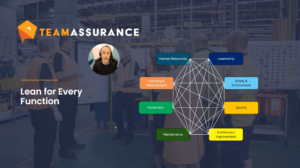
This article features takeaways from our recent webinar on embracing lean across all functions of an organisation. You can watch the webinar recording on-demand.
Efficiency and continuous improvement are not just goals; they are necessities for organizational survival. The principles of lean have transcended their manufacturing origins to become vital across all business functions. The concept of lean, often associated with the pioneering Toyota Production System, is a comprehensive approach focused on maximizing value through the elimination of waste and optimization of processes and resources.
However, embracing lean principles is not limited to production floors or the frontline. It is equally crucial in every corner of an organization; from HR to Finance, Marketing to R&D – all the way to the boardroom.
The Essence of Lean: A Dual Focus on Process and People
Lean methodology is built on two foundational elements: efficient processes and the empowerment of people.
The iconic Toyota house model encapsulates this philosophy, presenting an ambition to achieve the lowest cost, highest quality, and shortest lead time. These goals are supported by a framework that emphasizes flawless products and waste-free processes.
However, lean is not just about processes; it is equally about people.
The Toyota Way, with its emphasis on respect and continuous improvement, underlines the importance of a culture where every employee is engaged in the pursuit of perfection.
Embracing Lean Universally
Lean methodology's principles are universally applicable across all organizational functions. The traditional equation of cost plus profit equalling price is inverted in a lean organization.
Instead – by starting with the market price and subtracting cost – companies focus on cost reduction as a pathway to profit improvement. This approach necessitates a collaborative effort across all functions to identify and eliminate waste, thereby enhancing value.
It helps to frame this thinking with the following mantra:
"Every function has a customer"
When you do so, you create a universal starting point for improvement cycles. By keeping things 'customer-centric' – focused on the end of the value chain – functions can identify an ideal state to work back from.
Cost, Quality, and Lead Time: The Triad of Lean Focus
The lean approach to management and operations is distinguished by its meticulous focus on three fundamental areas: cost reduction, quality enhancement, and lead time minimization. This triad forms the core of lean's promise to transform organizations into more efficient, responsive, and customer-focused entities.
-
Cost Reduction: Lean practices dive deep into analyzing and reducing costs without compromising the quality or value delivered. Cost reduction transcends simply adhering to austerity measures but rather working towards overall organizational efficiency and competitiveness.
-
Quality Enhancement: Quality is not merely an output metric within the Lean framework; it is a fundamental principle that permeates every aspect of operations and decision-making. It elevates product and service quality and often involves cross-functional collaboration to identify root causes of issues and implement lasting solutions.
-
Lead Time Minimization: Contrary to filling warehouses to ensure prompt delivery, lean focuses on reducing the time from production to delivery. This exposes deep-seated inefficiencies and waste, forcing organizations to confront and rectify these issues.
Leveraging Technology in Lean Transformations
Technology plays a pivotal role in embedding lean capabilities within an organization. By distinguishing between human and machine work, technology enhances efficiency, reduces barriers to standard work practices, and fosters an environment of continuous improvement. Examples include:
-
Lean Strategy Deployment: The deployment of lean strategies across an organization requires a seamless connection between high-level strategic goals and day-to-day operational activities. Technology provides platforms that can break down business strategies into actionable tasks, distribute these tasks across the organization, and track progress in real-time.
-
Lean Standard Work Processes: The heart of lean is in its standard work processes—repetitive patterns of activity that ensure efficiency and quality. Digital tools and platforms can house an organization's entire repository of standard operation procedures (SOPs), making it easy for employees to access up-to-date instructions and guidelines.
-
Routine Work Processes: The application of technology in streamlining day-to-day, week-by-week processes is transformative. Daily checklists, structured meetings and monthly reports form the backbone of any organization's operations. Tech enables the automation of mundane tasks, accurate data capture and analysis, and the provision of actionable insights through real-time analytics.
Embracing Lean Across the Organization
To truly embed lean, organizations must integrate it into their very fabric, ensuring that processes, people, and technology work in harmony. This holistic approach requires a commitment to continuous improvement, cross-functional collaboration, and a culture that values excellence and efficiency.
Lean is not solely a set of tools or methodologies. It is also a mindset that must permeate every level of an organization. Its principles are as applicable in the boardroom as they are on the production floor, offering a path to excellence that transcends industry boundaries.
Embracing Lean Within Every Process of Your C.I. Framework
To ensure a synergistic, cohesive effort across all areas of strategy, project and daily management, we must ensure that each is built with all adjacent areas (and their respective processes) in mind. For example, daily routines like Leader Standard Work and Daily Huddles must be supported by standardised problem solving techniques, documentation and a disciplined PDCA process.
As mentioned above, to achieve this cohesion no element of the greater C.I. Framework should be orphaned or developed in isolation. That's why we designed an interconnected platform that ensures there are no disconnected 'Point Solutions' (digital or analog) that can hinder organisations from achieving their objectives.
If you are a business in need, or a Consultant with clients looking for support, contact us for a live demonstration of TeamAssurance.