

Strategy Deployment Is How Strategy Becomes Real Work
Most businesses do not fail because they lack strategy. They fail because the strategy never becomes part of how the organisation actually runs. The plan gets written, the priorities get agreed, the slides look impressive enough, and everyone leaves the room feeling broadly aligned. Then Monday arrives, and the business quietly goes back to operating the way it did before.
That is the gap strategy deployment is meant to close.
Strategy deployment is the discipline of turning business direction into real work, owned by real people, measured through real progress. It connects long-term ambition to daily management, projects, actions, problem solving, capability building and operational performance. Done well, it gives the organisation a way to move in one direction without relying on slogans, quarterly panic or heroic follow-up from the same few people.
The positive version is very powerful. People know what matters. Teams understand how their work connects to the larger direction. Leaders can see whether the business is improving, not just whether activity is happening. Problems surface earlier. Resources move toward the right priorities. The organisation learns faster because the work is connected.
That is strategy deployment doing its job.
What Strategy Deployment Actually Means
Strategy deployment, often linked to Hoshin Kanri, is the process of translating strategic goals into focused priorities, measurable targets and practical execution. It is not just cascading objectives down the organisation. That sounds tidy, but it often turns into a corporate game of telephone. By the time the message reaches the frontline, it is either too vague to guide action or too detached from the work to be useful.

Good strategy deployment works more like a structured conversation between direction and reality. Senior leaders set the ambition and the few breakthrough priorities that matter. Middle leaders translate those priorities into the systems, projects and capabilities that need to improve. Frontline teams bring practical knowledge about the work, the barriers, the risks and the opportunities. The plan gets stronger because it is tested against reality before everyone pretends it is finished.
That is the part many organisations miss. Deployment is not just communication. It is alignment through action.
Why Measuring Success Matters
Strategy deployment needs measurement because good intentions are not enough. A business can be busy, aligned in language, and still not be improving in any meaningful way. Measurement gives the organisation a way to see whether effort is turning into progress.
The trick is measuring the right things. Many businesses measure activity because it is easy. Projects launched, meetings held, actions closed, training delivered, dashboards updated. Fine, but that is not the same as success. Activity tells you the machine is moving. It does not tell you whether it is moving in the right direction.
Successful strategy deployment measures whether the business is becoming stronger. Are customers getting better outcomes? Is delivery more reliable? Is quality improving? Are people safer? Are problems being solved closer to the source? Are teams building capability? Are repeated issues reducing? Are leaders spending more time improving the system and less time chasing avoidable noise?
Those are better questions. They tell you whether the strategy is landing in the work.
The Work And The Reporting Should Become The Same Thing
This is one of the biggest wins available in strategy deployment. Doing the work and reporting on the work should not be two separate jobs. The work itself should create the visibility.
A project action is updated because the action moved, not because someone needs to prepare for a steering committee. A problem is escalated because support is needed, not because the monthly report is due. A KPI changes because the team is managing the condition now, not because someone copied numbers into a slide deck after the fact.
When work and reporting are separate, the business creates waste. People do the work once, then explain it again somewhere else. They update the spreadsheet, then the dashboard, then the meeting pack, then the email summary. Everyone calls it governance. A lot of it is just administrative recycling.
The better model is cleaner. The work is managed in the system. The action, owner, due date, risk, decision, barrier and result are visible as the work happens. Reporting becomes a by-product of management, not a second shift of administration performed by people who already have enough to do.
That is how strategy deployment becomes lighter, faster and more honest.
Financial Metrics Still Matter
Financial metrics matter because businesses are not charities with forklifts. Revenue, margin, profit, cash flow, return on investment and profitability ratios all help show whether the organisation is creating value in a sustainable way. A strategy that never improves financial health is probably not as clever as the strategy deck suggested.
Return on investment is especially useful when strategy deployment involves major projects, new systems, automation, capability programs or operational transformation. If the business invests time, capital and leadership attention, it should have a clear view of what return is expected and how that return will be tracked.
Profitability ratios can also help leaders see whether improvement is flowing through to the business model. Gross margin, operating margin and return on assets can show whether the organisation is becoming more efficient and more effective over time.
But financial measures are usually lag indicators. They tell you the result after the work has already happened. That does not make them useless. It just means they are not enough on their own. If leaders only look at financial outcomes, they are often looking in the rear-view mirror while pretending to steer.
Operational Metrics Show Whether The System Is Improving
Operational metrics are where strategy deployment becomes more useful. These measures show whether the business is building the conditions that will eventually produce better financial results.
Key performance indicators might include safety performance, first-pass yield, customer complaints, on-time delivery, lead time, schedule adherence, equipment reliability, cost of poor quality, employee skill coverage, action closure effectiveness, project delivery, problem-solving cycle time or improvement implementation rate. The right KPIs depend on the strategy. That sounds obvious, but plenty of businesses still drag around old metrics because they have always been reported.
Efficiency and effectiveness both matter. Efficiency asks whether the organisation is using its resources well. Effectiveness asks whether the work is achieving the intended result. A business can be efficient at doing the wrong thing, which is a neat way to become very busy and not much better.
Good deployment metrics show whether the organisation is improving the work that matters most. If the strategy says customer responsiveness is critical, then lead time, escalation speed, delivery reliability and issue resolution should be visible. If the strategy says operational excellence is critical, then recurring problems, standards, skills, flow and improvement maturity need to be measured. If the strategy says growth is critical, then capacity, constraint removal, project execution and capability building need attention.
The metric should serve the strategy, not the other way around.
Real-Time Visibility Beats Batched Information
Strategy deployment slows down when information is batched. The work happens this week, the update is written next week, the review happens the week after, and the decision arrives once the original problem has either grown teeth or quietly died in a workaround.
That is not management. That is archaeology.
Real-time visibility changes the rhythm. Leaders can see progress while there is still time to help. Teams can escalate issues before they become larger failures. Support functions can see where their input is needed. Senior leaders can understand whether strategic work is moving without waiting for someone to assemble a polished story.
This does not mean everyone needs to stare at screens all day. Spare us. It means the current condition of important work should be visible enough that the organisation can respond at the right speed.
Some things need moment-by-moment visibility. Some need daily review. Some need weekly pattern discussion. Some need monthly strategic reflection. The point is to match the visibility rhythm to the work, not batch everything into a meeting pack and hope the delay does not matter.
Every Level Needs Different Measures
This is where many organisations get themselves into trouble. They give everyone the same dashboard and assume alignment has been achieved because the same colours appear on the same screen.
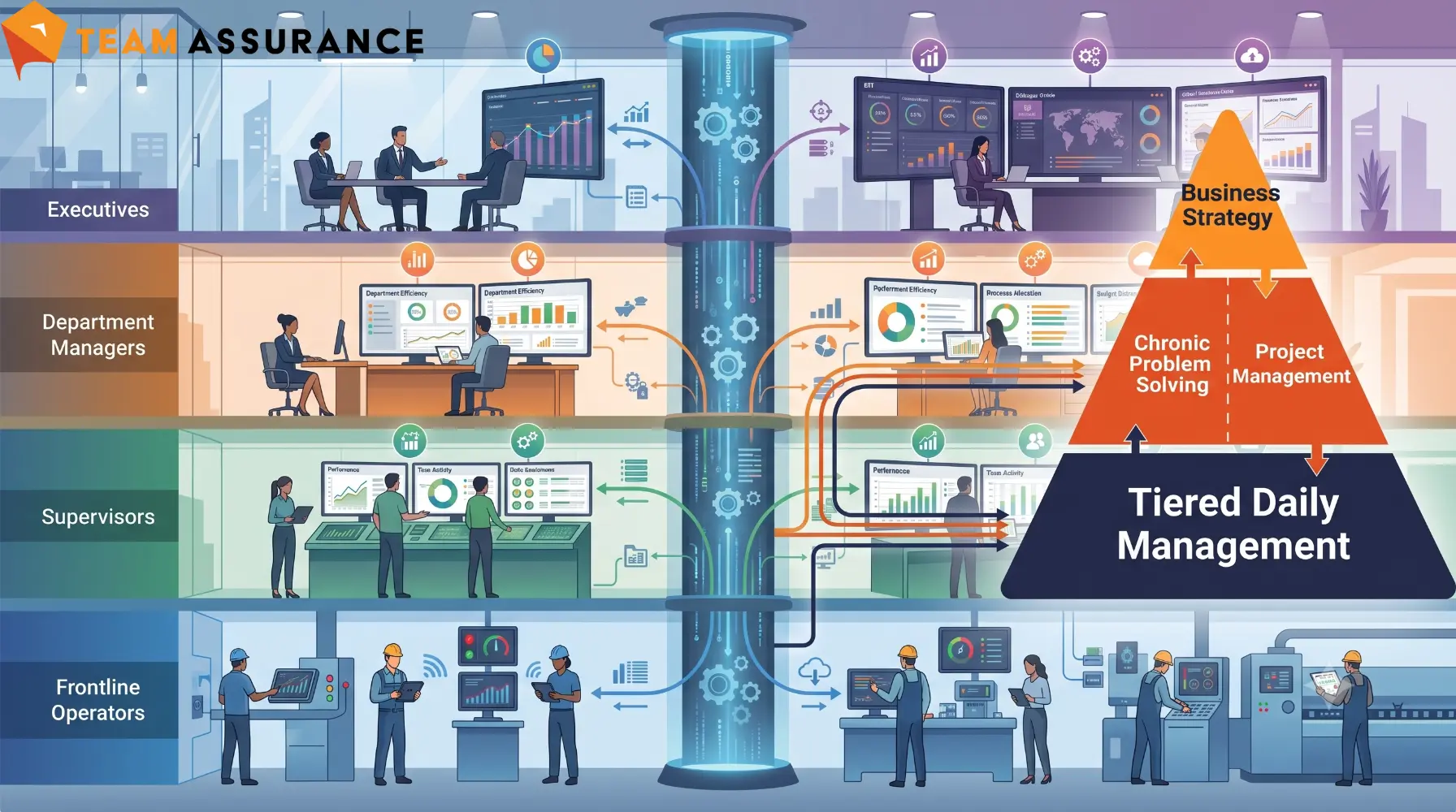
Frontline teams need to know whether today's work is healthy. Supervisors need to understand recurring barriers, capability gaps and where support is required. Senior leaders need to see whether the management system itself is becoming stronger.
That is not three versions of the same report. That is three different conversations.
Good strategy deployment creates agenda space at every level of the organisation. Frontline meetings have space for today's abnormalities and support needs. Tier two and tier three routines have space for recurring barriers, cross-functional issues and resource decisions. Functional reviews have space for capability, standards, process health and improvement progress. Senior leadership reviews have space for strategic priorities, risks, trade-offs and system-level learning.
That matters because strategy deployment cannot survive as a special activity done when there is time. There is never time. The work has to be given a place in the normal operating rhythm. It needs to become the regular beating of the drum.
Top-Down Deployment Gives Direction
Top-down deployment is useful because organisations need focus. Senior leaders are responsible for setting direction, choosing priorities and making trade-offs. Without that, every department creates its own version of what matters, and the business becomes a collection of local efforts competing for attention.
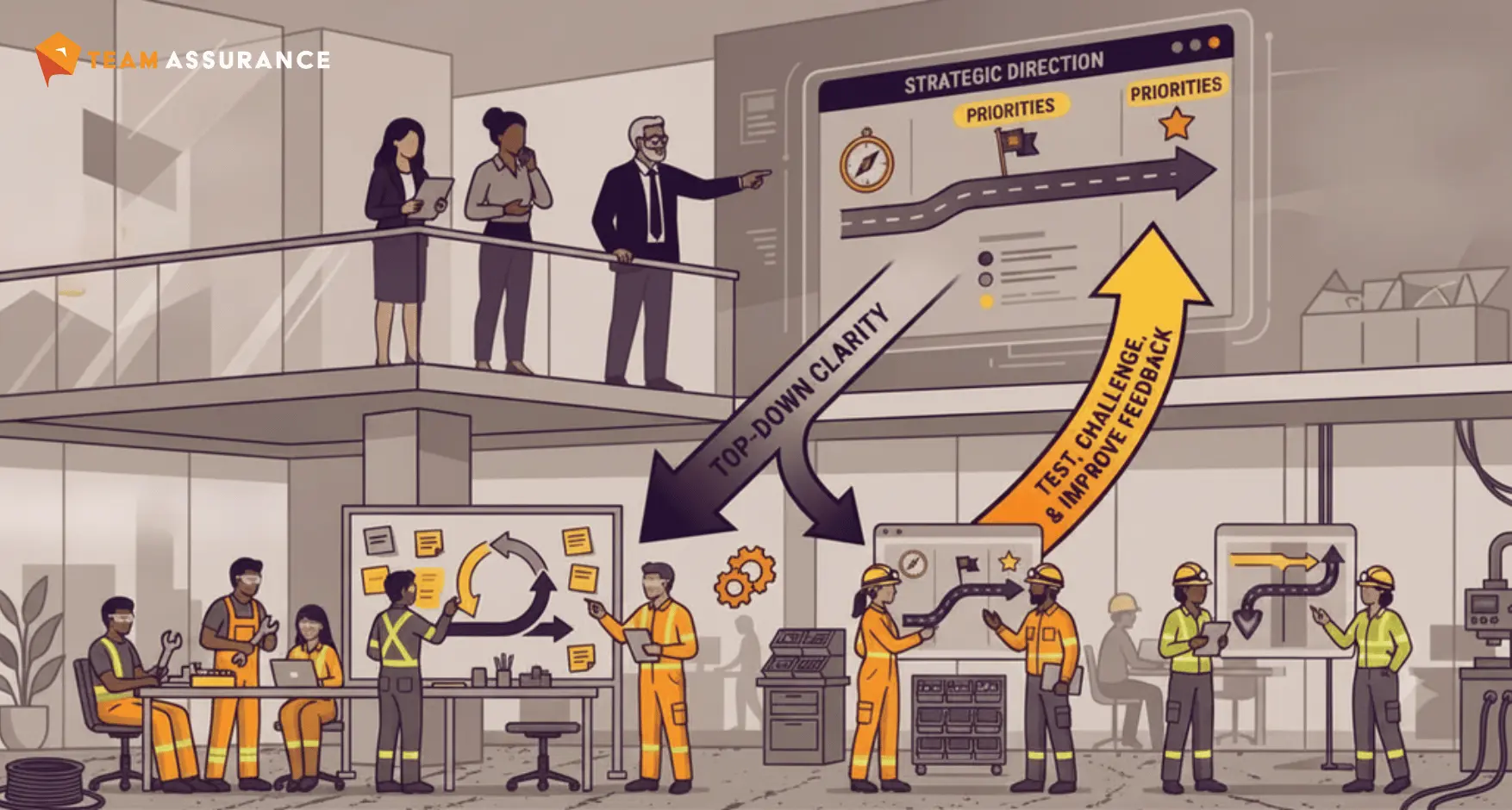
The advantage of a top-down approach is clarity. It gives the organisation a common direction and helps prevent fragmentation. It also allows leaders to focus resources on the few priorities that matter most, rather than spreading effort thinly across everything that sounds important.
The risk is that top-down deployment can become detached from the work. Leaders may set targets without understanding the real constraints. They may push too many priorities at once. They may assume communication equals commitment. They may mistake compliance for ownership.
The answer is not to abandon top-down leadership. The answer is to make it better. Senior leaders should set direction clearly, but they should also expect the plan to be tested, challenged and improved by the people closest to the work.
Bottom-Up Deployment Brings Reality
Bottom-up deployment matters because the frontline knows things the boardroom cannot see from a slide. Operators, supervisors, technicians, planners, quality teams and support functions understand where the friction is. They know which problems repeat, which standards are weak, which handovers fail, which workarounds keep the place moving, and which improvement ideas are actually practical.
The advantage of a bottom-up approach is ownership and realism. People are more committed to a plan they helped shape, especially when their practical knowledge has been respected. It also improves the quality of the strategy because the organisation learns from the work instead of guessing from a distance.
The risk is that bottom-up activity can become scattered if it is not connected to strategic direction. Every team may improve something, but the improvements may not add up to the business outcome that matters most.
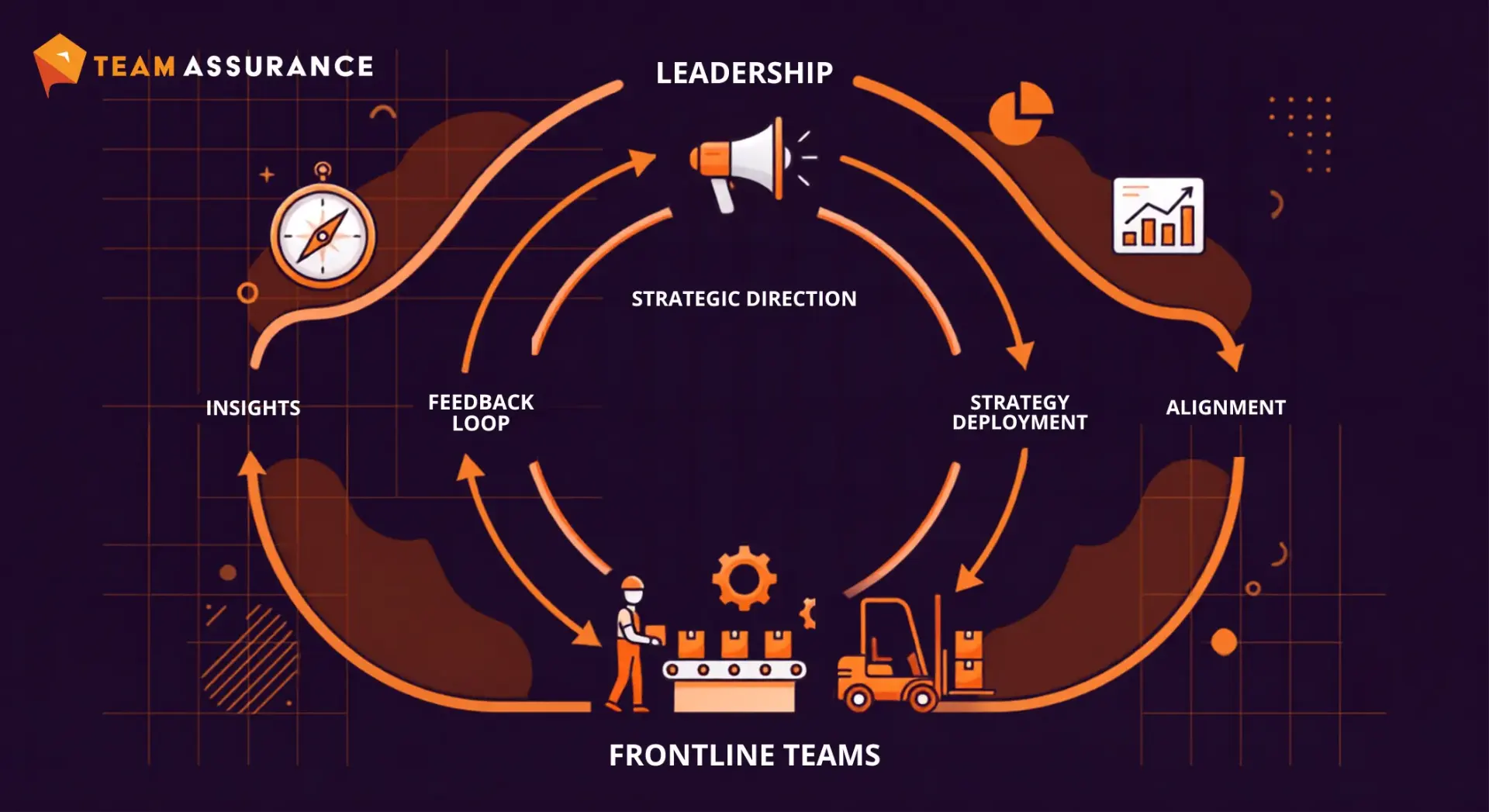
The best approach is not top-down or bottom-up. It is both. Direction from leadership, learning from the work, and a disciplined process that connects the two. That is where strategy deployment becomes useful instead of ceremonial.
Tools Help When They Connect The Work
Software and analytics tools can make strategy deployment much stronger when they connect goals, projects, actions, performance and learning. A good system helps leaders see whether priorities are moving, where actions are stuck, where support is needed, and whether improvement is producing results.
The right tools also reduce the usual mess of disconnected spreadsheets, slide decks, email trails and private action lists. That matters because strategy deployment dies quickly when nobody can see the current condition of the work. If every leader has a different version of progress, the business spends more time reconciling the story than improving the result.
The best tools make work visible as it happens. They reduce the gap between doing, managing and reporting. They create one operating view instead of twenty versions of the truth. They also help protect the rhythm by making agenda items, escalations, actions and decisions visible across tiers and functions.
Analytics can help identify trends, patterns and weak signals. Dashboards can show progress against key measures. Project tools can clarify ownership and timing. Digital daily management can connect frontline issues to larger strategic themes. AI can become useful when it has enough operating context to find repeated problems, highlight risk, summarise learning and suggest where attention may be needed.
But tools do not create discipline by themselves. They support discipline. A strong management system with good tools gets stronger. A weak management system with expensive tools usually becomes a more colourful weak system.
Feedback Is Part Of The Measurement System
Surveys and feedback mechanisms matter because not everything important shows up in a KPI. People can often tell you whether deployment is working before the numbers fully show it. They know whether priorities are clear, whether leaders are aligned, whether actions are realistic, whether support is arriving, and whether the strategy has changed the work or just changed the language.
Feedback can come through pulse surveys, frontline reviews, leader standard work, retrospectives, team discussions, project reviews and improvement sessions. The point is not to collect opinions for the sake of it. The point is to understand whether the deployment system is helping people execute better.
Good feedback loops also build trust. When teams can see that their input improves the plan, they are more likely to engage with the system. When feedback disappears into a corporate hole, people learn not to bother. Fair enough.
The Future Of Strategy Deployment
The future of strategy deployment will be more connected, more real-time and more learning-focused. The old model of annual planning, quarterly reviews and monthly status updates is too slow for many organisations. It creates long delays between intention, action and learning.
Better deployment systems will connect strategic priorities directly to operational routines. They will link projects to actions, actions to performance, performance to problem solving, and problem solving to organisational learning. They will help leaders see not only whether targets are being met, but whether the organisation is becoming more capable.
AI will play a role, but only where the operating memory exists. If the organisation has captured its issues, decisions, actions, lessons, risks, standards and improvements, then AI can help find patterns and accelerate learning. Without that context, it is mostly just another assistant producing summaries nobody asked for.
The winning organisations will not be the ones with the longest strategy documents. They will be the ones that learn fastest from execution.
The Main Takeaway
Strategy deployment works when it turns direction into disciplined action. It works when financial metrics and operational metrics are both understood. It works when top-down direction and bottom-up learning strengthen each other. It works when tools make execution clearer, not more complicated. It works when feedback is treated as part of the system, not an afterthought.
It works best when doing the work and reporting on the work become the same thing. It works best when visibility is current enough to support action. It works best when every level and function has a proper place to raise, review and resolve the work that matters.
Most of all, it works when the organisation can see whether the strategy is changing the work.
That is the standard.
Not better slides. Better execution. Not more reporting. More learning. Not strategy as a document. Strategy as the normal rhythm of how the business improves.
Effective strategy deployment depends on a connected management system. The TeamAssurance Operational Excellence Framework below illustrates how strategy, projects, daily management, problem solving and organisational learning work together to turn strategic priorities into everyday action and measurable results.
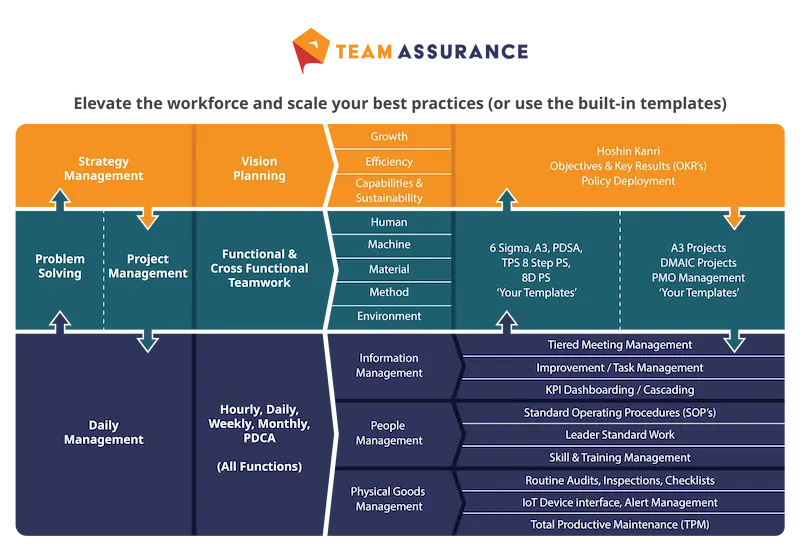
Discover how TeamAssurance helps organisations turn strategy into action. Book a demo to see how our connected Operational Excellence platform aligns strategic priorities with daily management, project execution and continuous improvement to deliver sustainable operational performance.