
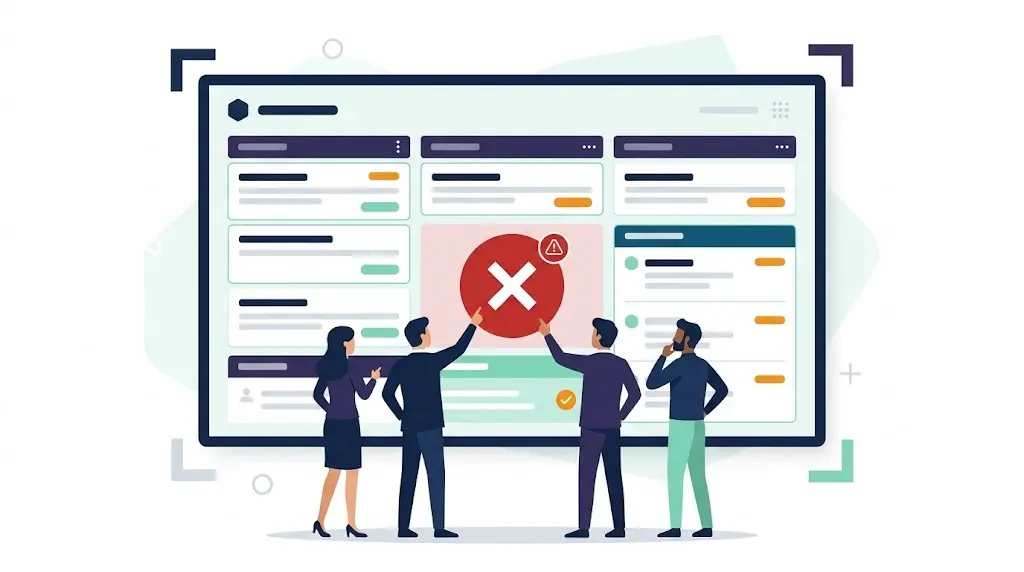
Tier meetings have become one of the most common features of modern operations.
Walk into almost any organisation pursuing Operational Excellence, Lean, TPM, WCM, IWS or Daily Management and you'll find them. There will be performance metrics, escalation processes, action registers, review routines, tier boards, and meeting schedules. The terminology varies from company to company, but the underlying idea is largely the same. Bring people together regularly, review performance, identify abnormalities, remove barriers and keep the operation moving.
Simple enough.
The problem is that many tier meeting systems look considerably better than they perform.
I've sat through tier meetings that were textbook examples of compliance. The agenda was followed. The metrics were reviewed. The actions were updated. The meeting finished exactly on time. Everybody appeared engaged and disciplined. Yet everyone walked away knowing little more than they knew before the meeting started.
I've also sat through tier meetings that were far less polished but produced genuine learning, rapid decision-making and meaningful improvement. People left with clarity. Problems moved. Support arrived. Decisions were made. Learning spreads.
The difference was rarely the format.
The difference was usually the purpose.
The Real Purpose Of Tier Meetings
Most organisations believe tier meetings exist to review performance. That assumption is understandable because performance review consumes much of the meeting. Metrics are examined. Variances are discussed. Actions are reviewed. Escalations are considered.
But performance review is not the purpose.
It is a by-product.
The real purpose of a tier meeting is to combine capability where individual capability is no longer sufficient and strengthen organisational response.
A useful test for any meeting is to ask a simple question:
Why couldn't this be solved by one person?
If the answer is that it could have been, the meeting probably shouldn't exist.
I've become increasingly sceptical of meetings that exist primarily to exchange information. Information can be communicated in many ways. Pulling capable people away from value-adding work should require a very high burden of proof. A meeting consumes labour, expertise, attention and time. There should be a clear reason why multiple people are needed.
That reason is usually that an issue, risk, constraint or opportunity has emerged that cannot be resolved by one person acting alone.
A good tier meeting brings together different perspectives, expertise and creates stronger cross-functional alignment. Individually, each participant can only influence part of the problem. Collectively, they can remove barriers, allocate resources, make decisions, coordinate action and create momentum.
In that sense, a good tier meeting functions as a force multiplier. The combined capability of the group should be significantly greater than the sum of the individual participants.
When this occurs, problems move quickly. Decisions happen immediately. Roadblocks disappear. Support arrives. Escalations are resolved. The organisation becomes more responsive.
When it doesn't occur, the meeting becomes little more than an expensive conversation.
This is why good tier meetings focus almost exclusively on abnormalities. Normal operations do not require collective intervention. Things that are already under control do not require the attention of multiple people. The meeting should be reserved for issues that have stalled, become constrained, crossed organisational boundaries or require additional support to progress.
A useful way to think about it is this:
Done well, tier meetings become part of an organisation's operating rhythm.
When work is flowing, the meeting should be brief. When progress is blocked, the meeting should help remove the blockage. When a decision is required, the meeting should produce one. When support is needed, the meeting should provide it. When learning needs to move, the meeting should accelerate it.
Everything else is secondary.
The Most Common Mistake
The most common mistake I see is confusing tier meetings with management meetings.
Management meetings often involve extensive discussion, detailed analysis, long debates and complex decision-making. Participants review information, challenge assumptions and work through issues in depth. That has its place.
A tier meeting serves a different purpose.
The objective is not to solve every problem. The objective is to identify where progress has stalled, determine what support is required and restore movement as quickly as possible.
When tier meetings become lengthy problem-solving sessions, two predictable things happen. First, the meetings become inefficient. Second, people begin waiting for meetings before taking action.
That is where many organisations unintentionally create delay.
An issue occurs at 9:00am. Rather than responding immediately, people wait until the next scheduled review. By the time the issue is discussed, valuable time has already been lost.
The strongest operations don't wait for meetings to solve problems. They solve problems in real time. Tier meetings exist to make that activity visible, coordinated and supported.
The meeting should never become a substitute for action.
What Good Tier Boards Actually Do
One of the more interesting observations from years of working with operations is how much energy organisations devote to designing performance displays and how little attention they devote to what happens around them.
The purpose of visual management is often misunderstood. Many people assume the objective is to display information. It isn't.
The objective is to make abnormalities visible.
A good tier board or performance display should allow people to quickly understand what is normal, what is abnormal, where attention is required and whether support is needed. More importantly, it should highlight the issues that require collective intervention.
If a problem can be solved locally, it should be solved locally. If an operator can resolve it, they should. If a supervisor can resolve it, they should. The display should focus attention on issues where additional capability, authority or support is required.
Too many systems evolve in the opposite direction. New measures are continually added. Existing measures are rarely removed. More detail is introduced in the belief that more information creates more insight.
The opposite is often true.
I've seen displays containing hundreds of data points that provided remarkably little understanding of what was actually happening. I've also seen simple displays that immediately highlighted the few issues preventing progress.
Good visual management reduces noise and amplifies signal.
Most importantly, it helps people respond faster.
What Good Agendas Look Like
One of the easiest ways to evaluate the quality of a tier meeting is to look at the agenda.
Poor agendas tend to revolve around updates. People take turns reporting information. Discussions drift. Time disappears. The meeting becomes a mechanism for broadcasting information rather than accelerating improvement.
Good agendas are built around abnormalities.
The conversation focuses on safety, quality, delivery, people and improvement opportunities that support continuous improvement. Areas operating normally move quickly. Areas operating abnormally receive attention.
The purpose is not to discuss everything.
The purpose is to identify where intervention is required and where movement has stalled.
A useful agenda asks a simple question:
What is preventing progress?
I've always found it curious that many organisations spend most of their meeting discussing things that are already under control. Meanwhile, the few issues genuinely threatening performance receive only superficial attention.
The best tier meetings reverse that equation.
Normal conditions require little discussion.
Abnormal conditions deserve focus.
The Behavioural Side Of Tier Meetings
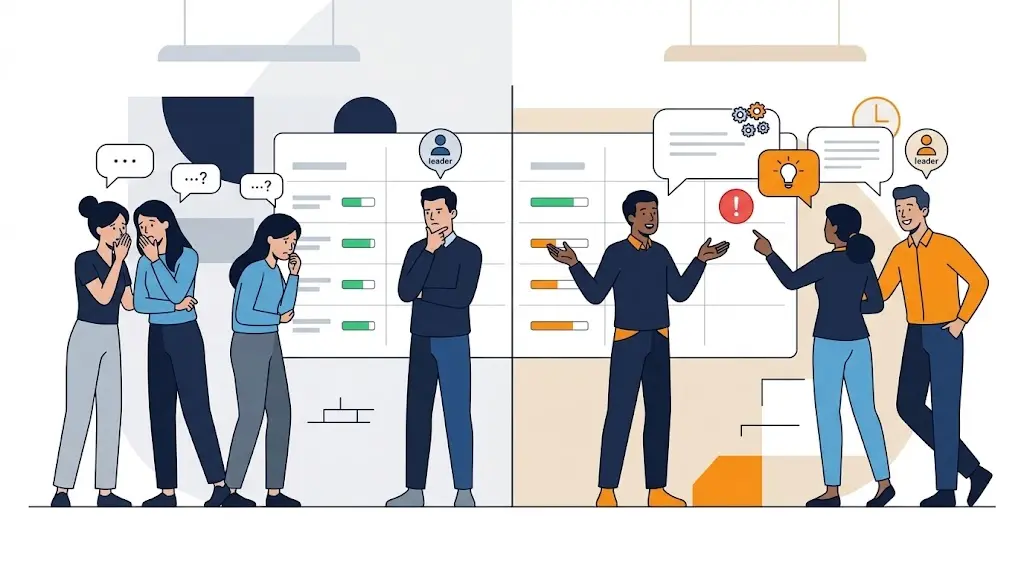
This is where many tier systems quietly fail.
Most tier meeting problems are not technical problems. Many are failures of the surrounding management system.
They are behavioural problems.
A perfectly designed agenda cannot compensate for a culture where people are reluctant to raise issues. Likewise, a sophisticated performance display cannot overcome leadership behaviours that punish transparency.
If raising a problem creates embarrassment, people stop raising problems.
If escalation is interpreted as failure, people stop escalating.
If abnormalities trigger criticism rather than support, people learn very quickly which parts of reality are safe to discuss and which are not.
Over time, the organisation begins presenting a sanitised version of reality. There is enough bad news to maintain credibility, but not enough to accurately reflect what people are dealing with every day.
Eventually the metrics look healthier than the operation itself.
The strongest tier meeting cultures create the opposite environment. Problems are treated as information. Escalations are treated as responsible behaviour. Abnormalities are treated as opportunities to learn.
This doesn't lower standards.
It raises them.
Because reality becomes easier to see.
The Role Of Escalation
Escalation is one of the most misunderstood concepts in tiered management systems.
In many organisations, escalation carries a negative connotation. It implies weakness, failure or lack of competence. People avoid it because they believe it reflects badly on them.
That mindset creates significant operational drag.
In high-performing organisations, escalation simply means the problem has reached the limits of the authority, resources or expertise available at the current level. Nothing more.
The purpose of escalation is not to transfer responsibility.
The purpose is to increase capability and support connected teams.
Support arrives. Expertise arrives. Decision-making authority arrives. Resources arrive.
Viewed this way, escalation becomes an accelerator of learning and improvement.
Problems move faster. Decisions occur earlier. Barriers are removed sooner. The organisation adapts more quickly.
Poor escalation systems achieve the opposite. Problems remain local for too long, support arrives late and the same issues continue circulating through the business long after they should have been resolved.
Getting The Cadence Right
Cadence is another area where organisations often focus on mechanics rather than purpose.
The real question is not how often we should meet.
The real question is how frequently must we learn.
Different levels of the organisation operate at different speeds. Frontline teams may need hourly or shift-based learning cycles. Supervisors may operate daily. Managers may operate weekly. Site leadership may focus on monthly patterns. Executives may be examining quarterly trends and strategic shifts.
The purpose of the tier structure is not simply to create a hierarchy of meetings.
It is to support leader standard work and connect learning cycles.
The purpose is to connect learning cycles and support cycles.
Every level of the organisation is running its own PDCA loop. This creates alignment from daily execution through to strategy deployment. The role of the tier system is to ensure that learning generated at one level strengthens decision-making at another and that support arrives when local capability reaches its limits.
Without this connection, local learning remains local, problems linger longer than necessary and organisational capability develops far more slowly than it should.
What Good Looks Like
A good tier meeting feels almost mechanical in its effectiveness.
People arrive prepared. Abnormalities are visible. Ownership is clear. Escalations are understood. Support requirements are obvious.
The discussion is focused. The conversation is honest. The meeting remains anchored in reality rather than opinion.
Most importantly, the meeting creates movement.
Issues arrive. Constraints are identified. Decisions are made. Resources are allocated. Learning is shared. Progress resumes.
Nobody leaves wondering what happens next.
Nobody leaves carrying an unresolved blockage that the group had the ability to remove.
The collective capability of the meeting has been applied exactly where it was needed.
That is the real test.
Not whether the meeting finished on time.
Not whether every metric was reviewed.
Not whether everybody attended.
Whether progress accelerated because the meeting occurred.
If it didn't, the meeting probably wasn't needed.
The Future Of Tier Meetings
The future of tier meetings is unlikely to involve more meetings, more metrics or more reporting.
Most organisations already have plenty of all three.
What many lack is the ability to convert operational experience into organisational learning and organisational action.
This is where AI and connected operational learning systems become increasingly interesting. Not because they replace meetings, but because they strengthen them. Patterns can be identified earlier. Recurring issues can be connected automatically. Lessons learned in one area can be surfaced elsewhere. Escalations can become smarter and faster. The right people can be brought together sooner and with better context.
The meeting itself may remain relatively simple.
What changes is the intelligence surrounding it.
Ultimately, the organisations that pull ahead will not be those with the most sophisticated meeting structures.
They will be the organisations that use tier meetings to accelerate learning, shorten improvement cycles, remove barriers faster, strengthen organisational capability and operational excellence.
Because that was always the point.
Tier meetings were never supposed to be reporting systems.
They were supposed to be organisational superpowers.
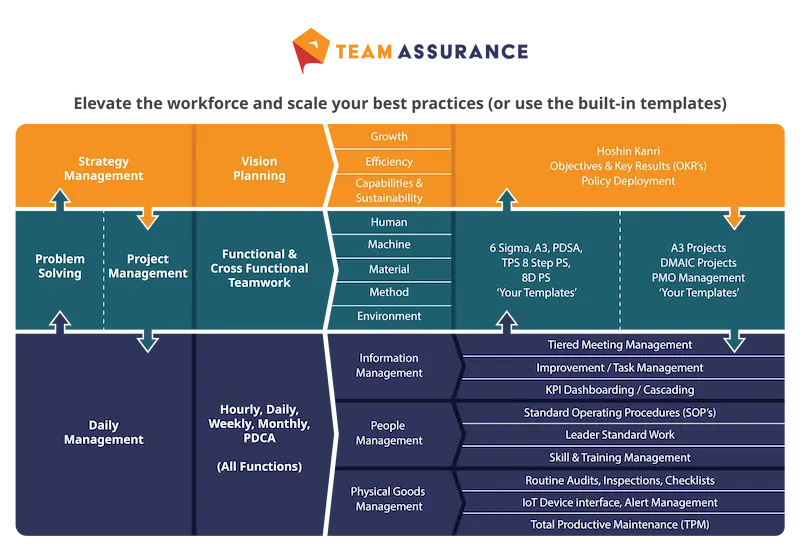
The TeamAssurance Operational Excellence Framework below illustrates how tier meetings fit within a connected management system. By linking visual management, escalation, daily management and continuous improvement, organisations can remove barriers faster, strengthen collaboration and turn operational insights into meaningful action.
Turn your tier meetings into a catalyst for faster decisions and continuous improvement. Book a demo to see how TeamAssurance supports a connected Operational Excellence system.