
A case study of how digital Lean tools embed cross-functional continuous improvement and enhanced collaboration.
In the world of continuous improvement, a transformative shift occurs when your people move from working as isolated individuals to collaborative teams.
More significant progress unfolds when these teams extend their collaboration cross-functionally, breaking down silos and achieving collective success.
This article is dedicated to continuous improvement professionals and lean practitioners, emphasising the need for this collaborative approach to both re-engage a flagging workforce, and win in the market.
The Power of the Real-time Tier Board for Cross-Functional Continuous Improvement
Tier boards, alternatively referred to as visual management boards, serve as a crucial instrument in facilitating Tiered Meetings, which are also known as huddles. These boards can be either physical or digital displays, designed to exhibit key data and information in a clear and consistent manner.
By providing easy access to this information, tier boards play a significant role in encouraging transparency, enhancing communication, and instilling a proactive attitude among team members.
It's more than what might appear at first glance to be a tracking tool. A tier meeting board is a manifestation of the transition from individual to collaborative work.
Imagine a tier board as a canvas where each team paints a part of a much larger picture. With this approach, isolated efforts evolve into a unified, well-orchestrated strategy.
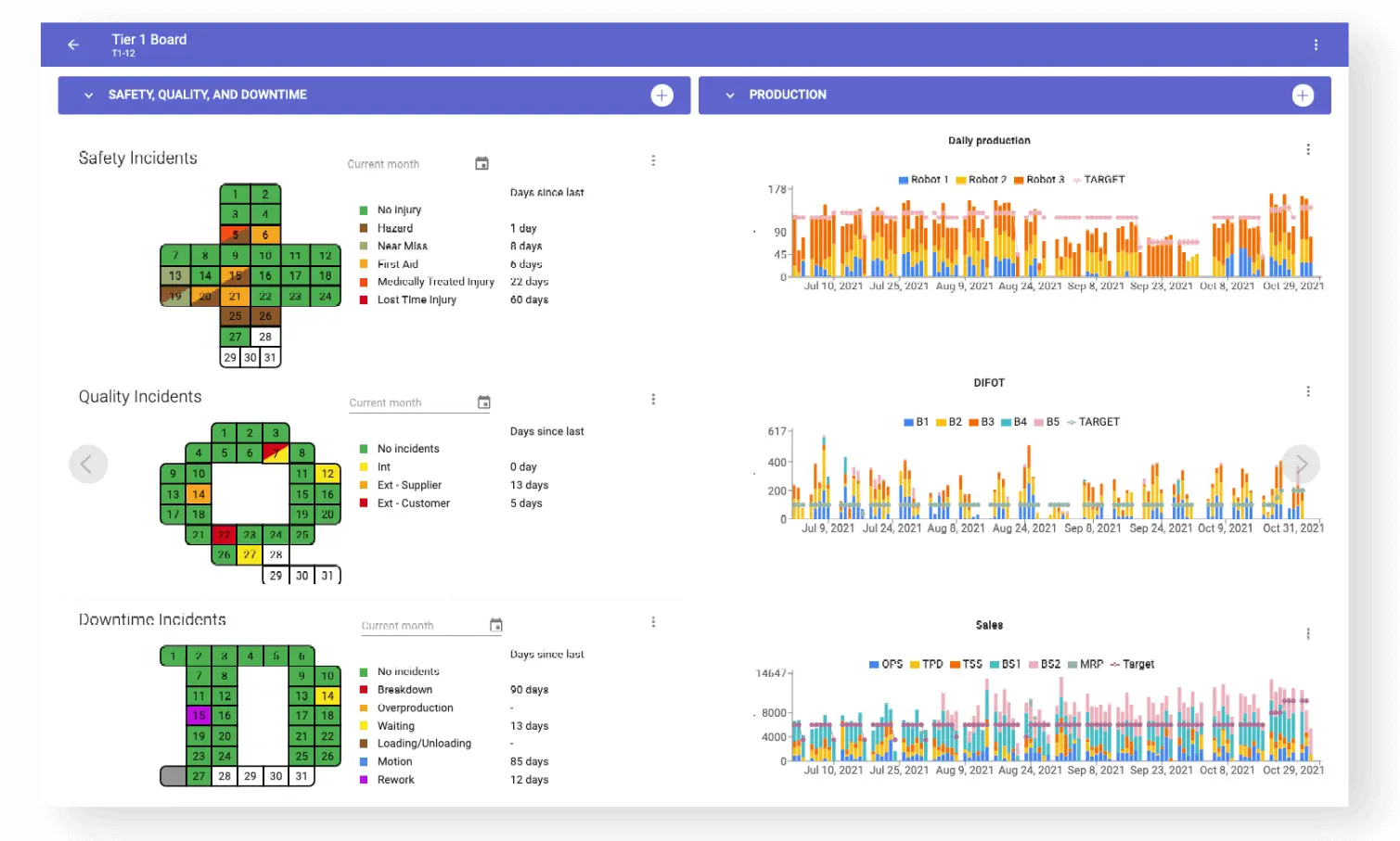
An example of a Tier 1 Board
The typical sections displayed on a tier board encompass:
- Performance Metrics: Key Performance Indicators (KPIs) like production output, quality rates, or safety incidents. It is essential for these metrics to be relevant to the team utilising it and in alignment with the broader organisational objectives.
- Problem-Solving Status: This section may outline information regarding current challenges, root cause analyses, and prioritized corrective actions. It could also report on the progress of ongoing improvement projects.
- Standard Work Status: This includes a list of regular tasks, checklists, or shift plans. It aids the team in ensuring they complete their designated roles and responsibilities efficiently, and it encourages them to seek assistance – escalating issues where necessary.
- Communication: This section might feature updates from management, acknowledgements for team members' efforts, or notifications about upcoming events. This section is crucial to nurturing a strong sense of unity and engagement within the team.
Case Study: Cross-Functional Improvement Activities In Action On TeamAssurance
To evolve further, teams need to engage beyond their immediate members and work alongside other teams.
In a tangible example, we see problem solving, 'A3' activity focused on the introduction of 5S within a Moulding Die Workshop. Instead of one team working independently, multiple teams contribute collectively to the process.
For example, a maintenance team might work with the operations and safety teams to ensure equipment is in optimal condition, properly arranged, and safe for use, thereby embodying a holistic 5S application.
The A3 report, a structured problem-solving and continuous improvement approach, outlines the specific activities required, assigns responsibilities across teams, and tracks progress meticulously.
In this scenario, cross-functional team members, each with their unique skill sets, are enlisted. For instance, Quality Control experts ensure the standards are met, Technicians align the machinery for optimal efficiency, and Human Resources help in scheduling and workforce management.
It's a well-structured system that provides a platform for everyone to contribute based on their expertise, making the process more efficient and the goals more achievable.
Understanding the Current Condition
Before a journey towards improvement begins, knowing the starting point—the 'Current Condition'—is vital. It involves a clear and honest assessment of where the team currently stands. This is not just a step; it's a philosophy.
Linking the current condition to the site's overarching goals is also essential. This helps in understanding how every small step taken by a team aligns with, and contributes to, the organisation's larger objectives.
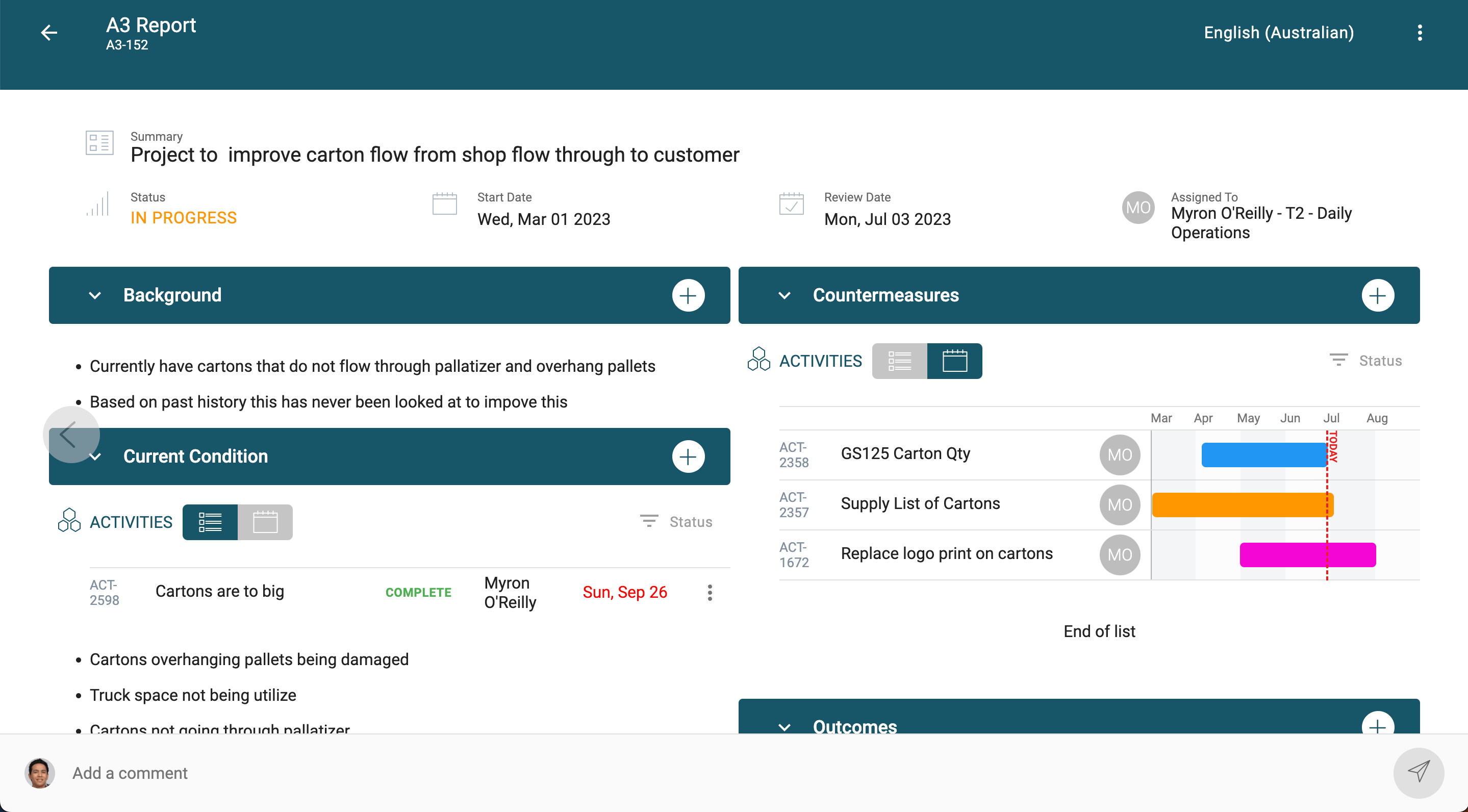
The tools that teams use to navigate and interpret their current condition are not mere utilities; they are the compass and map guiding the team towards their North Star.
And as processes are updated and tasks assigned, tools like the control chart allow organisations to understand if/when there are deviations from expected output or process behaviour.
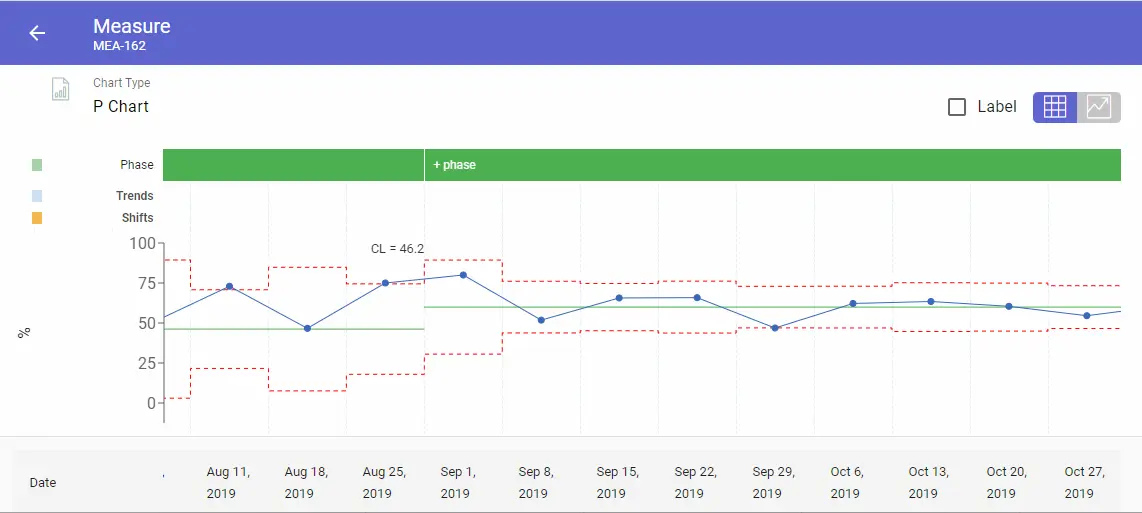
When connected to reports, capturing data in real-time, to be reviewed within the daily meetings, the feedback loop is closed. Cycles of improvement can occur faster and staff understanding of current condition is never nebulous.
The Ripple Effect: Visibility Across All Activities
Tiered meetings and a connected platform for daily, strategic, and project management gives a real-time snapshot of everyone's contributions to, and the overall health of, an organisation's projects. It's more than a status update; it's the pulse of the entire operation.
Thanks to transparent, real-time information, not only can teams see their immediate activities, but they can also identify if anything is overdue across an entire site (or multiple sites). It creates a ripple effect of improvement activity and holds everyone accountable.
It ensures that no critical activity slips through the cracks. In fact, it ensures that critical activity is completed proactively rather than reactively.
There is a constant reminder that every individual's work is a vital piece of a much larger puzzle. It echoes the sentiment that everyone is working towards a common goal and that everyone's role, no matter how small it may seem, is integral in the grand scheme of things.
A Framework for Cross-Functional Continuous Improvement
In essence, the world of continuous improvement is dramatically enriched when teams move from isolated silos to vibrant, collaborative ecosystems. As Lean practitioners and continuous improvement professionals, we are both the architects and the inhabitants of this ecosystem. In this interconnected world, the teams that collaborate effectively are the ones that will thrive sustainably.
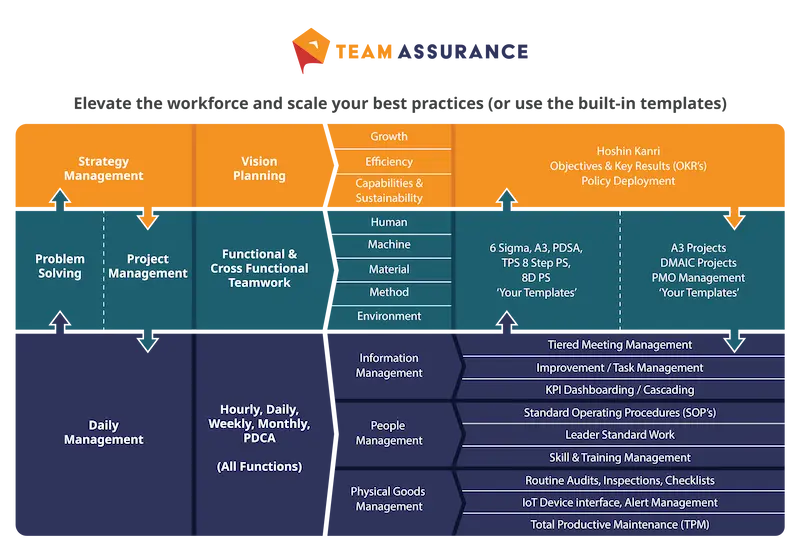
To appropriately align all of the people, processes and systems within your organisation you must consider how all the adjacent elements interact. The Lean tools we discuss regularly like standardised problem solving techniques, SOPs, tiered meetings, and more should all be optimised simultaneously.
The image below demonstrates how we developed our platform to avoid locally optimised, disconnected 'Point Solutions' (digital or analog) and improve the efficacy of your C.I. framework to achieve your organisation's Lean efforts.
If you're a business in need (or a consultant with clients in need) and you'd like to explore how to enable cross-functional improvement at all levels with TeamAssurance contact us for a demonstration of the platform today.