
The first year of a so-called lean transformation usually has plenty of energy. People learn the language. Leaders spend more time at the work. Pilot areas improve. A few obvious problems get fixed. The business starts to feel like it is moving.
That early movement matters. It proves change is possible. It gives people confidence. It shows that better ways of working are not theory. They can be built.
The real test comes later.
By year three, the easy wins are usually gone. The launch energy has faded. The posters are familiar. The routines are no longer new. This is where the serious organisations separate themselves from the ones that only installed lean language.
The question is no longer, “Did we start?” The question is, “Are we still learning?”
The Tools Are Not The Work
Lean tools are useful. Daily meetings, visual management, A3s, standard work, 5S, structured problem solving routines. None of them are the enemy. The problem starts when the tools become the work.
A board is not improvement. A meeting is not management. An action list is not learning. A completed A3 is not the same thing as a stronger organisation.
The best organisations use the tools to expose reality, improve standards, develop people and spread learning. The weaker ones use the tools to prove the program still exists.
There is a difference.
Year Three Reveals What Is Embedded
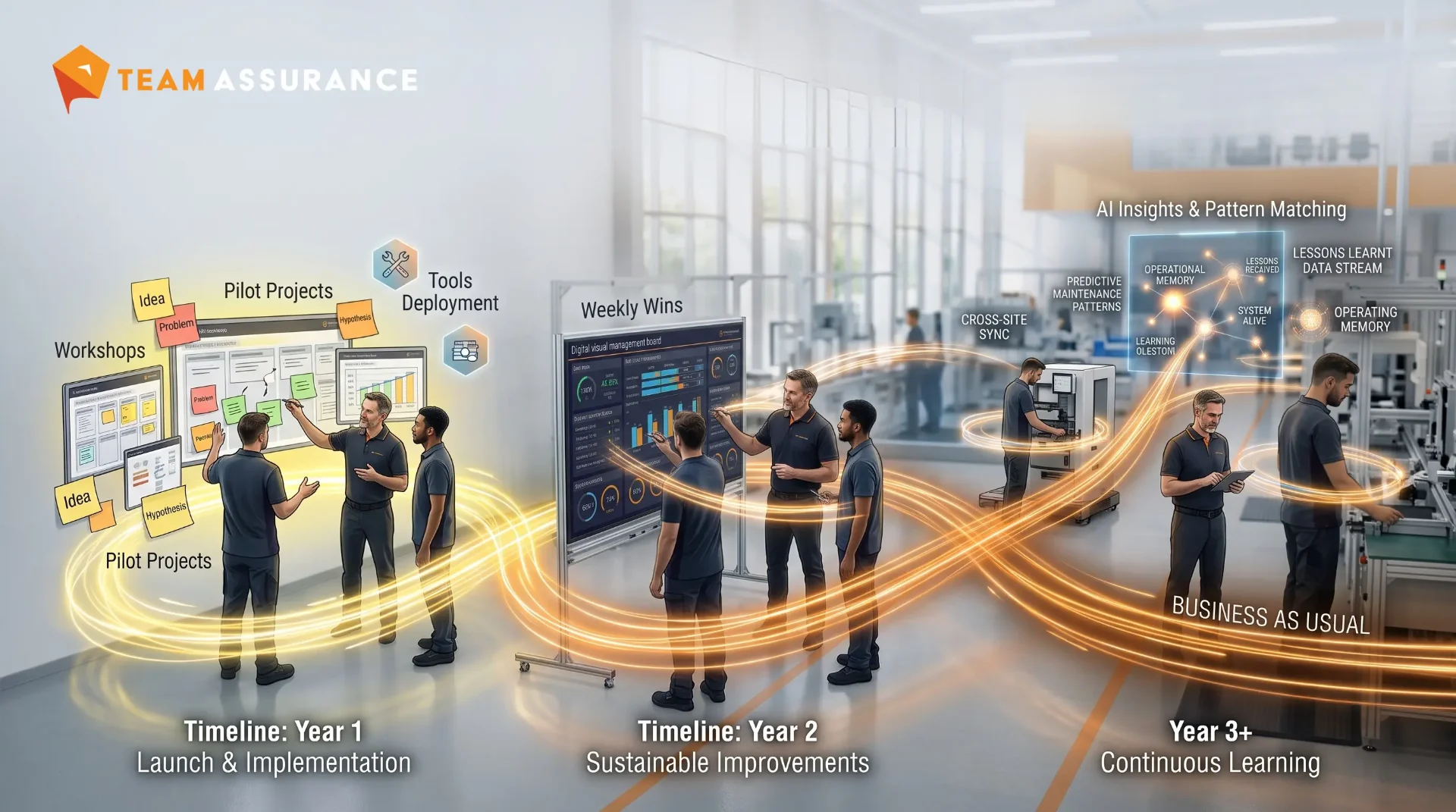
Year one tells you whether people can get excited. Year two tells you whether the business can create visible wins. Year three tells you whether the organisation has actually changed the way it runs.
By year three, good standard work supported by leader standard work should have done something useful. It should have removed noise. It should have made the basics calmer. It should have reduced the energy wasted on firefighting, chasing, correcting and remembering what should already be clear.
That is the positive side people sometimes miss. The goal is not to make the place dull. The goal is to conserve energy by making normal work stable, then deliberately point that saved energy at improvement.
If problems are visible early through visual management, leaders follow leader standard work, actions close with learning, and continuous improvement becomes part of everyday work, then the management system is alive.
If problems are visible early, leaders go to the work, actions close with learning, standards improve, and lessons move across shifts and sites, then the system is alive. If the routines continue but the learning has slowed, the business has drifted into maintenance mode.
AI Holds The Organisational Context
This is where TeamAssurance and AI start to matter. Not as another gimmick. Spare us.
The useful role of AI is to help the business find patterns, surface repeated issues, connect today’s problem to yesterday’s action, and point saved energy toward the next best improvement.
That only works when the operating memory exists. TeamAssurance holds the work: actions, decisions, issues, escalations, lessons, risks, routines and improvements. AI then has context. Without context, it is just summarising meetings and polishing emails. Handy, but not exactly transformation. Thus, TeamAssurance becomes the organisation's operating system for operational learning, capturing actions, issues, decisions, improvements and organisational context that AI can use to strengthen operational performance.
Keep The System Moving
A lean transformation keeps improving after year three when continuous improvement, daily management and continuous learning become normal work. Not a campaign. Not a relaunch. Not a quarterly theme with a slogan attached to it. Normal work. When learning becomes part of how the organisation operates every day, rather than a temporary program, operational excellence continues to grow long after the initial transformation has ended.
The organisations that sustain this do not keep asking people to believe in it. They make it useful. They make it visible. They make it part of how the business runs every day. That is the blunt test.
If the management system continues helping people see problems, practise structured problem solving, improve standard work, strengthen operational performance and prevent problems from returning, it will continue delivering operational excellence. A people-led virtuous cycle with a system-led fly-wheel.
If it needs constant re-launching, it was never really embedded. It was only introduced. It’s not a failure, it’s just a signpost telling you what to do next.
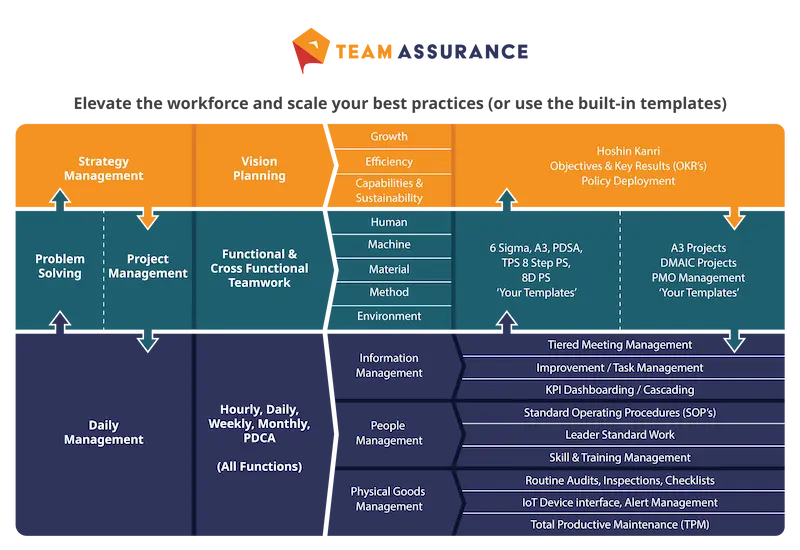
Sustainable lean transformations are built on connected systems, not isolated tools. The chart below shows how daily management, standard work, continuous improvement and organisational learning work together to create lasting change and keep improvement moving well beyond year three.
See how TeamAssurance helps organisations turn lean into a lasting way of working. Book a demo to discover how a connected Operational Excellence platform supports continuous improvement, organisational learning and sustainable operational performance.