
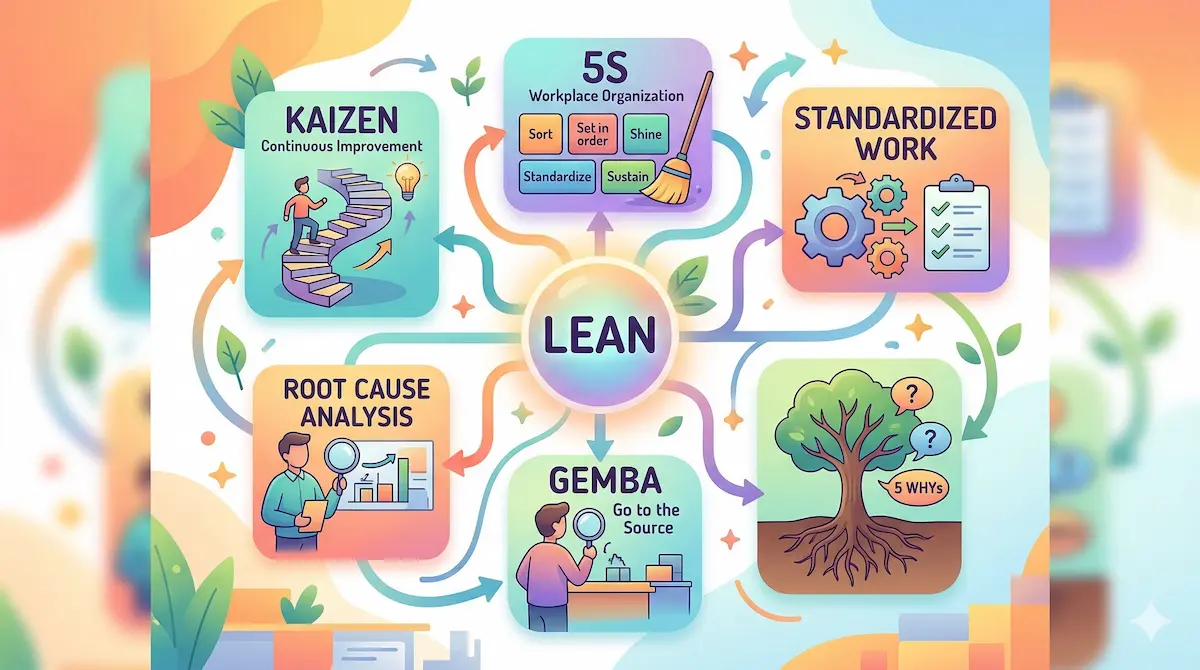
Understanding how Lean tools and principles interconnect is essential for any organisation seeking to build a robust and sustainable continuous improvement framework.
Lean is often taught as a collection of individual tools – 5S, Value Stream Mapping, Kanban, PDCA, A3 problem solving, and so on. While each tool is valuable in its own right, the real power of Lean emerges when we understand how these tools connect and reinforce each other.
The Lean House: A Framework for Connection
The Toyota Production System is often visualised as a house. This metaphor illustrates how the various elements of Lean work together:
- The Roof represents the goals: highest quality, lowest cost, shortest lead time, best safety, and high morale.
- The Pillars – Just-In-Time and Jidoka (quality at the source) – represent the core operational principles that support those goals.
- The Foundation provides stability: standard work, heijunka (levelled production), and visual management.
Without a solid foundation, the pillars cannot stand. Without the pillars, the roof (goals) will never be achieved. This interconnection is what makes the system work.
Continuous Improvement and Respect for People
At the centre of the Lean house sit two enabling values:
- Continuous Improvement (Kaizen): The relentless pursuit of better ways to work, driven by everyone in the organisation.
- Respect for People: Recognising that our people are the most valuable resource and investing in their development, engagement, and empowerment.
These values are not separate tools – they are the culture that binds all the tools together. Without respect for people, tools become mechanical exercises. Without a culture of continuous improvement, tools become static and eventually abandoned.
How the Tools Reinforce Each Other
Consider a practical example of how tools connect:
- Standard work defines the current best practice for a process
- Visual management makes deviations from that standard visible in real-time
- Daily huddles (Tier 1 meetings) provide a forum to discuss those deviations
- Problem solving (A3 / PDCA) provides a structured method to address root causes
- Training and skills management ensures people have the capability to execute the improved standard
- The improved process becomes the new standard work, and the cycle continues
This is the PDCA loop in action – and it only works when all the elements are connected.
Avoiding Locally Optimised 'Islands'
One of the most common pitfalls in Lean implementation is treating tools as standalone solutions. Organisations implement 5S in isolation, or run Kaizen events without connecting improvements back to daily management. The result is locally optimised 'islands' that don't contribute to the broader system.
To avoid this, every tool implementation should consider:
- How does this connect to our daily management system?
- How will improvements be sustained through standard work?
- How does this align with our strategic objectives?
- How will we develop people's capability to sustain and improve?
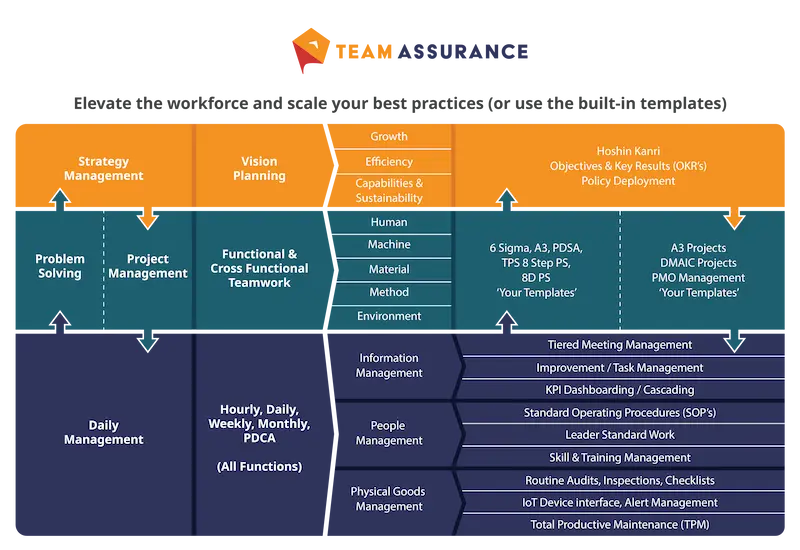
If you're a business in need (or a consultant with clients in need) and you'd like to explore how to connect your Lean tools into a cohesive framework, contact us for a demonstration of the TeamAssurance platform today.