
Standing at the foot of the mountain, looking at the top, the destination seems a long way off and the journey to get there downright impossible. That's often how we feel when faced with long term strategic planning or an audacious objective. Finding ourselves and our team in this situation has a number of challenges, aside from the most important and obvious one: Where do we start?
Starting Your Long Term Strategic Planning
Long term planning should help us align the short and medium term to strategic outcomes however it often comes with some challenges. Without a structured and intentional approach to the long term the bigger picture can overwhelm us. Before we look at some of the granular aspects of breaking goals down it is important we understand that long terms goals for teams or individuals must follow the tried and true SMART methodology as well as the following:
- Goals should be strategically linked and aligned to the organisation's vision
- Targets must be concise and clearly expressed
- Strategic planning must not be a wish list and be no more than 3–5 items per business pillar
- Goal setting must be a collaborative and consultative process, not to be imposed
- Objectives must reflect the achievement of the key priorities
Make It Chunky, Not Clunky
Once we have established the long term goals the challenge then becomes what do we do next? As the old adage states, "you eat the elephant one bite at a time." This is no different for our long term goals. The key to successfully negotiating a long term goal is to "chunk" it down to manageable pieces.
Keep the focus close and always work on the very next step – don't put the cart before the horse. This sounds like common sense and an obvious approach yet far too often our human tendencies take over. Suddenly we are:
- Trying to do too much too quickly
- Trying to achieve multiple objectives at the same time
- Failing to assess potential obstacles
- Overcommitting our time and overestimating our capability
- Intensely procrastinating to the point of paralysis
- Losing motivation due to the scale of the objective
- Deferring the priorities in lieu of less challenging work
In chunking an objective down we are minimising the amount of work in front of us to create something more manageable. Linked Lean A3 Reports allow us to manage, and report on, each chunk / activity ensuring there is always follow-up and closure of improvement cycles.
We are also creating milestones along the path to keep us motivated by experiencing a sense of progress and regular success. This is no different to the lean daily improvement and learning practice of Plan Do Check Act (PDCA).
Motivation on a Molecular Level Supports Strategy Execution
In the pursuit of any worthwhile goal the key to sustaining the journey is tapping into our internal reward system. To do so we stimulate and maintain a healthy supply of the neurotransmitter, Dopamine. Dopamine is the motivation molecule that drives us to seek rewards from achieving goals. It enables us to maintain the effort it requires to get there.
So by setting incremental goals we create an environment of regular success and a sense of achievement each time a step is completed or something is learned.
Accelerating Success Through Long Term Strategic Planning
Typically with a strategic plan an annual goal is best broken down into quarterly cycles. Then it's broken down again into weekly or fortnightly steps. Taking the macro to the micro may seem like we are overburdening, slowing down, and overcomplicating the execution process but the opposite is true. By breaking things down we are able to move with more velocity thanks to laser focus and enhanced accountability.
They help us to stay on track through regular review and assessment of our plan. We also quickly learn of obstacles along the way and can take action to navigate around them faster. No plan is a linear journey from point A to point B.
Enjoy the Journey
Ultimately PDCA is a great tool to achieve your long term goals through cycles of rapid learning and improvement. Whether it is a personal or a strategic business objective, the mindset and application is really no different in the pursuit of achieving the bigger picture goals.
Breaking goals down in a structured way allows us to climb the mountain with a focus on putting one foot in front of the other. We have clear markers to keep us on track, and opportunities to enjoy the view along the way.
Connecting the Varying Elements of Our C.I. Framework for Strategy Success
We must ensure alignment of all people, processes and systems for effective strategy planning, deployment, and execution. Lean tools like standardised problem solving techniques, Standard Operating Procedures (SOPs), and a Tiered Daily Management process that supports the entire PDCA loop are key to achieving our goals.
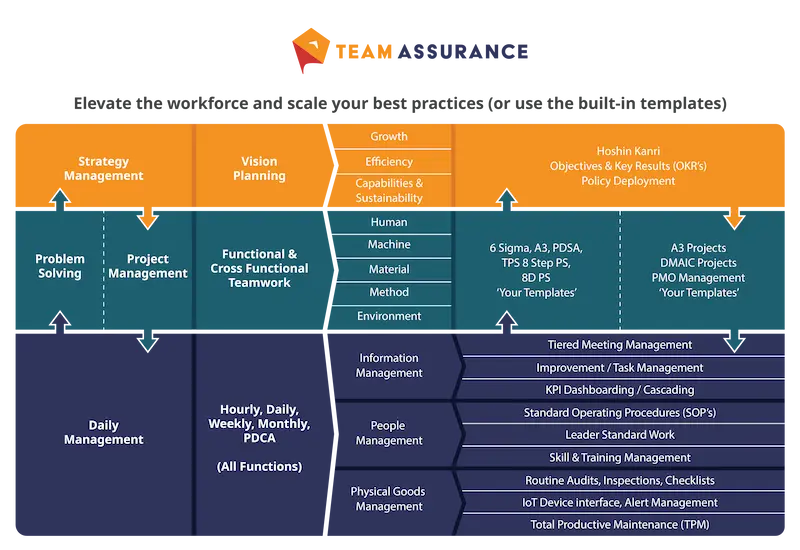
TeamAssurance enables organisations to achieve their long term goals through an intuitive, accessible daily management system. If you're a business in need (or a consultant with clients in need) contact us for a demonstration of the TeamAssurance platform today.