Rewarding employees effectively isn't a science, nor is it straightforward. But, by better understanding motivation we can better reward our teams.
Rewards can come in all shapes and sizes. However, we as organisations and as leaders often miss the mark. The concept of reward and recognition is misunderstood and frequently mismanaged.
How can we motivate our people and stimulate improvements in our processes? It is definitely not by implementing a 'one size fits all' reward and recognition scheme tied to our objectives.
Rewarding Employees Effectively
There are 3 key elements to a truly valued incentive:
- It must have merit
- It must be meaningful
- It must be tailored to the team or individual
The cadences we use for rewarding employees must also be calibrated to maintain an appropriate level of tension in the environment. All too often the effectiveness of reward systems starts out well enough but degrades over time.
Extrinsic and Intrinsic Motivations
Rewarding employees is driven by the intent to create motivation. Psychologists have proposed different ways of thinking about motivation, including looking at whether motivation arises extrinsically or intrinsically.
Extrinsic motivation is when we are motivated to perform a behaviour because we want to earn a reward or avoid punishment. This is very transactional.
Intrinsic motivation is when you engage in a behaviour because you find it rewarding. The behaviour in itself is its own reward.
Extrinsic rewards can help us to:
- Provide a source of feedback to highlight a KPI or behavioural standard has been achieved
- Induce interest and participation in an activity
- Motivate people to acquire new skills or knowledge
Some drawbacks can be:
- They can precipitate short term thinking
- They can diminish performance
- They can decrease intrinsic motivation
- They can become expected and addictive
- They can encourage shortcuts and unethical behaviour
The Effect of Rewarding Employees
Research suggests that most of our dopamine release is not from achieving goals, but actually released when we are in the pursuit of our goals. The one thing most high-performing environments have in common is that they are very good at defining and attaching reward to more granular steps.
Within Lean thinking people learn and improve the process simply because we can visualise, define and have agency over what is important to us. Each improvement cycle provides a regular feedback loop and the sought-after dopamine hit.
The Elements of Motivation
In Dan Pink's book Drive he cites three essential elements to motivation:
- Autonomy: the desire to direct our own lives
- Mastery: the urge to get better and better at something that matters
- Purpose: the yearning to do what we do in the service of something larger than ourselves
Develop the Whole C.I. Framework
To provide autonomy to individuals & teams, and to reward employees effectively, requires systems that support decision making at every level and at all times aligned to strategy.
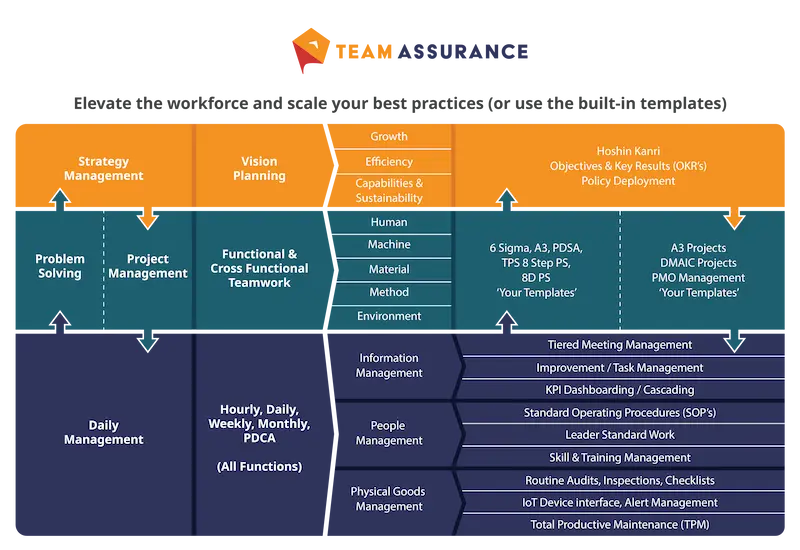
TeamAssurance enables organisations to provide clarity of purpose and visibility of progress towards goals to everyone. If you're a business in need (or have clients in need) contact us for a demonstration.