
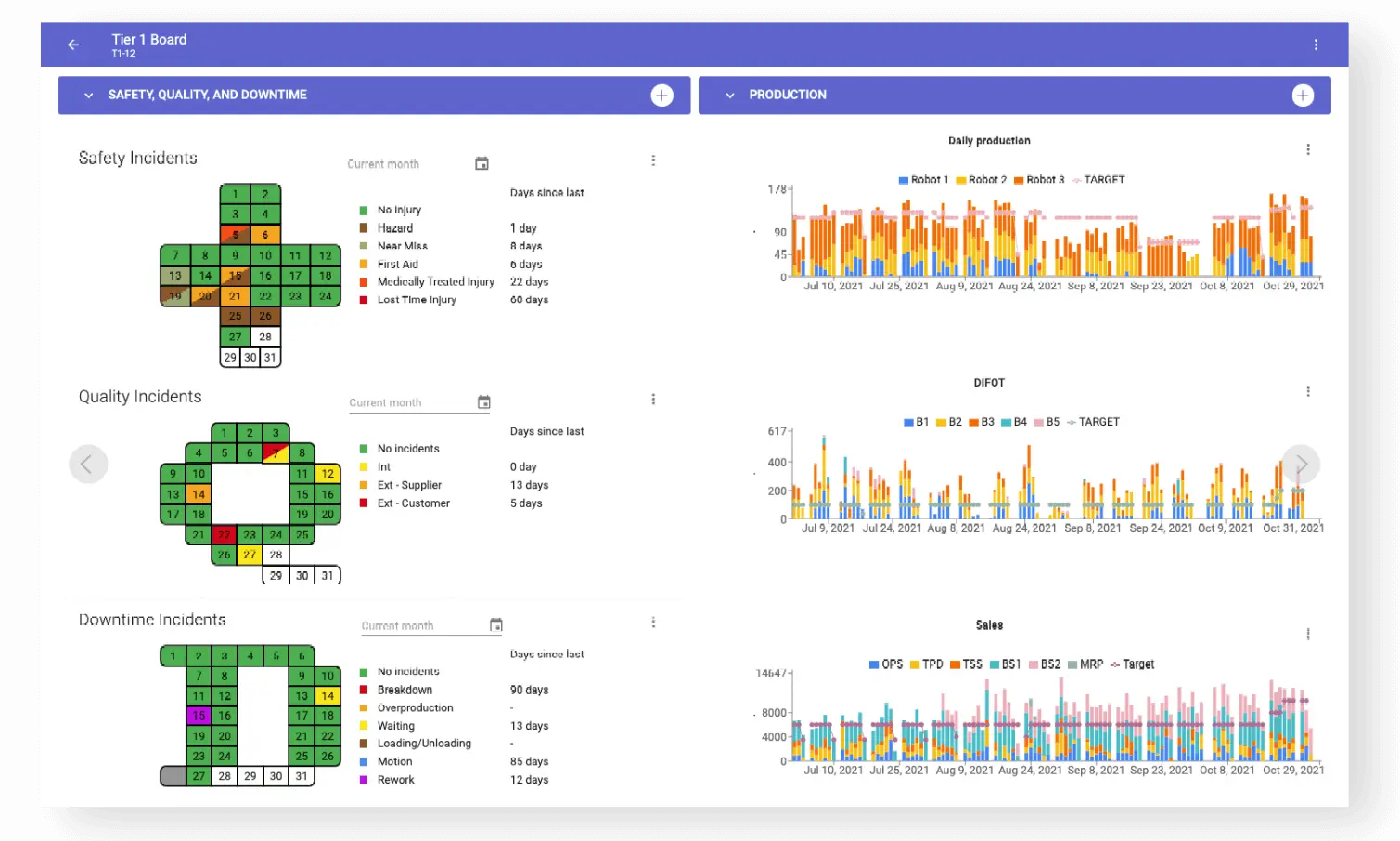
Tiered meetings depend on visual management: each tier reviews a board that shows its measures against target, open actions, problems and escalations, so the meeting is about the gaps the board makes obvious rather than about reporting. The board also carries the thread between tiers, as escalations move up and decisions come back down in a form everyone can see.
At a glance
- What it is: each tier reviews a board showing measures against target, open actions, problems and escalations.
- Why it matters: the meeting is about the gaps the board makes obvious, not about reporting.
- Board features: S/Q/D calendar reports, measures, embedded PowerBI and Excel, a live action list and mirrored tables.
- Related: what is a visual management board? and tier meeting board examples.
Visual management is incredibly important for tiered meetings, daily huddles, and strategy execution in general. Just as important is the flow of this information beyond the huddle.
That's why, in TeamAssurance, teams configure their own tier board. Higher tier boards automatically aggregate data from multiple teams, and from multiple sites in real-time.
Here are a few examples of how information is visualised and circulated beyond the immediate team in the huddle area:
S/Q/D Calendar Reports
Safety, Quality or Delivery incidents automatically update on these calendar reports. These can be for one team, multiple teams, or a whole site. Each incident only needs to be reported once, and all boards are immediately updated. Useful for functional leaders – like the Head of Safety – to be across all incidents in real time.
Measures
Measure anything and visualise it in a tier board. Enter the information at the frontline, and it's updated in every tier board immediately. There's no double entry. Even better – measures can be automatically aggregated to visualise a summary for higher level tiers.
This makes it easy to compare the same activities from different sites on one chart, to understand where intervention may be required. On a digital kiosk screen or in your pocket on your phone, access the same information wherever you are.
PowerBI and Excel Integration
Bring all the relevant information together by embedding PowerBI and Excel sheets inside a Tier board.
Live Action List
Review the burden, and the progress of actions for one team, or multiple teams.
Mirrored Tables
One table can be embedded in any number of tier boards, with different columns and rows hidden for each. Numbers can be summed, so that a higher level tier only see the totals – with the ability to review all the contributing data. Enter once, updated everywhere!
Which combination of board features suits your tiered meetings?
Each team uses various combinations of the aforementioned features to build a tier board that best reflects their needs. The real-time information flow, and the automatic synch to other tier boards, reduces the administration required between tier meetings to almost zero. This allows leaders to visualise issues from across the organisation, and review up-to-the-minute data, without requiring double entry or any other setup. Move the needle on strategy execution and execute at light speed through a tiered meeting approach.
Each tier can focus their efforts on the most pressing issues, and escalate knowing the information is immediately available beyond their huddle area.
Frequently asked questions about visual management in tiered meetings
What should a tier meeting board show?
A few measures against target with a trend, grouped by safety, quality, delivery, cost and people; the action list with owners and dates; new problems and escalations; and, at Tier 2 and 3, project and goal status.
How does visual management connect the tiers?
Each tier's board rolls up the measures of the tier below and carries its escalations, so a Tier 3 leader can trace a site measure to the line it comes from and an escalated issue back to the huddle that raised it.
Physical or digital boards for tiered meetings?
Physical boards work for one team in one place. Digital boards keep measures live, carry actions and escalations between tiers automatically, work across shifts and sites and keep the history, which matters as soon as several tiers are involved. The visual management tools guide compares the main board types and signals.
Why are tiered meetings part of a wider framework?
A Tiered Daily Management process that supports the entire PDCA loop is key to effective, continuous improvement. However, to align all of the people, processes and systems involved we must also consider how all the adjacent processes and systems interact. The Lean tools we discuss regularly like standardised problem solving techniques, Standard Operating Procedures (SOPs), Kamishibai Boards etc. should all be developed together.
The illustration below demonstrates how we designed the interconnected TeamAssurance platform to avoid locally optimised, disconnected 'Point Solutions' (digital or analog) that do not help, and may even hinder your organisation's Lean efforts.
If you're a business in need (or a consultant with clients in need) and you'd like to explore the opportunities that digital-aids to Lean tools provide contact us for a demonstration of the TeamAssurance platform today.