
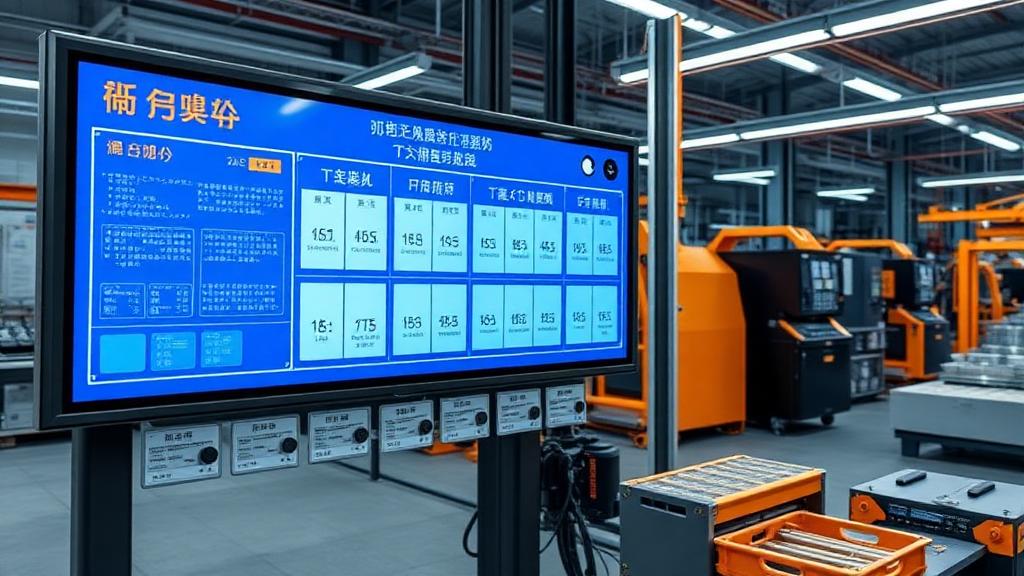
A kamishibai board is a visual audit board that holds a set of T-cards, each describing one standard to check. Leaders draw a card on schedule, go to the work area, check the standard by observing it and return the card green (met) or red (not met). It makes layered process audits and leader standard work visible on the floor.
Kamishibai boards at a glance
- Also called: T-card audit board, kamishibai audit board, red/green card board.
- Origin: Japanese paper theatre (kamishibai), borrowed by Toyota as a frame of audit cards for checking standards.
- Who audits: leaders at every level, from team leaders checking daily to site managers checking monthly.
- One card, one standard: a 5S condition, a safety control, a quality check, a maintenance task or a tier-meeting behaviour.
- Red card means action: every failed check gets an owner, a due date and a review at the next tier meeting.
Digitising improvement doesn't mean compromising on, or losing, your existing processes. Good digital aids to Lean tools should elevate and accelerate your existing processes: they are your hard-won gains. This article explains how kamishibai boards work, shows examples and set-up steps, and then walks through a hybrid digital kamishibai board we saw in use at an organisation running TeamAssurance.
What is a kamishibai board?
A kamishibai board is a Kaizen tool that standardises audits and tells the story of an area's standards visually. It gives operators and leaders a uniform way to carry out short inspections at the gemba, the place where the work is done.
The term kamishibai refers to traditional Japanese paper theatre. A storyteller worked through a sequence of picture cards in a wooden frame, often telling a morality tale that let the audience compare their own conduct with that of the characters: a self-audit, if you will. Toyota borrowed the frame of cards for a different purpose, and the name stuck: a board holding a set of standardised checks for daily, weekly and monthly auditing. For a short definition, see what is a kamishibai board in our glossary.
How does a kamishibai audit work?
A kamishibai audit is a short, scheduled check of one standard, done at the work by the leader who draws the card. The mechanics are simple, which is why the method lasts.
- Cards. Each T-card describes one standard and the few questions needed to check it: what to look at, what "good" looks like, and often a photo. The back of the card, or a linked checklist, holds the detail.
- Schedule. The board is laid out as a grid, usually days of the week across the top and areas or auditors down the side. Each slot holds the card that is due.
- The check. The auditor takes the card, goes to the area and checks the standard by observing the work, not by asking whether it was done.
- Red/green flip. Cards are green on one side and red on the other. If the standard was met, the card goes back green side out. If not, it goes back red, and a countermeasure is agreed on the spot or raised as an action.
- Rotation. Cards rotate between areas and between auditors, so every standard gets fresh eyes and leaders see parts of the operation they would otherwise miss.
At a glance, anyone walking past can see which checks have been done, which are overdue and where the reds are. That visibility is the point.
Kamishibai board vs layered process audit: what is the difference?
A kamishibai board is a way of running a layered process audit, not an alternative to it. The layered process audit (LPA) is the programme: several levels of leadership each check a small number of standards on a set frequency. The board is the visual schedule for that programme, and the questions on each card can come straight from your layered process audit checklist.
| Kamishibai board | Layered process audit | |
|---|---|---|
| What it is | A visual board of T-cards, one per standard | An audit programme run by several management layers |
| What you see | Which checks are done, overdue or red, at a glance | Audit results, usually in a form or system |
| Scope | One area or line per board | A line, a plant or a whole business |
| Where the history lives | Nowhere, once the cards are flipped back | In the completed audit forms |
Most sites that run LPAs well use both: the board keeps the habit visible, and the audit records keep the evidence.
What are examples of kamishibai audit boards?
The same format adapts to almost any standard. Common examples:
- Safety. Guarding in place, lock-out points labelled, PPE worn in marked zones, emergency exits clear, chemical storage correct.
- 5S. Shadow boards complete, floor markings intact, nothing stored outside its marked location, cleaning schedule signed off. See what is 5S.
- Quality checks. First-off inspection recorded, gauges in calibration, quarantine area used correctly, the latest version of the work instruction at the station.
- Leader standard work. Tier meeting started on time, the board updated before the meeting, actions reviewed, the previous day's escalations answered. Here the cards audit the management routine itself, which is where kamishibai fits naturally alongside leader standard work.
- Maintenance. Autonomous maintenance checks done, lubrication points marked, abnormality tags raised and closed.
Most sites start with one theme, usually safety or 5S, and add others once the routine is stable.
How do you make a kamishibai board?
Start with a board, a set of two-colour T-cards and a short list of standards worth checking. Then:
- Pick the standards that matter. Start with ten to twenty checks where a lapse would hurt safety, quality or flow. More than that and the routine becomes a chore. Each check should trace back to a written standard or SOP, so a red means the standard was not followed, not that opinions differed.
- Write each card so it can be checked in a few minutes. Two to five yes/no questions, observable at the work, with a photo of the standard where possible. Print the same questions on the green face and the red face.
- Decide who audits what, and how often. Team leaders might check daily, supervisors weekly and managers monthly. Make sure senior leaders take cards too; it signals that the standards matter.
- Build the board where the work is. A grid of card pockets, days across the top, areas or auditors down the side, visible to the team being audited rather than hidden in an office.
- Agree what happens on a red. Fix it on the spot if possible; otherwise raise an action with an owner and due date, and review it at the next tier meeting.
- Review the cards regularly. Retire checks that are always green, rewrite ones nobody understands, and add new ones as standards change.
What are the common mistakes with kamishibai boards?
- Tick-box audits. Checking from the office, or asking "is this done?" instead of looking.
- Reds with no follow-up. If a red card doesn't lead to an action, people stop believing the system and the cards go green whether they should or not.
- Too many cards. An overloaded schedule gets skipped, and skipped checks are rarely noticed on a paper board.
- Auditing people rather than standards. The aim is to find gaps in the standard, training or equipment, not to catch someone out.
- Losing the history. When cards are flipped back and the week resets, the evidence of which standards fail most often disappears.
That last mistake is the main reason to add a digital layer.
What is a hybrid digital kamishibai board?
A hybrid digital kamishibai board keeps the physical board and the ritual of drawing a card, but records each check and any red-card action in software. We recently visited an organisation doing exactly that with TeamAssurance, using the QR Code Checklist functionality to digitise their kamishibai audits.
In their set-up, the physical board and TeamAssurance work together so staff complete audits in a standardised way, with more accuracy, greater speed, and at the gemba. The operator selects the required card from the physical board, scans its code with the phone camera and follows the checklist prompts. Photos are taken and uploaded at the source, results are saved to the cloud immediately, and the audit is completed much faster than with pen and paper.
By digitising the activities the cards represent, the organisation removes waste from the routine and removes the barriers that stop frontline staff contributing easily and effectively.
How does the digital layer close the loop?
When a frontline team member or a leader finds something that needs follow-up, a task is raised and assigned on the spot. It flows in real time, so people can act in real time. These tasks then become an agenda item in each function's tiered daily management meeting, where the team discusses, prioritises and follows up.
The trends in those follow-up tasks (how many, what type) then become an agenda item in the leadership team's tier meeting, and so on up the tiers. Closing the loop this way makes certain that the next iteration of standard work is improved, that employees have been heard, that patterns of abnormality are identified, and that this routine work is genuinely worth doing.
Why does this matter for the frontline?
'Frontline first' is a core TeamAssurance value. We exist to remove barriers to participation for this group, because over the last decade they have become increasingly disconnected from the business information stack that is available to, well, everyone else.
Post pandemic, cloud applications, smartphones and tablets, and especially QR codes, are household technology. The example above shows an organisation recognising this and moving in the direction of the gemba, to make it easier for its frontline to engage and contribute, rather than simply in the direction of what is easy for 'everyone else'.
Digital kamishibai is part of a CI framework, not a locally optimised 'island'
For a process to not only be sustained but to thrive, it must be supported by adjacent processes. In this example, leader standard work and autonomous maintenance must be supported by standardised problem-solving techniques and by standard operating procedures.
These are delivered by a training management system and a tiered daily management process that can handle the full PDCA loop to deliver continuous improvement.
The schematic of the TeamAssurance platform below shows how we designed an interconnected platform that avoids the locally optimised, disconnected 'point solutions' (digital or analogue) that do not help, and may even hinder, your organisation's main goal.
How TeamAssurance helps with kamishibai boards
In TeamAssurance, kamishibai cards are scheduled checklists assigned to the right leaders at the right frequency and completed on a phone or tablet at the work. Checklists are customisable, with photos, signatures and conditional questions, and recurring schedules with reminders run across layers and sites. A failed check becomes an action with an owner and due date, unresolved findings escalate through tiered daily management, and reports show which standards fail most often across lines, shifts and sites. The physical board stays on the floor; the record lives in the layered process audit software.
Frequently asked questions about kamishibai boards
What is a kamishibai board used for?
A kamishibai board is used to make leader standard work and layered process audits visible and routine. Each T-card is a short audit of one standard, such as a 5S condition, a safety control, a changeover step or a meeting behaviour, scheduled to a named leader at a set frequency so that standards are checked, not just written.
What do the red and green cards mean?
Green means the standard was met when it was checked; red means it was not met and a corrective action is needed. A board with many reds on the same card is pointing at a standard, training or equipment problem to solve, not at the person who happened to be audited.
How do you make a kamishibai board?
Choose ten to twenty standards, write each as a T-card with two to five yes/no questions and a photo of the standard, and print it green on one face and red on the other. Mount a grid of card pockets where the work is, give each card a frequency and an auditor, and agree what happens on a red.
What is the difference between a kamishibai board and a layered process audit?
A layered process audit is the programme: several levels of leadership check a small set of standards at different frequencies. A kamishibai board is a visual way to run that schedule on the floor. The board shows what is due and what is red; the audit records keep the evidence and the history.
Why combine a physical kamishibai board with a digital one?
The physical board keeps the habit visible on the floor. The digital record keeps the schedule honest, turns red cards into tracked actions with owners and due dates, and shows which standards fail most often across areas and months, which a paper board loses every time the cards are flipped back.
Related terms and sources
- What is a kamishibai board?, layered process audit, leader standard work, gemba walk, standard work and 5S in the TeamAssurance glossary.
- Leader standard work: the basics and standard work as the backbone of a CI system on the blog.
- Lean Enterprise Institute, Lean Lexicon: Kamishibai board.
- Gemba Academy: What is a kamishibai?
Want to explore the opportunities that digital aids to Lean tools provide? If you're a business in need, or a consultant with clients in need, contact us for a demonstration of the TeamAssurance platform today.