How to develop robust communication channels and problem-solving capabilities across your organization.
Effective communication is the foundation of successful problem solving. Without clear communication channels, problems go unaddressed and opportunities are missed. In a Lean environment, the ability to surface issues quickly and resolve them efficiently is what separates high-performing organisations from those that constantly firefight.
The challenge is that most organisations default to communication structures that are slow, hierarchical, and disconnected from the work. Information passes through layers of management, losing context along the way. By the time a problem reaches someone who can act on it, the situation has often changed or worsened.
Why Communication Structures Matter
The way information flows through an organisation directly impacts its ability to solve problems. When communication is siloed – each department operating in its own bubble – issues that span multiple functions get stuck in no-man's land. Nobody owns them, and nobody resolves them.
Effective communication structures ensure that:
- Issues are visible – Problems can't be solved if they can't be seen. Visual management and digital tools make the current state transparent to everyone.
- Escalation is clear – People know exactly where to take an issue when they can't resolve it themselves. There's no ambiguity about the pathway.
- Feedback loops are closed – The person who raised an issue knows what happened with it. This sustains engagement and trust in the system.
- Cross-functional collaboration is enabled – Problems rarely sit neatly within one department. Communication structures must facilitate collaboration across boundaries.
Building Problem-Solving Capability
Problem solving should not be the exclusive domain of specialists or managers. In a truly Lean organisation, everyone is a problem solver. This requires building capability at every level.
Start Simple
Not every problem requires an A3 report or a full root cause analysis. Most issues at the frontline can be addressed with simple countermeasures. The key is to have a structured approach that people can follow:
- Identify – What is the problem? Be specific.
- Contain – What immediate action can prevent further impact?
- Investigate – What caused this? Use simple tools like 5 Whys.
- Countermeasure – What will we change to prevent recurrence?
- Verify – Did the countermeasure work?
This mirrors the PDCA cycle and builds a habit of structured thinking that becomes second nature over time.
Escalate Appropriately
Tiered daily management provides the escalation structure that ensures problems find the right level for resolution. A Tier 1 issue that can't be resolved at the frontline moves to Tier 2, where additional resources and expertise are available. System-wide issues escalate to Tier 3, where leadership can remove barriers and allocate resources.
The critical point is that escalation is not failure – it's the system working as designed. Frontline teams should feel empowered to escalate without hesitation.
The Role of Visual Management
Visual management is the bridge between communication and problem solving. When performance data, issue status, and improvement actions are visible, they create a shared understanding that accelerates both communication and resolution.
Effective visual management:
- Makes the current state immediately obvious
- Highlights abnormalities and deviations from standards
- Tracks countermeasures and their status
- Shows trends that reveal systemic issues
- Creates accountability through transparency
Digital Tools Enhance Communication
While physical boards and face-to-face huddles remain valuable, digital tools extend communication across shifts, sites, and functions. A digital daily management platform connects teams in real-time, ensuring that issues raised on night shift are visible to day shift, and that a problem identified in one area can quickly be communicated to all affected teams.
Digital tools also capture data that supports continuous learning. Patterns emerge from the data that wouldn't be visible from individual incidents. This turns your communication and problem-solving system into a learning system that gets smarter over time.
Building These Capabilities Takes Time
Developing robust communication and problem-solving structures is not an overnight transformation. It requires discipline, patience, and consistent practice. Start with the basics – clear escalation paths, simple problem-solving routines, and visible management – and build from there.
The organisations that excel are those where communication and problem solving are not separate activities but embedded in how work is done every day.
A Connected Framework, Not Isolated Tools
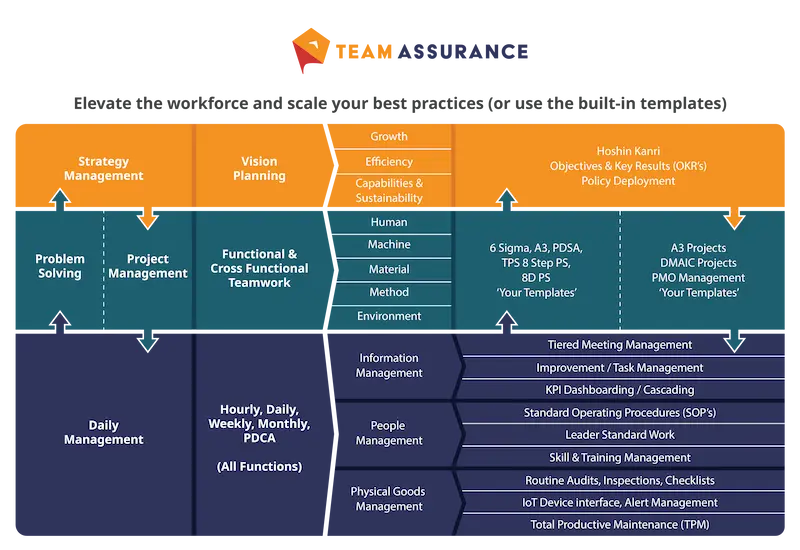
Communication and problem solving must be supported by adjacent Lean tools – standardised problem-solving techniques, Standard Operating Procedures (SOPs), and a Tiered Daily Management process that completes the full PDCA loop. Developing these in isolation creates disconnected 'Point Solutions' that limit effectiveness.
The illustration below shows how the TeamAssurance platform connects these elements into a cohesive framework.
If you're a business in need (or a consultant with clients in need) and you'd like to explore how TeamAssurance can strengthen your communication and problem-solving structures, contact us for a demonstration today.