
What it means to be a learning organisation and how to build a culture of continuous learning.
A learning organisation is one that continuously improves through the systematic development and application of knowledge. It's an organisation where learning is not a separate activity – a training course here, a workshop there – but embedded in how work is done every day.
The concept, popularised by Peter Senge in The Fifth Discipline, remains as relevant as ever. In a world of increasing complexity and rapid change, the organisations that can learn and adapt faster than the rate of change are the ones that will thrive.
Characteristics of a Learning Organisation
Learning organisations share common characteristics that distinguish them from traditional organisations:
- Curiosity is valued – People are encouraged to ask "why" and "what if" without fear of judgment
- Experimentation is supported – Trying new approaches is seen as essential, and failure is treated as a source of learning rather than blame
- Knowledge is shared – What one team learns benefits the entire organisation through systematic sharing mechanisms
- Reflection is routine – Teams regularly step back to review what happened, what worked, and what could be improved
- Systems thinking prevails – People understand how their work connects to the bigger picture and how changes in one area affect others
The Role of Daily Management in Organisational Learning
The tiered daily management system provides a powerful structure for organisational learning. Every daily huddle is an opportunity to learn – from the problems that occurred, the solutions that worked, and the improvements that were made.
When this learning is captured and shared through the tiered structure, it flows through the organisation:
- Tier 1 captures frontline learning from daily operations
- Tier 2 aggregates learning across teams and identifies patterns
- Tier 3 connects operational learning to system-wide improvement
This creates a learning loop that operates continuously, not just when someone schedules a "lessons learned" workshop.
Digital Tools Support Learning
Digital tools can significantly enhance organisational learning by:
- Capturing knowledge – Issues, solutions, and improvements are documented in a searchable, accessible system
- Facilitating sharing – Knowledge from one shift, team, or site is immediately available to others
- Revealing patterns – Data analysis identifies trends and recurring issues that wouldn't be visible from individual incidents
- Making information accessible – Anyone in the organisation can access relevant learning when they need it
- Preserving institutional knowledge – Learning is retained in the system even when individuals move on
Building a Learning Culture
Technology alone doesn't create a learning organisation. Building a learning culture requires:
Leadership Commitment
Leaders must model learning behaviours – asking questions, admitting mistakes, seeking feedback, and visibly acting on what they learn. When leaders demonstrate that learning is valued, it gives everyone else permission to do the same.
Psychological Safety
People will only share what they've learned – including mistakes and failures – if they feel safe doing so. Creating psychological safety is essential for a learning culture to take root.
Systems That Support Learning
Learning must be built into the rhythm of work, not added on top. Daily habits of reflection, problem solving, and knowledge sharing create the conditions for continuous learning.
Recognition of Learning
Celebrate not just results but the learning that led to them. When teams are recognised for what they discovered and shared, it reinforces the behaviours you want to see more of.
The Competitive Advantage of Learning
In uncertain and rapidly changing environments, the ability to learn faster than competitors becomes a decisive advantage. Organisations that can quickly identify what's changing, experiment with responses, and scale what works will outperform those that rely on historical approaches.
This is why building a learning organisation is not a "nice to have" – it's a strategic imperative.
A Connected Framework Enables Learning
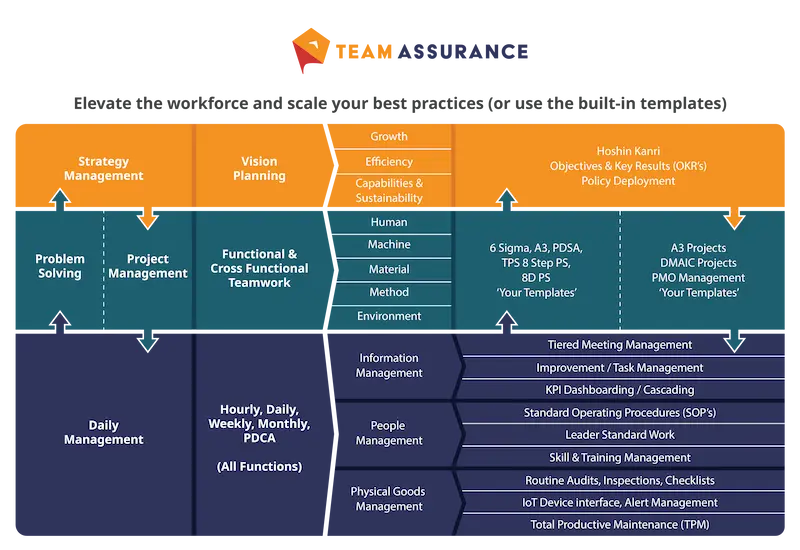
Organisational learning thrives when the tools and processes that support it are connected. Standardised problem solving captures learning, SOPs codify it, and tiered daily management ensures it's applied and refined through ongoing PDCA cycles.
The illustration below shows how TeamAssurance connects these elements into an integrated learning platform.
If you're a business in need (or a consultant with clients in need) and you'd like to explore how TeamAssurance can support your organisation's learning journey, contact us for a demonstration today.