
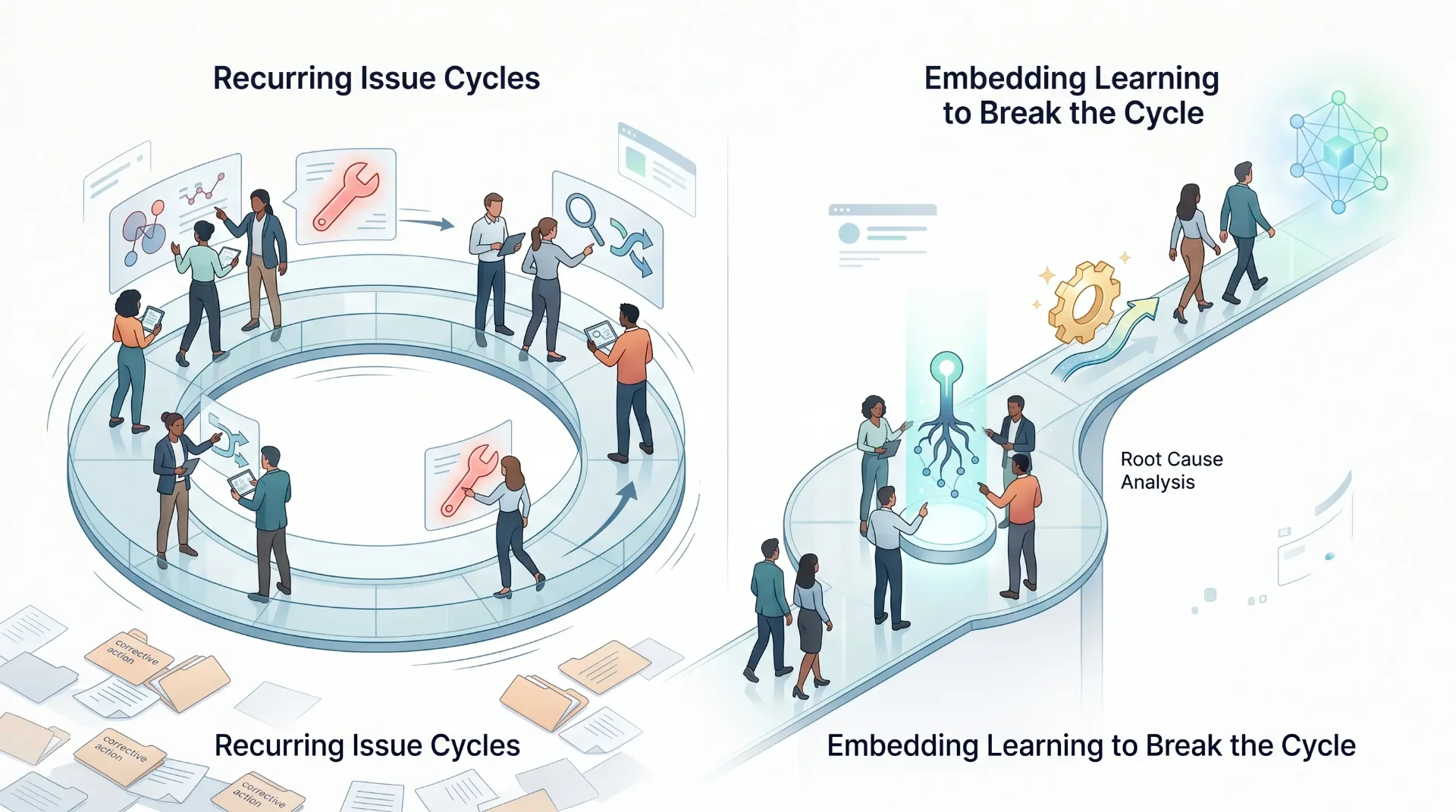
One of the more expensive habits I've seen in operations is solving the same problem multiple times while convincing ourselves we're doing continuous improvement while the underlying causes remain unresolved.
Most organisations don't have a shortage of problem solving. If anything, many invest significant time into structured problem solving, root cause analysis, corrective actions and improvement programs. Meetings are held, investigations are completed, corrective actions are assigned and improvement projects are launched. Looking at the amount of activity taking place, you could be forgiven for assuming that most businesses should be improving rapidly.
Yet when you spend enough time inside operations, a different pattern starts to emerge. The same frustrations keep resurfacing. The same conversations keep reappearing. The same categories of downtime, quality issues, customer complaints and capability gaps continue to circulate through the business. The names change. The people involved change. The circumstances change. The underlying problem often doesn't.
The challenge is that recurring problems rarely arrive wearing a name tag. They tend to disguise themselves as something new. By the time anyone notices the pattern, the organisation may have already paid for the same lesson several times.
Below, I've summarised the signs that indicate whether an organisation is genuinely learning or simply staying busy.
1. Corrective actions are being completed, but the same issues keep returning
Most organisations can produce a long list of completed actions. What is often harder to find is evidence that the underlying issue has genuinely disappeared. If quality defects, downtime events, customer complaints or safety issues continue to reappear despite a healthy-looking action register, there is a reasonable chance the organisation is managing symptoms more effectively than causes and that root cause analysis is not translating into sustained improvement.
A completed action is not the same thing as a solved problem folks!.
2. Different teams keep solving the same problem independently
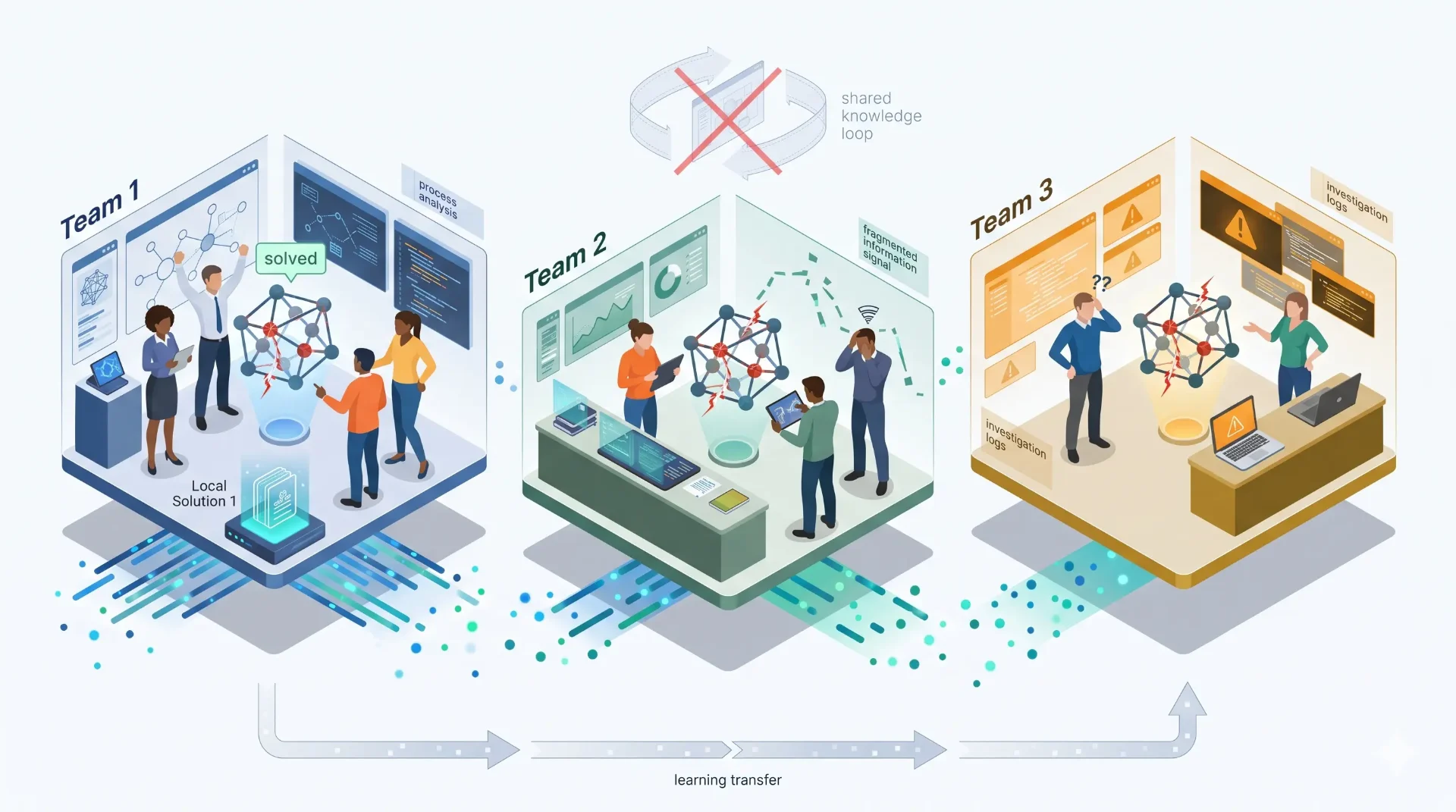
One department solves an issue. Six months later another department encounters something remarkably similar. A year later another site experiences the same thing again.
Everyone involved believes they are solving a new problem. In reality, the organisation is repeatedly paying for the same lesson.
One of the simplest tests of organisational learning is whether knowledge travels further than the people who discovered it and becomes embedded into the management system.
3. Your best problem solvers never seem to get any quieter
Every operation has people who get called when things go wrong. They know the process, understand the equipment and have seen enough history to recognise patterns.
The interesting question is whether their workload decreases over time.
If the same individuals remain responsible for solving the same categories of issues year after year, the organisation may be developing dependence rather than capability. Knowledge is staying with the experts instead of becoming embedded into standard work and becoming part of the management system.
4. The same discussions keep appearing in meetings
Pay attention to your tier meetings, production reviews and operational leadership meetings.
If you've had essentially the same conversation three or four times in the last year, there's a fair chance the organisation hasn't learned nearly as much as it thinks it has.
The wording changes. The examples change. The frustration remains remarkably familiar.
Repeated conversations are often one of the earliest indicators that continuous improvement has stalled.
5. New managers inherit old problems
This one is surprisingly common.
A new supervisor arrives and encounters the same challenges as the previous supervisor. A new manager inherits exactly the same recurring issues that frustrated their predecessor. Eventually the conversation shifts toward the individual rather than the system.
Sometimes leadership capability is the issue.
More often the issue has been sitting quietly inside the operation for years waiting for the next person to discover it.
If changing people doesn't change outcomes, the problem may not be the people…
6. Performance improves when attention arrives and declines when it leaves
Most organisations can improve almost anything temporarily.
A customer visit is approaching. An audit is scheduled. Senior management takes an interest. Suddenly standards improve, actions get completed and performance lifts.
Then attention moves elsewhere and old behaviours quietly return. That's not improvement, that's supervision.
Real improvement survives the withdrawal of management attention and becomes embedded into standard work.
7. Nobody can clearly explain what was learned
This is probably the simplest test of all.
After a significant issue has been resolved, ask a straightforward question. What did we learn?
Not what action was completed. Not who owns the follow-up. What did the organisation actually learn?
Can it be clearly explained? Has it been shared? Has it changed the way people work? Has it been incorporated into standard work, training or management systems?
Many organisations are much better at documenting activity than capturing learning.
The Real Problem
Looking across these seven signs, a common theme emerges.
Most recurring problems are not technical failures. They are failures of organisational learning. The machine breakdown, quality issue, customer complaint or safety incident is simply the visible part. The invisible part is the organisation's inability to retain and spread what it learned from the experience.
This is why some businesses seem to improve steadily while others remain trapped in cycles of recurring frustration. The difference is not that one experiences fewer problems. The difference is that one extracts more value from the problems it experiences.
I've become increasingly convinced that operational excellence is not really about becoming better at solving problems. Most organisations are already reasonably competent at that. It is about turning problem solving, root cause analysis and corrective action into continuous improvement and ensuring the organisation only needs to solve the problem once.
The real challenge is building an organisation that only needs to solve the problem once. That is where sustainable operational excellence starts.
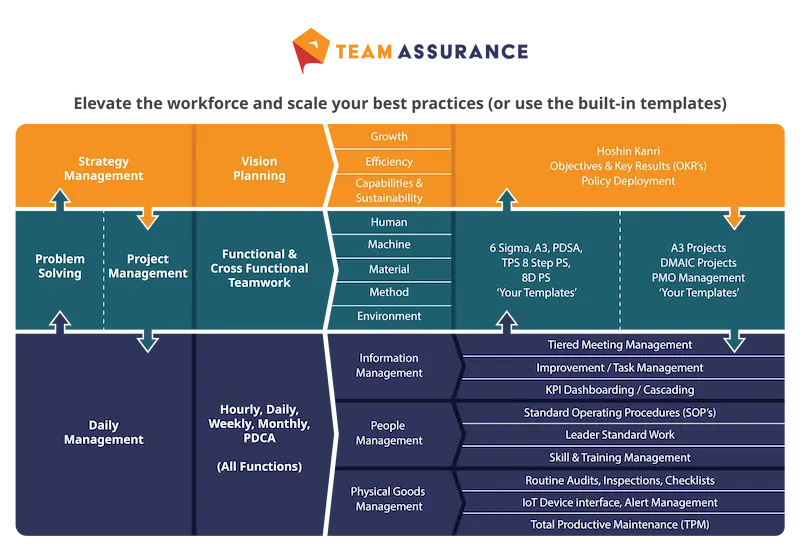
The TeamAssurance Operational Excellence Framework below illustrates how structured problem solving, root cause analysis and continuous improvement are connected within a single management system. By capturing organisational learning and embedding it into standard work, organisations can solve problems once, prevent recurring issues and drive sustainable operational excellence.
Ready to stop solving the same problems over and over? Book a demo to see how TeamAssurance helps organisations connect problem solving and continuous improvement into one integrated Operational Excellence platform.