
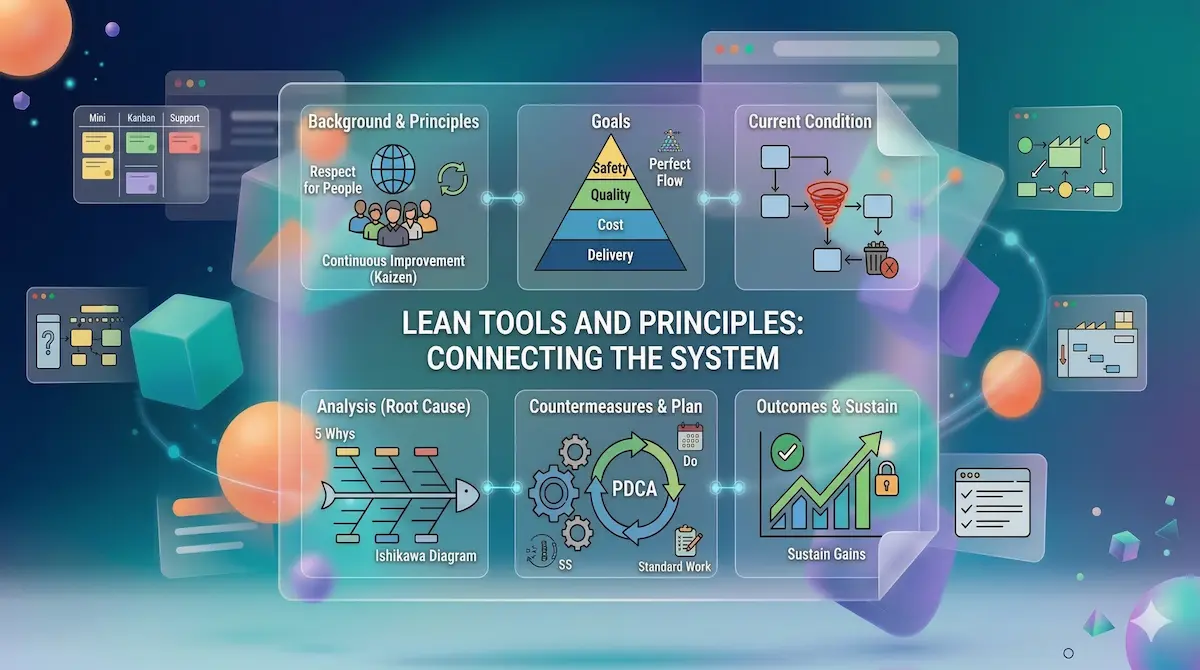
A3 is a one-page problem solving report, developed at Toyota, that tells the whole story of a problem on a single sheet of A3 paper (297 × 420 mm, or 11.7 × 16.5 inches). Also called the A3 format, an A3 report or an A3 analysis, it reads left to right through seven sections: background, current condition, target, root causes, countermeasures, plan and follow-up, following the PDCA cycle.
The single page forces clear thinking and makes the reasoning easy to review. A3 thinking, the heart of the lean A3 methodology, is the scientific, PDCA-based way of thinking behind the page: facts from the gemba, root causes verified before solutions, and agreement built by sharing drafts. This guide walks through the lean A3 format section by section, with a worked example and a comparison with 8D and DMAIC.
Updated in November 2026 by the TeamAssurance team, including what A3 means, what A3 thinking is, what A3 problem solving is and when to use it, the A3 method step by step, how to do an A3 analysis, A3 continuous improvement and sources.
The A3 format at a glance
- Meaning: "A3" is the paper size, not an acronym. In lean it means the one-page report and the A3 thinking behind it.
- Paper size: A3 is 297 × 420 mm (11.7 × 16.5 inches), twice the size of A4 and close to US tabloid (11 × 17 inches).
- Origin: Toyota, where one-page reports were used to propose, solve and report on problems.
- Layout: the left side is Plan (background, current condition, target, root causes); the right side is Do, Check and Act (countermeasures, implementation plan, follow-up), following PDCA.
- Sections: usually seven, plus a title, an owner and a date.
- Used for: problem solving, continuous improvement, improvement proposals, status reports and strategy (planning) A3s.
What Does A3 Mean?
A3 means a one-page problem solving report used in lean management. The name comes from the A3 sheet of paper (297 × 420 mm) it is written on, so A3 is a paper size, not an acronym. In lean, the meaning of A3 covers both the single-page report and the A3 thinking behind it: facts first, causes before solutions.
The same page is used to solve a problem, propose a change or plan strategy. When someone at Toyota asks you to "write an A3", they mean: put the problem, the evidence, the causes and the plan on one page so others can review the thinking.
The term is used in four connected ways:
- A3 paper: the ISO 216 sheet, 297 × 420 mm.
- A3 report: the one-page document itself, also called the A3 format or simply "an A3".
- A3 problem solving: the seven-step process the report follows, from background to follow-up.
- A3 thinking: the mindset behind it: facts from the gemba, causes before solutions, and agreement through shared drafts.
What Is the A3 Format?
The A3 format is a one-page problem solving report, named after the international paper size it was first written on. Toyota used it to propose, solve and report on problems, and the lean A3 spread with lean management to manufacturers and operations around the world. You will also see it called an A3 report, a lean A3 or simply "an A3". For a one-minute definition, see What is an A3 report?
The A3 follows the PDCA cycle. The left side of the page is Plan: background, current condition, target and root causes. The right side covers Do, Check and Act: countermeasures, the implementation plan and follow-up. Read from top left to bottom right, it tells the story of a problem in the order the thinking happened.
If you want a blank layout to work from, download our free A3 problem solving template, which has prompts for each of the seven sections described below.
What Is A3 Thinking?
A3 thinking is the structured, scientific way of solving problems that sits behind the one-page A3 report. Developed at Toyota, it follows the PDCA cycle: go to the gemba for facts, define the gap to a target, verify root causes before choosing countermeasures, and build agreement by sharing drafts, so each A3 develops people as well as solving problems.
The term comes from Toyota, where managers developed problem solvers by coaching them through A3 reports. It was popularised outside Toyota by Durward Sobek and Art Smalley's Understanding A3 Thinking and John Shook's Managing to Learn (see Sources). The report is only the visible output: the thinking is what builds a culture of problem solvers.
What Are the Principles of A3 Thinking?
A3 thinking rests on five habits:
- Going to the gemba. Facts about the current condition come from the place where the work happens, not from a meeting room.
- Understanding before solving. Most of the effort goes into the left side of the page. Countermeasures come only after causes are verified.
- Being concise. One page forces you to decide what matters. If it doesn't fit, you probably don't understand the problem well enough yet.
- Building agreement. The author shares drafts with the people affected, and the A3 improves with each conversation.
- Learning by doing. A mentor coaches the author with questions, so the A3 develops the person as well as solving the problem.
What Is the Difference Between A3 Thinking and the A3 Report?
The A3 report is the document. A3 thinking is the discipline that produces it. The difference matters, because many organisations adopt the form and miss the point. A filled-in template written alone at a desk, with solutions decided in advance, is an A3 report without A3 thinking. It rarely changes much.
What Is A3 Problem Solving?
A3 problem solving is a lean, PDCA-based approach to solving a workplace problem on a single sheet of A3 paper. The owner works from background and current condition to verified root causes, countermeasures and follow-up, coached by a mentor, so the problem is fixed at its cause and the reasoning can be reviewed at a glance.
Where the A3 method below sets out the seven steps, A3 problem solving is the wider practice around them: choosing which problems deserve an A3, giving each one an owner and a mentor, and reviewing the finished page with the people affected. The A3 report is the record it leaves behind, and the free A3 problem solving template gives you the page to start from.
When Should You Use A3 Problem Solving?
Use an A3 when the problem is:
- Recurring. It has come back after quick fixes, a sign the root cause hasn't been found. See 7 signs your problems are repeating.
- Worth a few weeks of effort. It affects safety, quality, delivery or cost enough to justify collecting data and checking the result later.
- Not obvious. The cause is unknown or disputed. If the cause and the fix are already clear, just make the fix and record it.
- Small enough for one owner. One person can lead it in days or weeks and talk to everyone affected. A problem that needs a whole programme is usually several A3s.
Customer complaints that need formal containment and a report usually suit 8D, and complex, variation-driven problems with plenty of data suit DMAIC. The comparison table further down shows the differences.
What Are the Benefits of A3 Problem Solving?
- Problems stay solved. Countermeasures target verified root causes, and the follow-up check and updated standard stop the problem coming back.
- Shared understanding. One page read left to right lets anyone see the problem, the evidence and the plan in a few minutes.
- Agreement before action. Sharing drafts with the people affected means the plan has support before it starts.
- Better problem solvers. Mentor coaching develops the author's thinking with every A3, which builds problem solving skill across the team.
- Less money spent on the wrong fix. Understanding the process first often avoids buying a solution, as the worked example below shows.
What Is the A3 Method?
The A3 method, also called the A3 methodology or lean A3 methodology, is Toyota's structured approach to solving a problem on one sheet of A3 paper. It follows the PDCA cycle in seven steps: clarify the background, grasp the current condition, set a target, find and verify root causes, choose countermeasures, plan the work and follow up on results.
The A3 format is the page and A3 thinking is the mindset; the A3 method is the sequence of steps that fills the page, in the order the thinking happens. Each step is reviewed with a mentor before the next one starts, so the method builds problem solving skill as well as fixing the problem.
What Are the Steps of the Lean A3 Methodology?
- Clarify the problem and background. Agree why the problem matters now, who owns the A3 and which goal it affects, and write the problem in one sentence with no solution in it.
- Grasp the current condition. Go to the gemba, collect data and show the gap between what is happening and what should happen, in numbers.
- Set the target condition. State a measurable target with a date, so the result can be checked later.
- Find and verify the root causes. Narrow the problem down, explore causes with a fishbone diagram and the 5 whys, and confirm them with data or a trial. This is the A3 analysis described in the next section.
- Choose countermeasures. Pick one or more countermeasures for each verified root cause, and treat each one as a hypothesis to be tested.
- Agree the implementation plan. Give each action an owner and a due date, and share the draft with the people affected (nemawashi) until there is agreement.
- Check results and follow up. Compare results with the target, update the standard so the problem stays solved, and share what worked with other areas (yokoten).
Steps 1 to 4 are the Plan step of PDCA and fill the left side of the page; steps 5 to 7 cover Do, Check and Act on the right. If a later step shows the thinking was wrong, such as results that miss the target, the team goes back a step rather than forcing the plan through. The free A3 problem solving template has a box for each step.
What Is A3 Analysis?
A3 analysis is the fact-finding half of A3 problem solving: showing the current condition with data, measuring the gap to a target and verifying the root causes before any countermeasure is chosen. It fills the left side of the A3 page, the Plan step of PDCA, and people also use "A3 analysis" for the whole one-page A3 report.
How to do an A3 analysis:
- Frame the problem. Write one sentence that says what is going wrong, where, and why it matters, with no solution in it.
- Go and see. Observe the work at the gemba (genchi genbutsu) and collect data on how often, where and when the problem happens.
- Show the current condition. Turn the data into a trend chart, a Pareto chart or a simple process sketch, and state the gap to the target in numbers.
- Narrow the problem down. Focus on the biggest contributor, such as one line, one shift or one failure point, before looking for causes.
- Find the root causes. List possible causes with a fishbone diagram, then use the 5 whys to trace each one back to something you can act on.
- Verify the causes. Check each likely cause with data or a trial at the gemba. Only verified causes move to the right side of the page.
A3 analysis is broader than root cause analysis on its own. It places the causes in the context of the background, the current condition and a measurable target, so the countermeasures that follow can be checked against that target. In the worked example below, the A3 analysis is the four weeks of jam logging, the narrowing down to reel changes and the peel plate, and the checks at the line that confirmed two causes.
What Are the 7 Sections of an A3?
An A3 is filled in left to right: understand the problem before planning the fix.
Layouts vary between organisations, but most A3s contain these seven sections, plus a title, an owner and a date.
1. Background
What to write: why this problem matters now and how it connects to the organisation's goals, such as safety, quality, delivery or cost. Keep it to two or three lines a stranger could understand.
Common error: writing the history of the department, or stating the solution here ("we need a new machine").
2. Current Condition
What to write: what is actually happening, shown with facts, data and sketches. A trend chart, a Pareto chart or a simple process sketch is better than paragraphs of text. Quantify the gap in terms of the measure that matters.
Common error: describing the problem from memory or opinion rather than from observation at the gemba and real data.
3. Goal / Target Condition
What to write: what good looks like, as a measurable target with a date, for example "reduce X from 14 to 3 per week by the end of Q1".
Common error: a vague goal ("improve reliability") or a goal that is really an action ("install a sensor").
4. Root Cause Analysis
What to write: why the gap exists. Use root cause analysis tools such as a fishbone diagram to explore possible causes and the 5 whys to follow each one back to something you can act on. Then verify the likely causes at the gemba.
Common error: stopping at the first plausible answer, or blaming people ("operator error") instead of asking why the process allowed the error.
5. Countermeasures
What to write: what you will change to address each verified root cause. Lean practice says "countermeasure" rather than "solution" because each change is a hypothesis to be tested.
Common error: countermeasures that don't trace back to a root cause, or a list of generic actions such as "retrain staff" and "remind team".
6. Implementation Plan
What to write: who does what, by when. A simple table of actions, owners and due dates is enough, with any checkpoints for measuring progress.
Common error: actions owned by "the team" or with no dates, so nothing has a clear owner and nothing is late.
7. Follow-Up
What to write: whether it worked. Compare results against the target, record what you will standardise, and note what you will adjust or share with other areas.
Common error: closing the A3 as soon as the actions are done, without checking results over time or updating the standard work so the problem doesn't return.
What Is an A3 Example? A Worked A3 for Recurring Labeller Jams
An A3 example is a completed one-page A3 report that shows all seven sections filled in for a real-style problem: background, current condition, target, root causes, countermeasures, plan and follow-up. The A3 example below follows a recurring labeller jam on a packing line from 14 jams a week to 3, and you can copy its layout for your own A3.
Use this A3 example as a model for how much to write in each box: short, factual and measurable, with the reasoning readable left to right in a few minutes.
The example is illustrative: the line, the numbers and the causes are invented to show how an A3 reads.
Background. The labeller on packing Line 3 jams several times a shift. Each jam stops the line, and mislabelled packs have reached the end-of-line check, putting delivery and customer complaints at risk.
Current condition. The team logged every jam for four weeks. Line 3 averaged 14 jams per week, losing about 6 hours of packing time. Most jams happened in the first hour after a label reel change, and most were at the peel plate.
Goal. Reduce labeller jams on Line 3 from 14 to 3 or fewer per week within 12 weeks, with no mislabelled packs passing the end-of-line check.
Root cause analysis. A fishbone session with operators and maintenance listed possible causes, and the team checked each at the line. Two were confirmed. First, adhesive builds up on the peel plate because cleaning it is not part of any standard. Second, reel changes were done differently by each shift, and web tension was set by feel. A 5 whys on the tension issue showed there was no marked setting and no reel-change standard.
Countermeasures. Add a peel plate clean to the shift start-up checklist. Mark the correct tension setting on the unwind and write a one-page reel-change standard with photos. Train all three shifts on the new standard at the line.
Implementation plan. Each action has a named owner (team leader, maintenance technician or shift supervisors) and a due date over the first four weeks, with a jam count reviewed daily at the team's tier 1 meeting.
Follow-up. After six weeks the illustrative jam count averaged 3 per week. The reel-change standard was added to the line's standard work, the peel plate clean was kept in the start-up checklist, and the A3 was shared with the team leaders on Lines 1 and 2, which use the same labeller.
Notice what the A3 does not say: "buy a new labeller". The problem was solved by understanding the process, not by spending money first.
A3 vs 8D vs DMAIC: Which Should You Use?
The A3 format is one of several structured problem solving methods, alongside 8D and DMAIC. They share the same scientific logic but suit different situations.
| A3 | 8D | DMAIC | |
|---|---|---|---|
| Origin | Toyota and lean management | Automotive industry, widely used for customer complaints | Six Sigma |
| Structure | 7 sections on one page, following PDCA | 8 disciplines, from forming the team to recognising it | 5 phases: Define, Measure, Analyse, Improve, Control |
| Typical use | Everyday operational problems and improvement proposals | Customer or supplier quality issues needing formal containment and reporting | Complex, variation-driven problems needing statistical analysis |
| Typical duration | Days to a few weeks | Weeks, often with a customer deadline | Weeks to months |
| Who runs it | Frontline leaders and teams, coached by a mentor | Cross-functional team, often led by quality | Trained belts with project sponsors |
| Main strength | Clear thinking and shared understanding on one page | Containment and a formal record for customers | Statistical rigour |
Many organisations use all three. A3 is usually the default for day-to-day problems because it is light enough for team leaders to use regularly.
A3 Planning: Proposals and Strategy A3s
The same one-page format is used for more than problems. In A3 planning, a team writes a proposal A3 to make the case for a change before it is approved: background, current situation, the proposal, the analysis behind it, the plan and how success will be checked. Leaders use strategy A3s in the same way to set out an annual plan, the few priorities that matter and how progress will be reviewed, which is how A3s connect to hoshin kanri and its X-matrix.
The discipline is the same as in problem solving. One page, facts before conclusions, and drafts shared with the people affected until there is agreement. A good planning A3 is short enough to read in a few minutes and clear enough that someone who missed the meeting can see what was decided and why.
How Do You Use the Lean A3 Format in Project Reviews?
Lean A3 reports also work well for project reviews, where a team confirms its countermeasures worked, captures what it learned and standardises the change. Slide decks and verbal updates tend to bury the logic, so reviewers can't see how conclusions were reached and follow-up actions get lost. Because every A3 tells the same left-to-right story, reviewers know where to look.
A practical way to run an A3 review:
- Prepare the A3. The team updates it beforehand with current results and any changes made during implementation.
- Present the story. Walk through it from left to right: why the problem mattered, what the data showed, which root causes were found and how, what changed and what resulted.
- Ask questions, don't lecture. The reviewer's job is to develop the team's thinking, not to redo its work.
- Capture actions and lessons. Record follow-up actions and lessons on the A3 itself or in your daily management system, so they are tracked rather than forgotten.
As the number of A3s grows, a calendar view of A3 activities and review dates helps keep reviews from slipping.
How Do You Coach an A3?
In Toyota's approach, an A3 author typically has a mentor, usually their manager or an experienced problem solver. The mentor doesn't write the A3 or supply the answer. They ask questions that expose gaps in the thinking, and the author goes back to the gemba to find out.
Good coaching questions include:
- What is the problem, in one sentence?
- How do you know? What data or observation supports that?
- Have you seen this happen yourself?
- What is the gap between the current condition and the target?
- How did you confirm this is the root cause, and not just a symptom?
- How does this countermeasure address that cause?
- How will we know if it worked?
- What will you standardise, and who else should learn from this?
Keep coaching sessions short and frequent. Fifteen minutes at the A3 every few days does more than one long review at the end.
What Is A3 Continuous Improvement?
A3 continuous improvement is the use of Toyota's one-page A3 report to drive ongoing, step-by-step improvement through the PDCA cycle. Each A3 tackles one problem or gap, verifies its root causes, tests countermeasures and standardises what works, so every completed A3 raises the baseline for the next round of improvement and builds problem solving skill across the team.
A3 is one of the core methods in a continuous improvement system, alongside kaizen ideas, kaizen events and DMAIC. Small, obvious fixes can go straight onto a tier board and be done; problems that are recurring, unclear or worth a few weeks of effort get an A3.
How Does A3 Drive Continuous Improvement?
A3 drives continuous improvement by turning each problem into one complete PDCA cycle and then making the result the new standard. The cycle repeats:
- Spot the gap. A red measure on a tier board, a recurring defect or a missed target shows where performance falls short.
- Run the A3. The owner works through the seven steps of the A3 method, from current condition to verified root causes and countermeasures, coached by a mentor.
- Check the result. Results are compared with the target. If the target is missed, the team goes back to the analysis rather than closing the A3.
- Standardise the gain. What worked goes into standard work, so the improvement holds and becomes the new baseline.
- Share it and raise the bar. The A3 is shared with similar areas (yokoten), and the next gap becomes the next A3.
What Is the Difference Between A3 and Kaizen?
Kaizen is the philosophy of continuous improvement through many small changes, often made by frontline teams in hours or days. An A3 is a structured method for one problem that needs more investigation, usually over days to weeks. Both follow PDCA, and a kaizen event often uses an A3 to record the problem, the analysis and the results.
What Are Examples of A3 Continuous Improvement?
Typical A3 continuous improvement projects in operations include:
- Stopping a recurring machine stoppage, such as the labeller jams in the worked example above.
- Cutting changeover time on a bottleneck line.
- Lowering a defect or rework rate traced to an unclear standard.
- Reducing near misses at a busy loading dock.
- Improving on-time completion of preventive maintenance.
Each one has a measurable target, verified causes and a follow-up check, so the gain can be standardised and shared. Our free A3 problem solving template gives you the page to start one.
How Do You Keep A3s Visible? Link Them to Tier Meetings
The most common reason A3s fail is not poor analysis. It is that they are written, filed and forgotten. Actions slip, nobody checks the results, and the same problem comes back months later.
The fix is to run A3 work through the routines that already run the operation:
- Tier 1. In daily tier meetings, the team reviews the measure the A3 is targeting, such as jams per shift, alongside safety and output. New problems are raised and the bigger ones become A3s.
- Tier 2 and Tier 3. Supervisors and managers check that A3 actions are on time and remove obstacles when they are not. Overdue actions and reviews are visible, not hidden in a folder.
- Monthly reviews. Leaders review the larger A3s that support strategic goals. Linking A3s to goals through hoshin kanri shows how problem solving on the shop floor contributes to the organisation's priorities.
This is how A3 problem solving becomes part of tiered daily management and wider continuous improvement, rather than a separate activity done when someone has time.
How TeamAssurance Supports A3 Problem Solving
TeamAssurance includes A3 problem solving as a structured method that follows the A3 format: problem statement, current state, root cause analysis, target state, countermeasures and implementation plan. A3 projects can be linked to goals for larger improvement initiatives, and progress is tracked through tiered daily management, so A3s stay visible after they are written.
Frequently Asked Questions About A3, A3 Problem Solving, A3 Thinking, the A3 Format and Continuous Improvement
What is A3?
A3 is a one-page problem solving report from Toyota, named after the A3 paper (297 × 420 mm) it is written on. It tells the story of a problem from background and current condition through root causes and countermeasures to follow-up, following the PDCA cycle, so the reasoning can be reviewed on a single sheet.
What is A3 thinking?
A3 thinking is the structured, scientific way of solving problems behind the one-page A3 report. Developed at Toyota, it follows PDCA: get facts at the gemba, define the gap to a target, verify root causes before choosing countermeasures, and share drafts to build agreement. A mentor coaches the author, so each A3 develops people as well as solving problems.
What is the difference between A3 thinking and an A3 report?
The A3 report is the one-page document; A3 thinking is the discipline that produces it: facts from the gemba, causes verified before solutions and agreement built through shared drafts. A template filled in alone at a desk, with the answer decided in advance, has the A3 format without the A3 thinking.
What does A3 mean?
A3 means the one-page problem solving report used in lean, named after the A3 paper (297 × 420 mm) it is written on. A3 is not an acronym and does not stand for anything. Depending on context it can mean the paper size, the report itself ("an A3"), the seven-step A3 problem solving process or A3 thinking.
What is an A3 report?
An A3 report is the one-page document a team writes when it uses A3 problem solving: background, current condition, target, root causes, countermeasures, plan and follow-up, plus an owner and a date. "A3 report", "A3 format" and "an A3" all mean the same page. See the short glossary definition.
What is A3 problem solving?
A3 problem solving is a lean method for solving a workplace problem on one sheet of A3 paper. Following PDCA, the owner records the background, current condition, target and verified root causes, then countermeasures, a plan and follow-up. A mentor coaches the thinking, so the problem is fixed at its cause and the team builds problem solving skill.
When should you use A3 problem solving?
Use A3 problem solving for a recurring or unclear problem that matters to safety, quality, delivery or cost and is worth a few weeks of structured effort. If the cause and fix are already obvious, just make the fix. Customer complaints needing formal containment usually suit 8D, and complex, data-heavy problems suit DMAIC.
What are the benefits of A3 problem solving?
A3 problem solving fixes problems at their verified root cause, so they stay solved. The single page gives everyone a shared view of the problem, the evidence and the plan, sharing drafts builds agreement before action, and mentor coaching develops better problem solvers with every A3.
What is an example of A3 problem solving?
A common example is a recurring machine stoppage. In this guide's illustrative example, a packing line labeller jammed 14 times a week. Four weeks of jam logging and checks at the line found adhesive build-up and inconsistent reel changes; a peel plate clean and a reel-change standard brought jams down to 3 a week.
What is the A3 method?
The A3 method, also called the A3 methodology, is Toyota's structured way of solving a problem on one sheet of A3 paper. It follows PDCA through seven steps: background, current condition, target, verified root causes, countermeasures, an implementation plan and follow-up. A mentor reviews each step, so the method develops problem solvers as well as fixing problems.
What are the steps of the lean A3 methodology?
The lean A3 methodology has seven steps: clarify the problem and background, grasp the current condition at the gemba, set a measurable target, find and verify root causes, choose countermeasures, agree an implementation plan with owners and dates, then check results and follow up by standardising what worked and sharing it with other areas.
Is the A3 method the same as PDCA?
The A3 method is built on PDCA but is not the same thing. PDCA is the general Plan-Do-Check-Act improvement cycle; the A3 method applies it to one problem on one page. The first four A3 steps are Plan, and countermeasures, the implementation plan and follow-up cover Do, Check and Act.
What is A3 analysis?
A3 analysis is the left side of an A3: the current condition shown with data, the gap to a measurable target and the root causes, each verified at the gemba before countermeasures are chosen. It is the Plan step of PDCA, and the term is also used for the whole one-page A3 report.
What is the A3 format?
The A3 format is a one-page report that tells the story of a problem from background to follow-up on a single sheet of A3 paper. It follows the PDCA cycle through seven sections: background, current condition, goal, root cause analysis, countermeasures, implementation plan and follow-up. Toyota developed it so a problem could be understood and reviewed quickly.
What size is A3 paper?
A3 paper is 297 × 420 mm, or about 11.7 × 16.5 inches: the ISO 216 size that is twice A4 and close to US tabloid (11 × 17 inches). The one-sheet limit is deliberate. It forces the author to be concise and to show only the facts and reasoning that matter.
What are the sections of an A3?
Most A3s have seven sections: background, current condition, goal or target condition, root cause analysis, countermeasures, implementation plan and follow-up, plus a title, owner and date. The left side covers the problem and its causes; the right side covers the plan and the results. Our free A3 problem solving template has prompts for each section.
What is the A3 format used for?
The A3 format is used for structured problem solving, improvement proposals, project status reports and strategy (hoshin) planning. In lean organisations, team leaders use it for everyday operational problems, while managers write proposal and strategy A3s to make the case for a change and to review progress against annual goals.
What is the lean A3 format?
The lean A3 format is the same one-page report used as part of lean management: a problem or proposal told left to right through PDCA, with facts from the gemba, verified root causes and tested countermeasures. In lean, the A3 is also a coaching tool, so a mentor reviews the thinking as well as the result.
What is A3 continuous improvement?
A3 continuous improvement is the use of Toyota's one-page A3 report to drive ongoing, step-by-step improvement through the PDCA cycle. Each A3 tackles one problem or gap, verifies its root causes, tests countermeasures and standardises what works, so every completed A3 raises the baseline for the next round of improvement and builds problem solving skill across the team.
How does A3 support continuous improvement?
A3 supports continuous improvement by running each problem through a full PDCA cycle on one page: grasp the current condition, verify root causes, test countermeasures, check results against a target and standardise what worked. Each finished A3 becomes the new baseline and is shared with similar areas, so improvement builds step by step instead of stopping after one fix.
What is the difference between A3 and kaizen?
Kaizen is the philosophy of continuous improvement through many small changes, often made by frontline teams in hours or days. An A3 is a structured, one-page method for a single problem that needs more investigation, usually over days to weeks. Both follow PDCA, and a kaizen event often uses an A3 to record the analysis and results.
How long does an A3 take?
It depends on the problem. A focused operational problem might take a few days to a few weeks from first draft to verified results. Larger, cross-functional problems can run for several months. If an A3 has stalled for weeks with no progress, the scope is usually too broad.
Sources
- John Shook, Managing to Learn: Using the A3 Management Process to Solve Problems, Gain Agreement, Mentor and Lead, Lean Enterprise Institute, 2008.
- Durward K. Sobek II and Art Smalley, Understanding A3 Thinking: A Critical Component of Toyota's PDCA Management System, Productivity Press, 2008.
- Lean Enterprise Institute, "A3 Report", Lean Lexicon, 5th edition, 2014.
Want to see how TeamAssurance keeps A3 problem solving visible through daily tier meetings? Book a demo.