
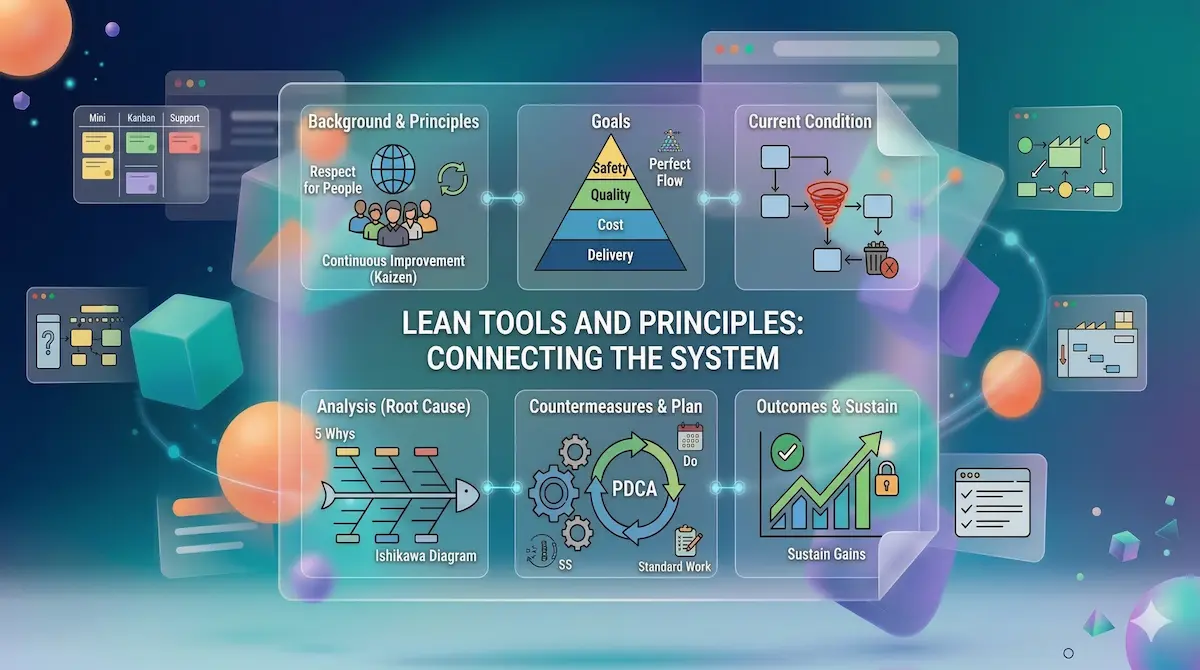
Simple structured problem solving follows four steps: assemble a small team of the people closest to the process, identify possible causes, determine the root causes with tools such as the 5 whys or a fishbone diagram, then prioritise and investigate the countermeasures. The aim is for everyone, not only specialists, to be able to run it.
At a glance
- Four steps: assemble a team, identify possible causes, determine root causes, then prioritise and investigate countermeasures.
- Tools: an Ishikawa (fishbone) diagram for possible causes and the 5 whys for root causes.
- Who: the people who do the work where the problem occurs, plus someone from the process before or after it.
- Related: what are the 5 whys? and what is a fishbone diagram?.
Imagine every person in your organization has '…and continuous improvement specialist' in their job title. That's what you're aiming for with lean transformation. It means investing in your people and as a result you'll build resilience into your process improvement system.
A simple and effective starting point is basic problem-solving skills, and incidents are a natural opportunity to develop these skills. Before an incident occurs, each team member should understand the trigger to investigate. Once that is established, team members should be equipped to respond.
Who should you assemble for process improvement?
The first step, once the incident is under control, is to assemble a cross-functional team of individuals. For example: a team leader, a team member plus representatives from Quality and Maintenance. Each person brings different perspectives and experience.
How do you identify possible causes?
A fishbone keeps the team listing causes before it jumps to a fix.
An Ishikawa diagram (also known as a fishbone diagram) is useful for determining possible contributing factors. The causes are typically categorized as Machine, Method and Material, Measurement and Person. Everyone should be encouraged to participate.
How do you determine root causes?
Circle the most likely contributing factors and perform a 5 Why Analysis for each. This really is as simple as it sounds. Ask 'Why?' and after each answer ask 'Why?' again, until you've exhausted the possibilities.
How do you prioritise and investigate?
After completing all the 5 Whys and identifying the root causes, you need to follow up with actions. The aim is to prevent the incident ever occurring again. With that in mind, it may require:
- Actions – to confirm a hypothesis or perform further investigation
- One Point Lesson – to educate team members about best practice
- Improvement – that could help avoid the situation altogether
- Checklist – for a routine inspection or preventative maintenance
- A3 report – for deeper analysis, investigation and resolution
Frequently asked questions about problem solving and process improvement
What is the simplest problem-solving method?
Define the problem in one sentence with a measure, ask why until you reach a cause you can act on (the 5 whys), make the change, and check the measure. Most everyday problems need no more; chronic or cross-functional ones move to an A3.
Who should be on a problem-solving team?
The people who do the work where the problem occurs, someone from the process before or after it, and a specialist (maintenance, quality, engineering) when the cause is likely technical. Keep it to four to six people.
How do you know you have found the root cause?
When removing it stops the problem recurring, which is why the countermeasure is verified against the measure before the problem is closed. If the problem returns, the cause was a symptom.
Why is problem solving part of a greater framework?
Lean tools like standardised problem solving techniques, Standard Operating Procedures (SOPs), and a Tiered Daily Management process that supports the entire PDCA loop are key to achieving continuous improvement success.
TeamAssurance is an Operational Excellence platform that helps teams with process improvement. If you're a business in need contact us for a demonstration today.