
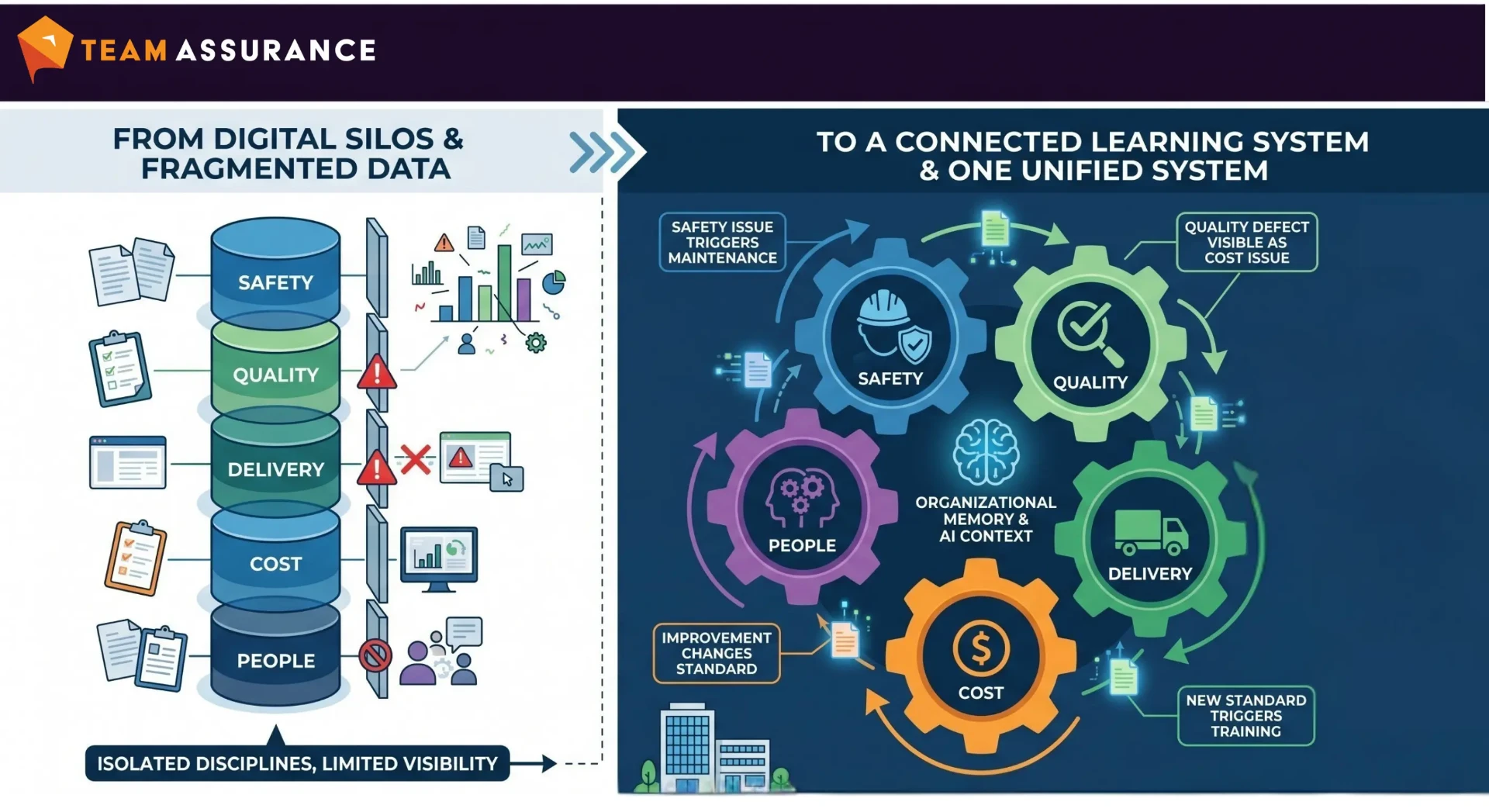
Factories have spent the last twenty years buying software one problem at a time.
Safety needed better inspections, so a safety system arrived. Quality needed better non-conformance management, so another system arrived. Maintenance needed work orders, so the CMMS went in. Production got dashboards, HR got people systems, continuous improvement got another platform, actions ended up somewhere else, and management meetings continued to rely on PowerPoint, spreadsheets and people remembering what happened last month.
Every decision made sense at the time but the combined result often makes considerably less sense.
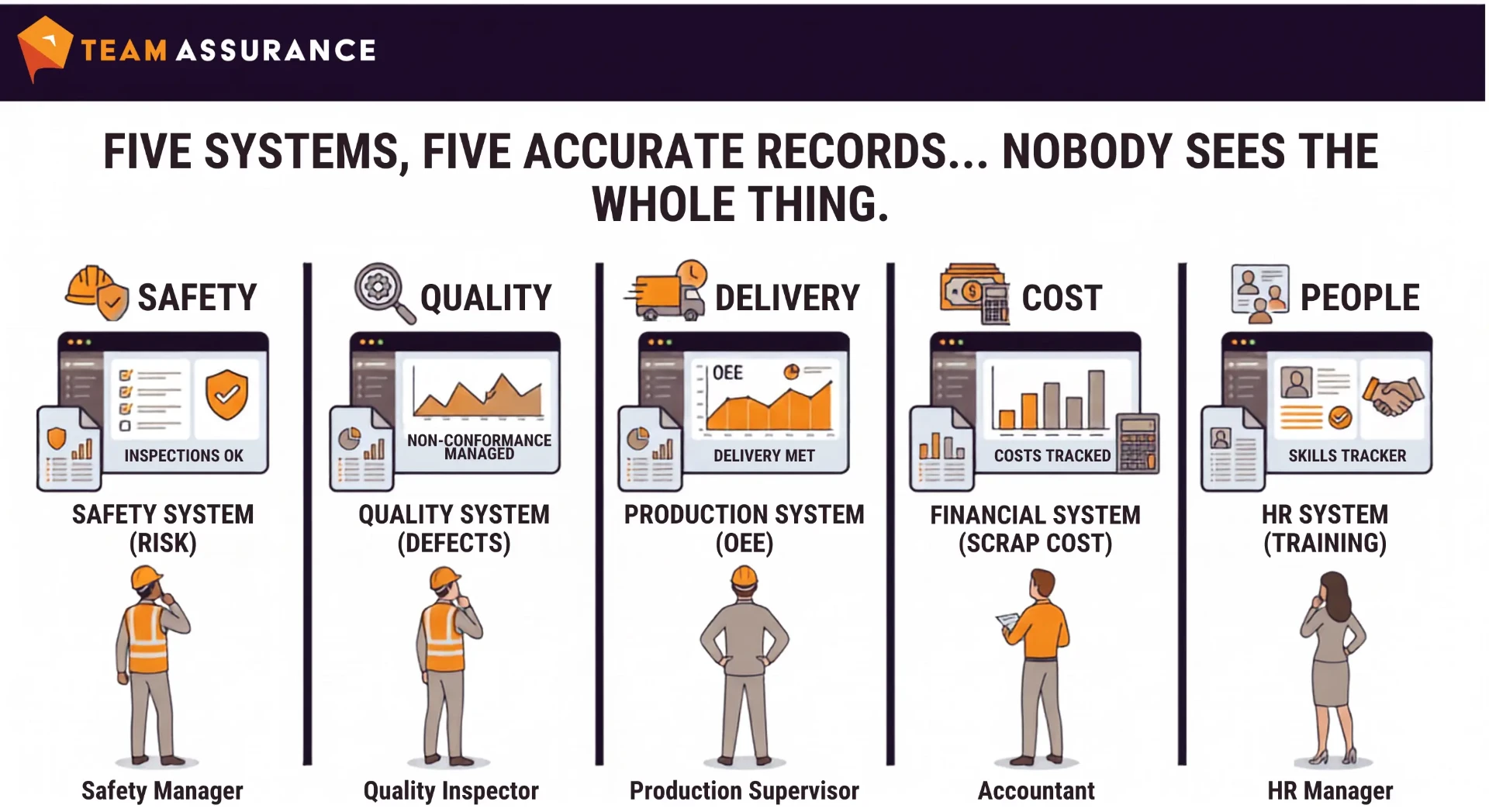
A modern factory can have excellent systems for individual functions and still have a surprisingly poor operating system for the factory as a whole. Each silo becomes better at recording and managing its own information while the relationships between Safety, Quality, Delivery, Cost and People remain largely dependent on humans joining the dots whilst maintaining an amicable working relationship.
That matters because of course the operation itself does not operate in silos.
A machine does not know whether the problem it has just created belongs to Safety, Quality, Delivery or Cost. An operator does not suddenly become a different person because the conversation has moved from productivity to ergonomics. A poorly informed team can create quality problems, safety exposures and delivery losses all at the same time.
While the condition exists in the work, we are the ones who decide which department owns it.
Consider a worn machine component. Maintenance notices the vibration first. Eventually it starts affecting product quality. An operator compensates by changing the way the machine is run, creating additional manual handling. The line slows down, output falls, overtime increases and the supervisor spends the next three shifts fighting the consequences.
Safety sees one part of that story. Quality sees another. Production sees delivery. Finance eventually sees cost. The supervisor sees people struggling with all of it.
Five systems can record five perfectly accurate versions of the same event while nobody necessarily sees the whole thing.
The Trouble With Optimising a Silo
There is nothing inherently wrong with specialist software. Point solutions can be very good at what they do. A dedicated safety platform might make inspections easier. A quality system might improve CAPA administration. An MES might give production excellent performance data. A CMMS might schedule maintenance brilliantly.
The difficulty begins when improving the administration of one function is mistaken for improving the operating system of the factory.
You can make safety reporting faster while Safety remains disconnected from daily management. You can digitise quality audits beautifully while the same defect keeps appearing at shift meetings for six months. You can produce extraordinary OEE dashboards while nobody owns the recurring losses they expose. You can improve labour reporting while the underlying capability gap causing poor performance goes untouched.
The silo has been optimised. The factory has not necessarily improved.
In some cases, digitisation actually makes the silo stronger. Information becomes easier to capture, dashboards become prettier and workflows become more disciplined, but the walls between functions remain exactly where they were.
That is particularly awkward because most meaningful operational problems eventually cross those walls.
A safety observation may require a maintenance response. A quality defect may expose a skills gap. A delivery miss may lead back to an equipment condition. A cost increase may be driven by rework. A people issue may actually be badly designed standard work. A recurring production loss may eventually become all five.
The work moves sideways even when the software does not.
This is why I think the more useful design question is becoming: what should the factory learn from this?
Once you ask that, the architecture starts to look different.
SQDCP Is Already the Management System
Most factories already have some version of Safety, Quality, Delivery, Cost and People sitting at the centre of daily management.
There is a good reason for that. SQDCP reflects how operations are actually run. Leaders may have specialist functional responsibilities, but the factory ultimately needs to produce a safe, good-quality product, when the customer needs it, at the right cost, with capable people.
None of those things operates independently.
If equipment reliability deteriorates, Delivery suffers. If people are poorly trained, Quality and Safety generally follow. If defects create excessive rework, Cost rises and Delivery deteriorates. If a safety countermeasure makes a difficult task easier and more stable, productivity may improve as well. If absenteeism increases, skills gaps may appear, workload changes and the remaining four measures can all move with it.
The management system already understands these relationships.
Our software architecture often does not.
A consolidated SQDCP platform gives the operation a common place where abnormalities can enter the same management rhythm, regardless of which functional label eventually gets attached to them. Safety still retains the investigation, confidentiality and governance it requires. Quality still has the appropriate controls around non-conformances and corrective actions. Delivery still needs production information. Cost still needs financial and loss data. People still needs appropriate controls and permissions.
The point is not to make everything identical.
The point is to stop everything disappearing into separate universes.
One Problem Can Have Several Lives
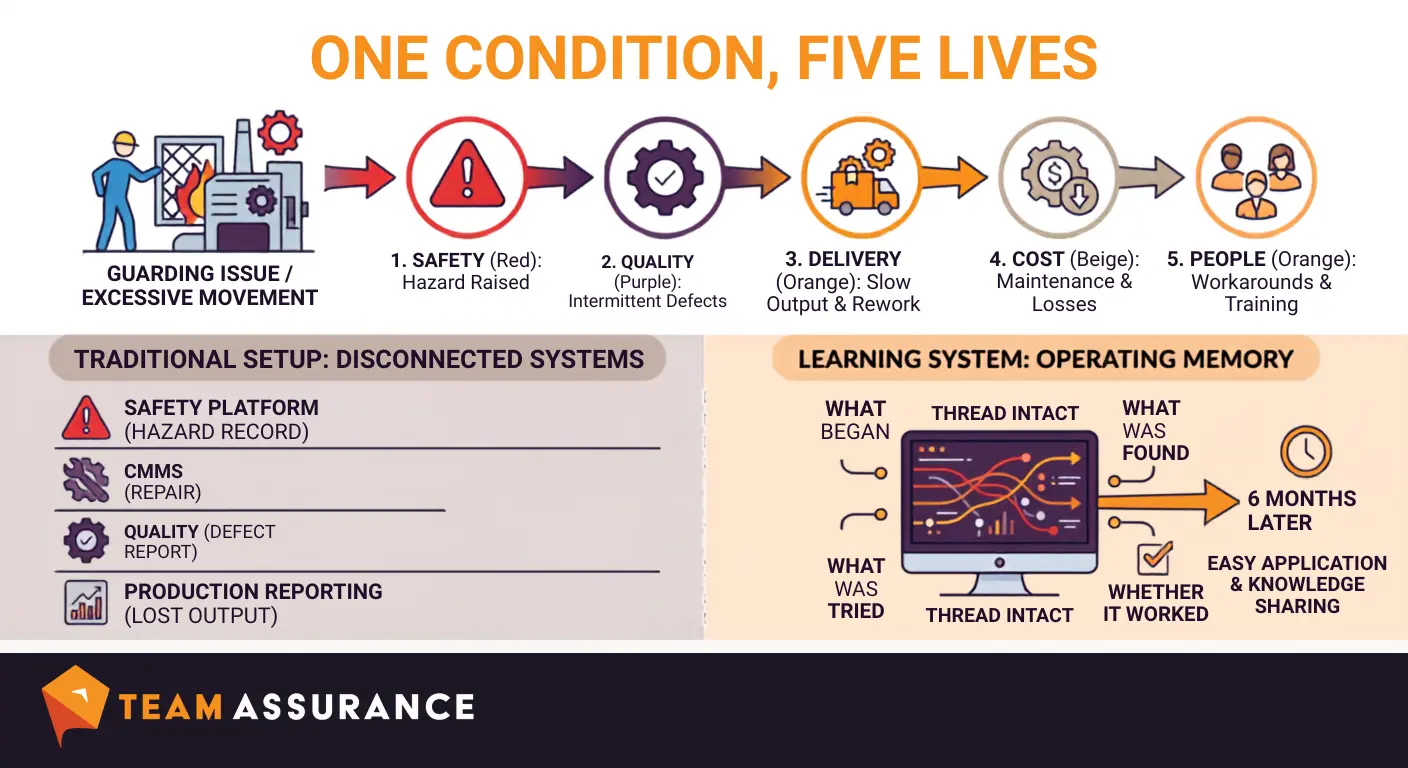 Consider a recurring machine guarding issue.
An operator raises a safety concern during the shift. The immediate risk is controlled and an action is assigned. Maintenance discovers excessive movement in part of the equipment. Investigation shows the same movement is also causing intermittent product defects. Those defects are producing rework and slowing output. Operators have developed their own workaround to keep production going, and the workaround itself requires additional training and manual intervention.
One condition has now touched Safety, Quality, Delivery, Cost and People.
In a traditional point-solution environment, pieces of that story may exist in five or six systems. The safety platform contains the hazard. The CMMS contains the repair. The quality system contains the defect. Production reporting contains the lost output. Cost appears somewhere downstream. The training system contains the revised instruction. The daily management board contains an action saying somebody is looking into it.
Every record can be correct while the organisation loses the thread.
A learning system keeps that thread intact. People can see where the issue began, what conditions were discovered, what impact it had, what actions were taken, what standards changed and whether the final countermeasure actually worked.
Six months later, if the same condition appears on another line or at another factory, the organisation does not have to rediscover the entire story.
That is when the platform becomes more than workflow software.
It becomes operating memory.
Safety Should Feed the Learning System
There has been an enormous amount of investment in making hazards, observations, incidents and inspections easier to report. That is worthwhile. A system that people refuse to use is not much of a system.
Reporting, however, is only the beginning.
What happened afterwards? Was the condition understood? Who owned the response? Did the issue escalate? Was the countermeasure completed? Was it verified? Did the standard change? Did training change? Has the same hazard appeared elsewhere? Was there a relationship with equipment, production pressure or process variation?
Those are operational management questions, not simply safety administration questions.
Safety culture is built through the response to small things. When people raise problems and watch them disappear into systems, they learn something. When they raise problems and see the organisation respond, verify and learn, they learn something very different.
A connected SQDCP system allows Safety to remain visible inside the normal management rhythm rather than becoming information that only the safety function routinely sees.
Quality Has the Same Opportunity
Quality systems have similar challenges.
A non-conformance may be processed perfectly from an administrative perspective while the underlying operational lesson travels nowhere. The defect is recorded, disposition is completed, CAPA is closed and the audit requirement is satisfied.
Then another line produces the same defect.
Or another shift does.
Or another factory does.
That is where the distinction between record keeping and organisational learning becomes important. The useful question is whether the knowledge produced by solving the defect has become available to the rest of the operating system.
Did the countermeasure change standard work? Did the morning meeting know the issue was recurring? Was there an equipment relationship? Was delivery being affected? Was rework driving cost? Were people trained differently afterwards? Was effectiveness actually verified?
Quality becomes much more powerful when it is connected to the daily rhythm of the factory rather than living beside it.
Delivery Is More Than a Red Number
Delivery is often treated differently because many organisations already have excellent production data.
We can see output, schedule attainment, downtime, OEE, labour performance and missed orders in extraordinary detail. That visibility is useful, but a red delivery number is still only a signal.
Why did we miss?
Was it an equipment failure? A quality hold? A slow changeover? Missing skills? Material availability? A recurring process condition? An action that should have been completed three weeks ago?
The interesting work begins when the delivery result connects back to the conditions that created it.
A consolidated management system allows production abnormalities to flow directly into ownership, escalation, problem solving and verification. The Tier 1 team sees today's condition. Tier 2 sees what requires cross-functional support. Tier 3 sees the recurring systemic issues that need leadership attention.
Now Delivery becomes part of the learning system rather than just another scoreboard.
Cost Should Point Back to the Work
Cost can be even further removed from the condition that created it.
Scrap has a cost. Rework has a cost. Overtime has a cost. Excess maintenance has a cost. Poor changeovers have a cost. Customer complaints, expedited freight and repeat investigations all have a cost.
Finance can tell you what was spent. The operating system needs to help explain why.
That becomes much easier when losses remain connected to the problem, action, equipment, process and countermeasure that produced them. Cost stops being purely retrospective and starts becoming another lens through which the organisation decides what deserves attention.
A recurring quality issue may look modest until the rework, labour and lost throughput are considered together. A persistent maintenance problem may climb the priority list once its delivery and cost impact become visible.
That is a far richer management conversation than five departments presenting five dashboards.
People Is Where the System Becomes Real
The final part of SQDCP is sometimes the easiest to underestimate.
People are involved in every other letter.
Skills, workload, standard work, training, capability, leadership, absenteeism, engagement and improvement participation all influence how the operation behaves. When a process repeatedly requires experienced operators to rescue it, that is information. When new starters struggle with one particular job, that is information. When the same supervisor carries twenty overdue actions across four different systems, that is information too.
A connected platform gives leaders a better view of where people need support rather than assuming every problem is a performance problem.
It also allows learning to travel.
A lesson from a quality issue can become revised standard work and training. A safety investigation can improve a pre-start. A recurring delivery issue can expose a capability gap. A successful countermeasure can become part of how new employees are taught the process.
The experienced human is amplified rather than replaced. Their judgement becomes part of the organisation's operating memory instead of disappearing when they move role or retire.
One Action System Matters More Than It Sounds
Actions are one of the clearest examples of what fragmentation does to daily work.
Most factories have actions everywhere: safety actions, quality actions, audit actions, maintenance actions, meeting actions, improvement actions, project actions and a collection of personal spreadsheets for everything that fell between the cracks.
Quite often the same supervisor has commitments sitting in four different systems.
The supervisor has one Tuesday afternoon.
The software behaves as though they have four.
A consolidated SQDCP system allows actions from different parts of the operation to compete for attention in the same reality. Risk, urgency, ownership and escalation become visible together. A leader can see whether the same person has a critical safety action, an overdue quality countermeasure and a production issue due before the next shift instead of discovering it in three separate meetings.
It also becomes easier to distinguish between completing an activity and changing a condition.
Someone can complete an action saying, "Install new guarding." The guarding can be installed and the action technically finished. The better question is whether the original risk has actually been reduced as intended.
Verification closes that loop.
The same logic applies across SQDCP. Completion tells us somebody did something. Verification tells us whether it worked.
The Real Prize Is Cross-Functional Learning
Once Safety, Quality, Delivery, Cost and People information starts living within a connected management system, much more interesting questions become possible.
Which recurring quality problems are also affecting delivery? Which safety observations repeatedly appear during particular production conditions? Which equipment problems create the greatest total operational loss? Which defects are driving the most rework cost? Which areas are relying heavily on a small number of experienced people? Which actions are repeatedly completed without eliminating the original condition? Which sites have already solved problems another site is now encountering?
These questions become difficult when information is scattered across disconnected systems because somebody first has to assemble the story and understand the relationships.
In a connected learning system, those relationships increasingly become part of the architecture.
This is also where AI starts becoming genuinely useful.
AI Needs the Whole Story
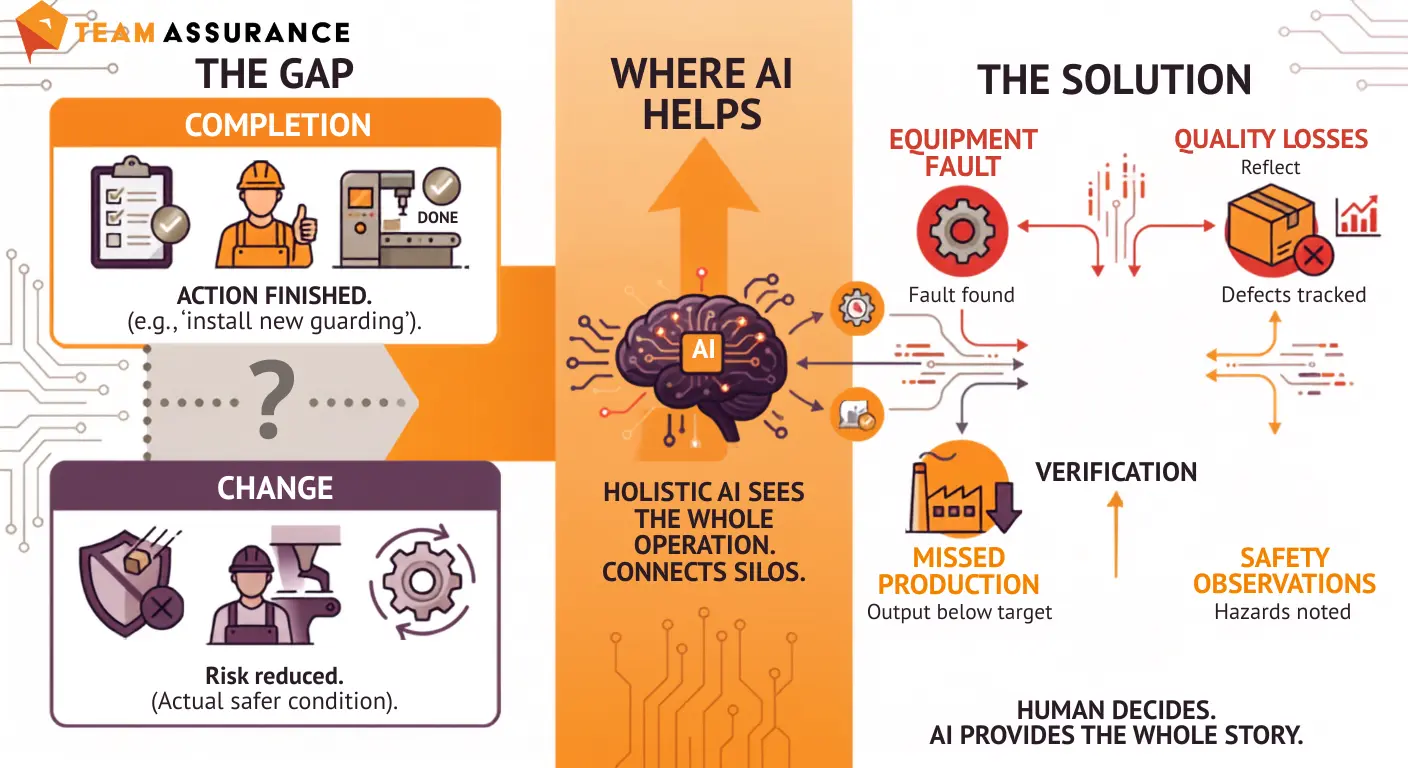 AI applied to a single silo can make that silo more efficient. An assistant inside a safety application can analyse safety information. Quality AI can identify defect trends. Production AI can interpret downtime.
All useful.
The larger opportunity appears when AI can work across the operating context.
A manager might invoke AI before a Tier 2 meeting and ask what recurring issues have affected the area during the previous month. The answer might connect an equipment fault with quality losses, safety observations during manual intervention, missed production, overtime, repeated actions and the history of previous countermeasures.
That is a much richer conversation because the AI is seeing the same operation that the humans are trying to manage.
It can also help the organisation retrieve its own experience. If another factory solved the same equipment-related quality issue twelve months earlier, that history can be surfaced when it becomes relevant instead of relying on somebody remembering who to telephone.
The human remains in the loop. AI helps people see context, patterns and history. Humans still decide what matters, go to the work, ask the questions and decide what to do.
Your AI and Our AI
This does not need to become a contest between the intelligence built into an operational platform and the customer's enterprise AI.
Both have a role.
TeamAssurance can provide product-native intelligence because it understands the structure of the operational management system: SQDCP measures, issues, actions, verification, standards, meetings, equipment, improvement activity and the relationships between them.
At the same time, governed MCP connectivity can allow the customer's approved LLM to work with permitted TeamAssurance context alongside information from other enterprise systems.
The customer keeps their AI governance, permissions and enterprise strategy. TeamAssurance contributes the operational context and operating memory.
That architecture becomes considerably more useful than installing another isolated AI assistant inside another isolated functional application.
Consolidation Does Not Mean One Giant Database
There is a trap here. When people hear "one platform", they sometimes imagine replacing ERP, MES, CMMS, QMS, LMS and every other specialist enterprise system with one enormous piece of software.
That is not what I mean.
Factories will continue to have specialist systems because specialist systems are useful. ERP may remain the source for production orders and financial information. MES may provide machine and production data. CMMS can remain responsible for maintenance execution. Specialist compliance systems may continue to hold regulated records.
The opportunity is to create one operational management layer through which the organisation manages what those systems are telling it.
That is the layer where SQDCP comes together.
An abnormal condition appears. Somebody owns it. It moves through the appropriate management rhythm. It escalates when necessary. Actions are taken. Effectiveness is verified. Standards change. Lessons move across shifts, lines, departments or factories.
The organisation learns.
That is consolidation where it matters.
From Digital Silos to a Learning System
The next generation of operational software should probably be judged less by how beautifully it digitises a particular form and more by how effectively it helps the organisation learn.
Can information travel from the frontline to management without losing context? Can a safety issue trigger maintenance or improvement activity without starting again? Can a quality defect become visible as a delivery and cost issue? Can an improvement change a standard? Can the new standard trigger training? Can another site discover the lesson before repeating the problem? Can management see these connections through the normal Tier 1, Tier 2 and Tier 3 rhythm?
If the answer is yes, the software is starting to support the operating system rather than simply computerising parts of it.
Safety, Quality, Delivery, Cost and People are already connected in the real factory. They always have been. We have simply spent years representing them as separate worlds in software.
Bringing them into one learning system does not diminish the specialist disciplines. It makes their work more valuable because the lessons travel further and leaders can see the relationship between the things they are already trying to manage.
The factory gets a better memory. Supervisors get a clearer picture of what deserves attention. Leaders see conditions rather than isolated dashboards. Experienced people have their judgement amplified across the organisation. AI gets the operational context it needs to be useful. Proven countermeasures become reusable knowledge rather than forgotten history.
Most importantly, the organisation gets better at learning across boundaries its problems never recognised in the first place.
That is how Safety, Quality, Delivery, Cost and People stop being five letters on a board and start becoming one learning system.
Interested in connecting Safety, Quality, Delivery, Cost and People into one operational learning system? TeamAssurance brings daily management, actions, verification and cross-functional learning together, while AI Assisted Workflows help surface patterns and connect insights across the operation. Explore TeamAssurance's capabilities or book a demo to see how a connected management system can help your organisation learn and improve faster.