
Most organisations don't have a shortage of improvement activity or continuous improvement initiatives.
Operators solve problems every day. Supervisors solve problems every day. Managers solve problems every day. Executives solve problems every day. Projects are launched, corrective actions are raised, audits are completed, daily management routines operate and customer complaints are investigated. Improvement work is happening everywhere.
In other words, PDCA is already alive and well.
The problem is that most organisations don't think about it this way. More importantly, they don't connect it. What often exists instead is a collection of disconnected learning loops operating at different levels of the organisation. Each loop generates experience, knowledge and learning. Unfortunately, much of that learning remains trapped within the level where it was created.
An operator learns something. A supervisor learns something. A manager learns something. A site learns something. The enterprise learns something. Yet the learning rarely flows effectively between them. The organisation learns, but it doesn't always become smarter because learning is rarely embedded into the management system.
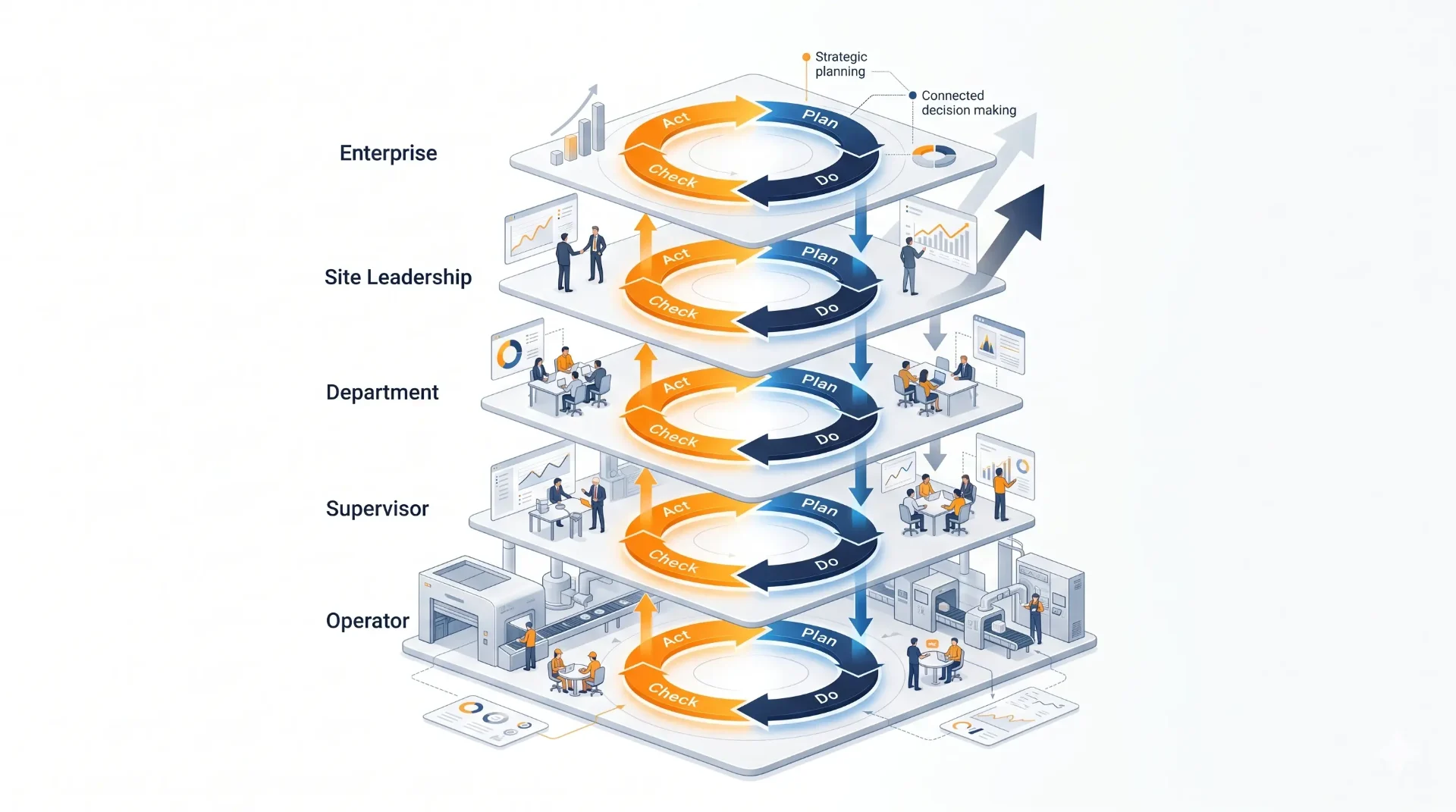
This is where the concept of the PDCA Stack becomes useful.
Every Organisation Already Runs A PDCA Stack
One of the misconceptions surrounding PDCA is that it is primarily a problem-solving tool. It isn't. PDCA is simply the mechanism through which organisations learn, adapt and drive sustainable performance improvement. Every time someone plans an action, executes it, evaluates the outcome and adjusts accordingly, a learning cycle has occurred.
What is interesting is that these cycles exist simultaneously at every level of the organisation. An operator may be running a learning cycle measured in minutes. A supervisor may be running a learning cycle measured in days. A manager may be operating on a weekly cycle. Site leadership may be thinking in months, while executives are often learning and adjusting over quarters or years.
All of these cycles generate knowledge. All of them influence performance. All of them contribute to organisational capability. Yet very few organisations deliberately think about how those learning cycles interact with one another.
Most organisations have a management structure. Far fewer again have a learning structure capable of sustaining continuous learning.
Level 1: Operator PDCA
The most frequent learning cycles occur closest to the work. Operators constantly encounter abnormalities, make adjustments, observe outcomes and refine how tasks are performed. Much of this happens naturally and often without formal documentation.
What's often overlooked is how much valuable knowledge is generated at this level. Experienced operators know things that don't appear in procedures, work instructions or training manuals. They understand subtle indicators, recurring patterns and practical realities that only become visible through direct experience.
The challenge is that much of this learning disappears at the end of the shift. The organisation benefits from the experience of the individual without necessarily retaining the knowledge itself. As a result, the same lessons are often relearned by different people over time.
I've always found it strange that organisations work so hard to generate experience and so little to retain it.
Level 2: Team and Supervisor PDCA
Supervisors operate at a different time horizon. Their focus extends beyond individual tasks and into team performance, recurring issues, capability development and short-term improvement. This is where many abnormalities are escalated, prioritised and addressed.
A strong supervisor does far more than manage today's work. They create conditions for tomorrow's improvement through leader standard work and capability development. They identify patterns, remove obstacles and help teams learn from experience. Done well, this level acts as a bridge between frontline activity and broader organisational improvement.
Unfortunately, many of the lessons generated at this level never travel beyond the immediate team. The learning remains local rather than becoming organisational. One shift gets better. Another shift continues to struggle with exactly the same issue.
The organisation pays for the lesson twice.
Level 3: Department and Functional PDCA
Managers begin to see patterns that are difficult to detect at operator or supervisor level. They can observe recurring failures across teams, capability gaps across departments and systemic issues that may not be visible within individual work areas.
This level often produces some of the most valuable learning in the organisation because it provides context. Individual events can be connected into broader themes and isolated incidents can be recognised as symptoms of larger problems.
This is also where many organisations begin to discover that their problems are not as unique as they first appeared. What looked like five separate issues often turns out to be one underlying issue expressing itself in five different ways.
The challenge is ensuring that learning flows in both directions. Insights generated at management level need to reach the frontline, while frontline learning should shape the broader management system.
Most organisations struggle with at least one half of that equation.
Level 4: Site Leadership PDCA
By the time learning reaches site leadership, the focus has shifted from individual problems toward system performance.
Site leaders are typically concerned with safety, quality, delivery, cost, capability and strategy deployment. Their role is not to solve every problem. Their role is to understand the conditions that create those problems and improve the system accordingly.
The best site leaders I've worked with spend less time discussing individual incidents and more time understanding patterns. They're interested in why problems continue to emerge, what conditions allow them to persist and what changes would prevent them from occurring in the first place.
The learning cycles at this level are slower than those on the frontline, but they often have a much larger impact. A single improvement to a management system can eliminate hundreds of recurring operational issues.
The challenge is maintaining connection to reality. The further leaders move from the work, the greater the risk that decisions become detached from the conditions they're intended to improve.
Level 5: Enterprise PDCA
At enterprise level the learning cycles become broader still.
Decisions around strategy, investment, capability, markets, risk and organisational priorities often unfold over quarters and years rather than days and weeks. The consequences of these decisions are significant, but so is the distance from the work itself.
This creates a challenge that most large organisations eventually encounter. The people making the largest decisions are often the furthest removed from operational reality.
Without strong feedback loops, enterprise learning becomes disconnected from operational learning. Without connected learning loops, strategy deployment becomes detached from execution. Decisions become detached from evidence. Assumptions replace observation.
When this happens, organisations often become very busy while simultaneously becoming less effective.
The Problem Is Not PDCA
Most organisations already have all of these learning loops. The operator is learning. The supervisor is learning. The manager is learning. The site is learning. The enterprise is learning.
The problem is not the absence of PDCA.
The problem is that the learning loops are disconnected.
There is another issue that quietly creeps into many organisations as well. What begins as a PDCA cycle gradually becomes something else.
Plan. Do. Plan. Do. Plan. Do.
The Check and Act phases slowly disappear.
New initiatives are launched before previous initiatives have been properly evaluated. Corrective actions are assigned before anyone determines whether earlier corrective actions actually worked. Projects are completed and attention immediately shifts to the next priority.
Everyone remains busy. Activity levels stay high. Progress reports continue to look positive.
But learning begins to weaken.
I've seen organisations that are extraordinarily effective at planning and executing activity while being surprisingly poor at extracting learning from that activity. They generate enormous amounts of effort but relatively little organisational capability. The same issues keep returning. The same conversations keep reappearing. The same frustrations continue to circulate through the business.
This is often mistaken for an execution problem.
More often it reflects weak continuous learning capability.
The Check phase is where reality confronts assumptions. The Act phase is where learning becomes capability. When either of those stages are weak, the organisation may still be active, but it is no longer fully learning.
An operator discovers a better way of performing a task and nobody else hears about it. A supervisor solves a recurring problem and another team repeats it six months later. One site develops a highly effective practice while another site unknowingly struggles with the same issue.
The organisation learns. The organisation forgets. The organisation pays for the lesson again.
I've become increasingly convinced that this is one of the largest hidden costs in modern organisations.
The Power Of A Connected PDCA Stack
When learning begins to flow between levels, something interesting happens.
Local knowledge becomes organisational capability. Improvements discovered in one area benefit others. Patterns become visible earlier. Decisions become better informed. Problem solving becomes more effective because people are building on previous learning rather than starting from scratch.
Over time, learning begins to compound.
The organisation starts behaving less like a collection of departments and more like a connected system. Capability accumulates. Organisational memory strengthens. Adaptation becomes easier.
Most organisations talk about continuous improvement. Far fewer have built mechanisms for continuous learning.
The difference is larger than many people realise.
Why AI Changes The Equation
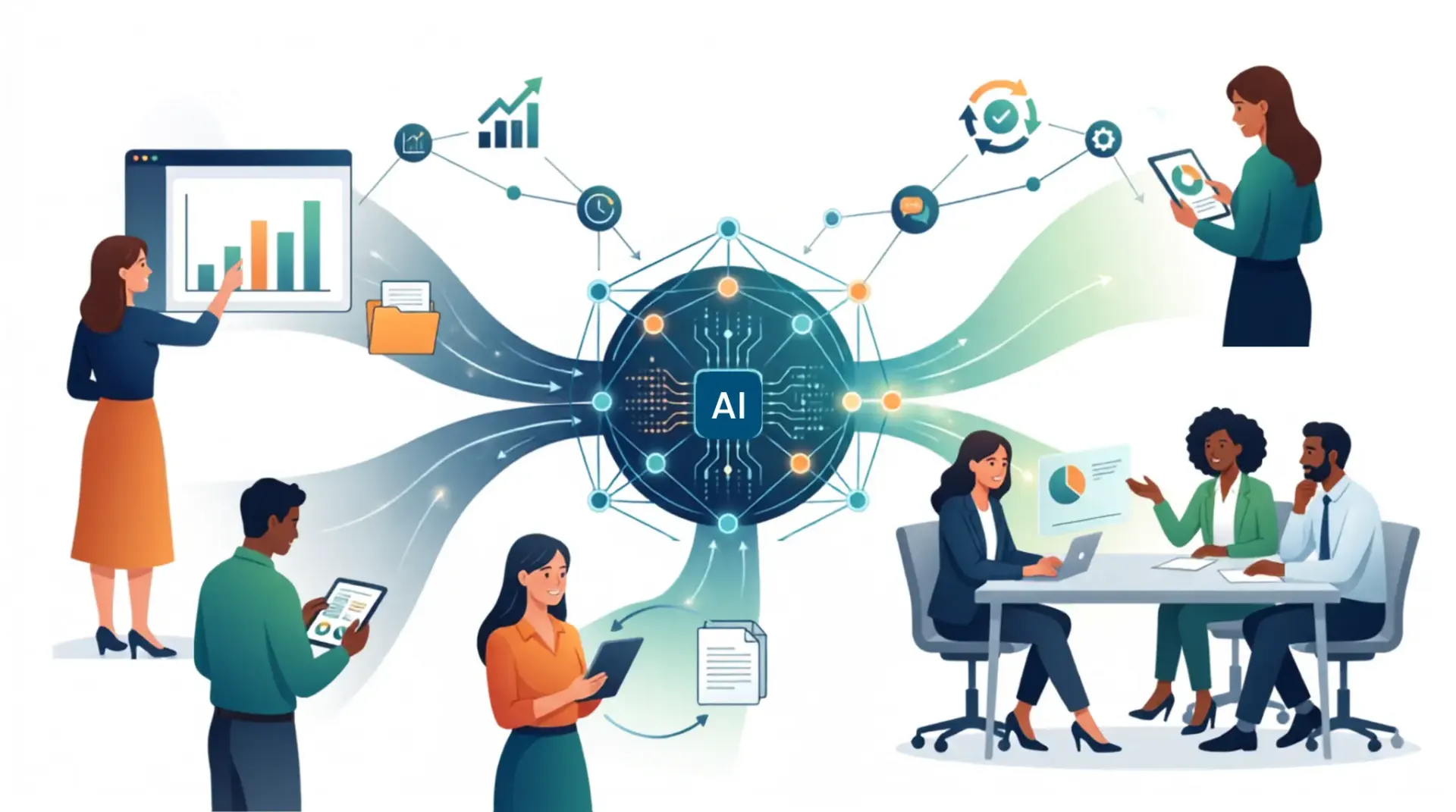
Historically, connecting learning across an enterprise has been difficult. Information becomes fragmented. Lessons become buried in documents. Knowledge becomes trapped in spreadsheets, reports, emails and people's heads.
AI changes some of those constraints.
Patterns can be identified earlier. Similar problems can be connected automatically. Lessons learned in one part of the business can be surfaced elsewhere. Knowledge becomes easier to find and easier to apply.
For me, this is where AI is proving to be a genuine game changer.
Not because it replaces people. Not because it automates thinking.
But because it may help organisations become better at learning from themselves.
That is a far more significant opportunity than most people realise.
The Future Belongs To Organisations That Learn Faster
Most discussions about operational excellence eventually end up talking about processes, systems, technology or tools.
Those things matter but underneath all of them sits a more fundamental capability.
The organisations that consistently outperform their competitors are rarely those with the fewest problems. They are usually the ones that learn from those problems more effectively and adapt more quickly.
The PDCA Stack is simply a way of viewing an organisation through that lens. Every level is learning. Every level is adapting. Every level is generating knowledge. The question is whether those learning loops remain isolated or become connected.
Because once they become connected, continuous improvement stops being an activity.
It becomes a capability.
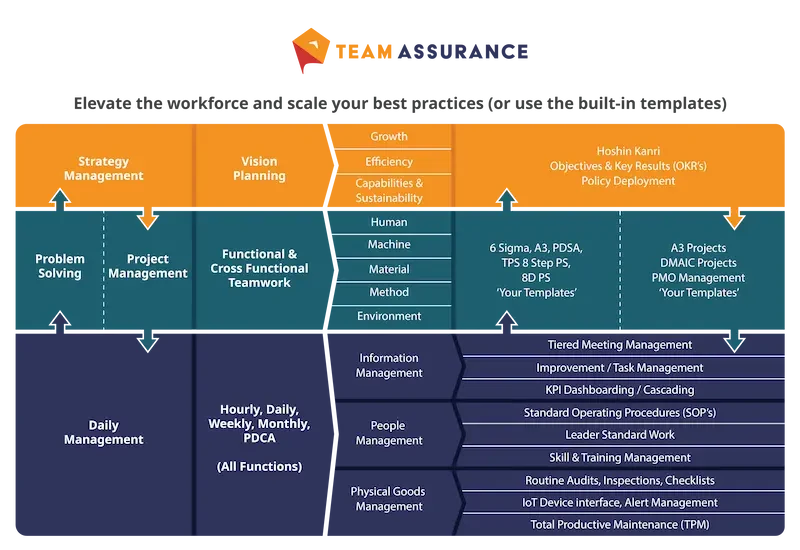
The illustration below shows how TeamAssurance connects learning across every level of the organisation. TeamAssurance links them into a connected Operational Learning Platform that helps learning flow from the frontline to the enterprise.
If you're looking to connect learning loops, strengthen organisational capability and turn everyday experience into lasting improvement, contact us to see how TeamAssurance can help.