
When it comes to operational efficiency and continuous improvement, 'Standard Work' is a fundamental principle.
We've touched on Leader Standard Work previously; this concept is not just about maintaining consistency in leadership teams, it's about creating a foundation for excellence, innovation and improvement for everyone.
Understanding Standard Work
Standard work refers to the documentation and consistent application of the best practices in any operational process. It's about identifying the most efficient and effective way to perform a task, then standardising that process across the organisation to ensure consistency and predictability in outcomes.
Taking this approach a step further it's about establishing routines that add value to – rather than slow down – our daily toil. Standard work is key to achieving strategic outcomes because it embeds daily / weekly / monthly execution of your plans.
When standard work is built on an interactive platform, like TeamAssurance, accountability for this execution becomes instilled in every process owner by default.
By identifying and documenting key tasks and processes, utilising skills matrices to assign the most effective process owners, and establishing digital hybrid solutions at the Gemba, leaders and teams become much more efficient.
Waste is minimised, productivity increases, and morale is boosted because our people aren't playing 'firefighter' or working on redundant tasks.
Identifying and Documenting Key Tasks
The first step in establishing standard work is to identify the essential tasks that our people must perform. These are categorised into 'must do', 'should do', and 'nice to do' activities.
By clearly defining these tasks, staff can focus their efforts on what truly matters, ensuring that their time is spent adding value to the organisation.
This work can then be contained within an accessible daily checklist that outlines key activities. Plus, when done digitally, this list can be updated easily as new tasks / priorities come up in our daily tiered meetings.
The Role of Digital Tools in Standard Work
Standard work is a Lean practice; it should be supported by Lean digital tools. Raising actions, triaging issues, problem solving, assigning follow-up activity, reviewing data – all of these are made easier and more effective when digitised.
Every process and all documentation is connected to another. Meaning no misalignment, no orphaned processes, and action tracking by default. A prime example of a digital solution for standard work is a Kamishibai Board.
The organisation takes advantage of QR Code Checklist functionality – making standard work visible (and accessible) to all at the Gemba, eliminating manual handling of key data, and enhancing documentation throughout the process.
This accessibility lowers barriers to entry for staff contribution, ensures standards are applied consistently and critical processes never get overlooked.
Even Standard Work Continuously Evolves
Don't let the name fool you – standard work is a dynamic concept. It's not just about maintaining the status quo; setting and forgetting. Like any other element of your continuous improvement programs, standard work must be reviewed regularly.
That's another way digitisation trumps static, whiteboard methods. When reviewed, standard work practices can be updated for everyone instantly – ensuring your documentation always reflects the 'current best way' of doing things.
Part of The Greater C.I. Framework Not an Isolated Process
We must remember that Standard Work is not an isolated process. It's part of a greater framework and therefore needs to be integrated with all adjacent processes. Paper / whiteboard based processes just can't achieve the real-time interconnectivity needed.
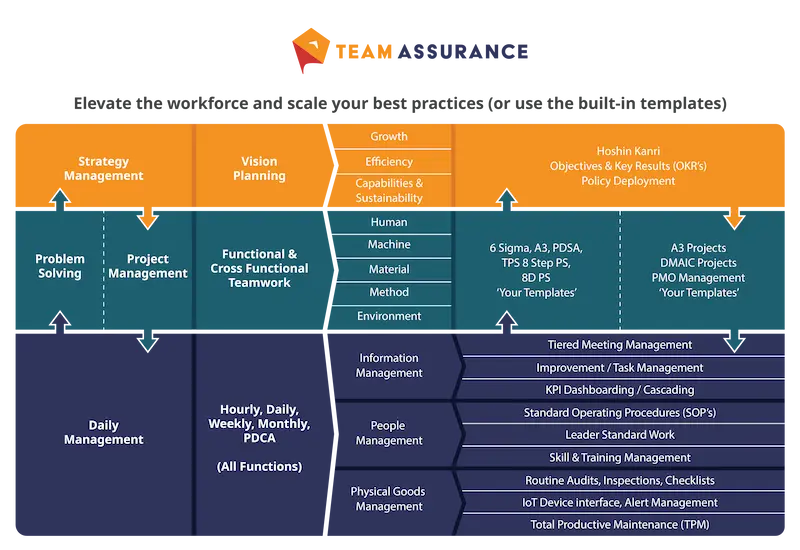
Lean tools like standardised problem solving techniques, Standard Operating Procedures (SOPs), and Tiered Daily Management that supports the entire PDCA loop are key to achieving our continuous improvement objectives.
The diagram below demonstrates how we designed the TeamAssurance platform to avoid locally optimised 'Point Solutions' (digital or analog) that do not help, and often hinder your progress towards the organisation's objectives.
If you're a business in need (or a consultant with clients in need) and you'd like to explore the opportunities that digital-aids to Lean tools provide contact us for a demonstration of the TeamAssurance platform today.