
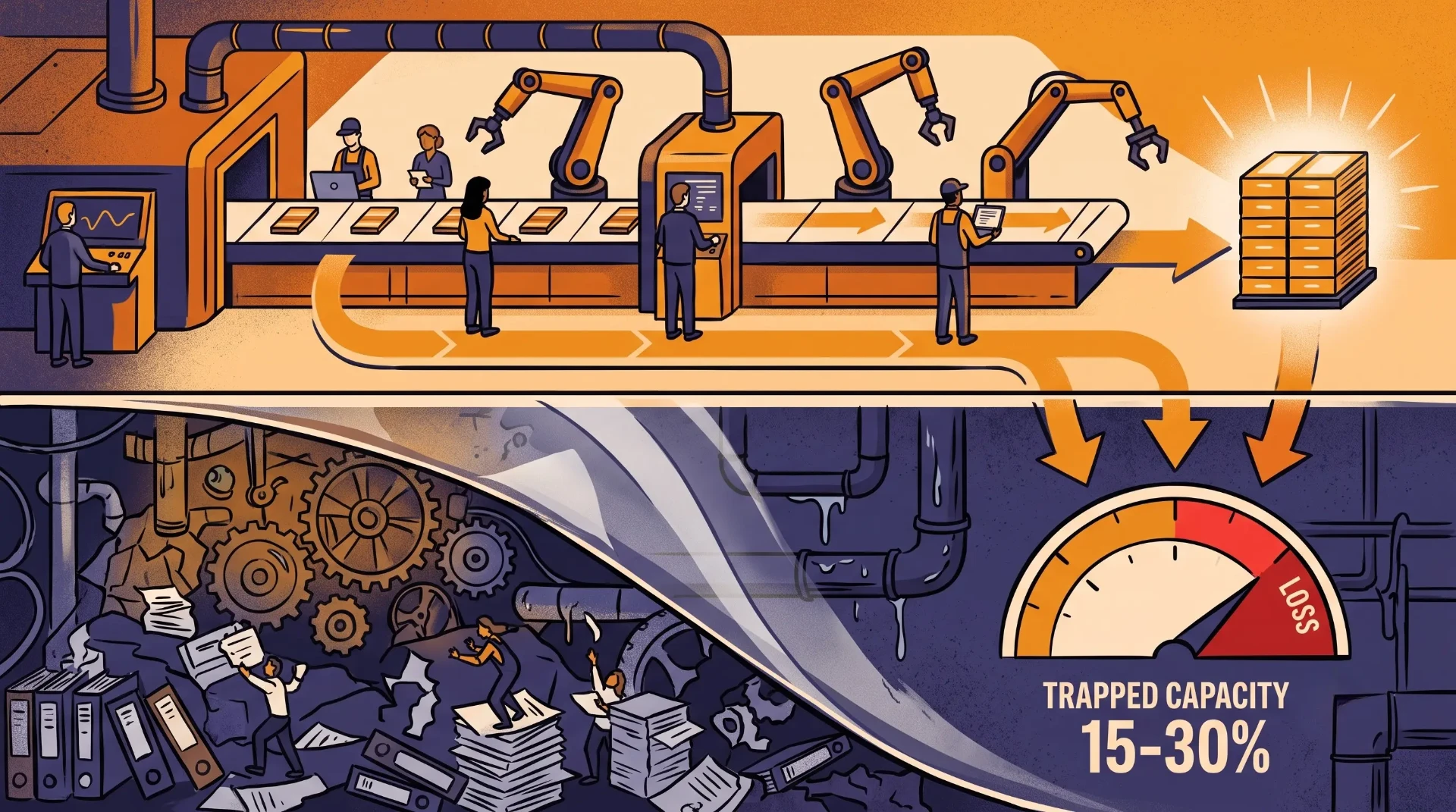
In a previous article, we talked about the two factories inside every operation. The first is the physical factory: machines, people, materials, shifts, warehouses, production lines, schedules and targets. Everyone can see it, measure it and spend money on it.
The second is the management factory: the way problems are seen, decisions are made, actions are followed up, standards are improved, learning is shared and people are supported. That earlier article was about the idea. This one is about the cost.
Because when the management factory is weak, the physical factory pays for it, quietly eroding operational performance every single day. Not in one clean, obvious line item. That would be too convenient. It pays through rework, waiting, chasing, correcting, expediting, double-handling, missed handovers, poor escalation, repeated problems, weak standards and all the other operational nonsense that gets treated as normal because everyone is too busy to call it what it is.
That is the cost of your hidden factory and its impact on operational performance.

It Usually Looks Like Work
The hidden factory is hard to see because it often looks like effort. A supervisor chasing an update. An operator waiting for a decision. A planner rebuilding the schedule. A quality issue being checked again because nobody trusts the first answer. A maintenance problem being worked around because fixing it properly would require someone to make a decision.
From a distance, everyone looks busy. Up close, a fair bit of it is waste wearing work clothes.
That is the annoying thing about operational waste. It does not always arrive with a label on it. Sometimes it arrives as a meeting. Sometimes it arrives as a spreadsheet. Sometimes it arrives as a “quick follow-up”. Sometimes it arrives as a person walking across the site to ask a question that should already have an answer.
Effort is not the same as value. Activity is not the same as progress. A full day does not mean a useful day.
Where The Capacity Goes
The capacity does not disappear in one dramatic event. It leaks. Five minutes here. Half an hour there. A job done twice. A defect found late. A problem solved on one shift and repeated on the next. A meeting that reviews issues but removes nothing. A decision that waits three days because nobody is quite sure who owns it.
That is how 15–30% of capacity can vanish without anyone really noticing. Not through one disaster, but through a thousand tolerated leaks.
Eventually the workaround becomes normal. The extra check becomes normal. The recurring problem becomes normal. The late escalation becomes normal. The business then wonders why it needs more labour, more overtime, more supervisors, more meetings and more management attention just to stand still.
This is where the two-factory idea becomes very practical. The physical factory may have enough capacity on paper. The management factory is simply consuming too much of it before it turns into value, limiting Operational Performance long before production reaches its true potential.
More Resources Usually Feed The Problem
The standard answer is to add more. More people. More meetings. More reports. More dashboards. More supervisors. More reminders. More escalation emails with half the company copied in.
Sometimes more is needed. Often it is just feeding the hidden factory.
If problems are not visible early, more people will chase them later. If decisions are slow, more dashboards will not make them faster. If operational learning does not travel, more meetings will not stop the same problem showing up somewhere else next month.
You can add resources to a broken operating system and still get a slow, confused mess. You just get a more expensive one.
This is why capacity discussions so often go wrong. The business thinks it has a shortage of people, equipment or time. Sometimes it does. But often it has a shortage of flow, visibility, ownership and operational learning.
Those are management factory problems. And they are expensive because they quietly reduce Operational Performance every day.
The Capacity Is Already There
This is the uncomfortable part. A lot of the capacity leaders are looking for is already inside the business. It is inside the existing people, assets, shifts, routines and management structure. It is just trapped.
Trapped in repeated problems. Trapped in poor handovers. Trapped in slow decisions. Trapped in actions that close on paper but not in reality. Trapped in lessons that never move beyond the person who learned them.
The business has already paid for this capacity. Then it wastes it. Then it pays for more. That is not a capacity strategy. That is a tax on a weak management system.
How You Get It Back
You get it back by making reality visible earlier through better Visual Management. Not next week. Not after the report is finished. Not after the customer complains. Early enough for someone to do something useful.
You get it back by escalating properly. Not as blame. Not as theatre. Escalation should mean bringing the right support to the right problem before it becomes a bin fire. That is effective Daily Management.
You get it back by closing actions properly. Not just changing the status to complete. Check whether the action worked. If it did, capture the learning. If it did not, stop pretending it did. That is Continuous Improvement.
You get it back by making learning travel. That is how organisations strengthen Operational Performance instead of repeatedly paying for the same lessons. One shift should not pay for a lesson the previous shift already learned. One site should not repeat a failure another site already solved.
This is not complicated. It is just rarely done with enough discipline.
The Prize
The prize is not a slogan. It is capacity. Real capacity.
Fewer repeated problems. Faster decisions. Cleaner handovers. Less chasing. Better escalation. Less rework. More time spent producing value instead of cleaning up avoidable mess.
The earlier article argued that every operation has two factories. This article is the uncomfortable follow-up: if the second factory is weak, the first factory will quietly bleed capacity every day.
Most businesses do not need to start with a grand transformation. They need to stop stepping over trapped capacity while pretending the answer is another project.
The hidden factory is already there. It is already costing you. The question is whether you are prepared to look at it properly, or whether you would rather keep buying more capacity while wasting the capacity you already own.
That is what sustainable Operational Excellence looks like: improving Operational Performance by eliminating hidden waste instead of continually adding more resources.
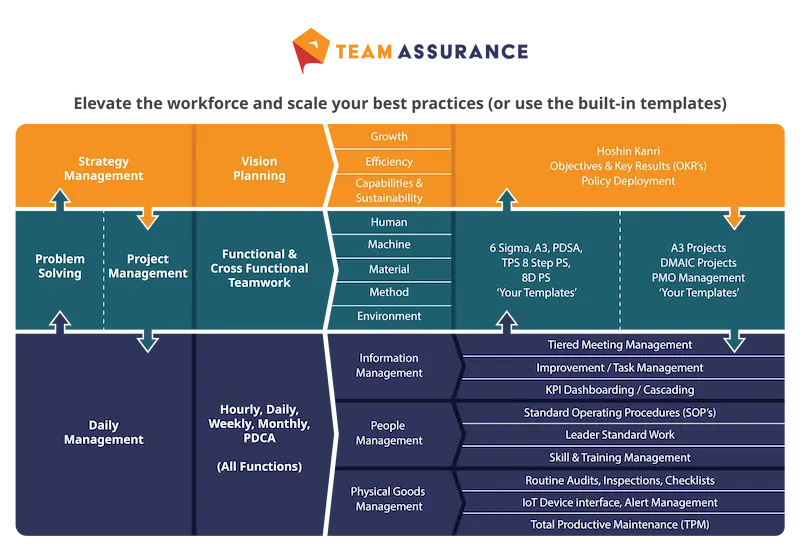
The chart below illustrates how connected management systems help organisations eliminate hidden waste and unlock existing capacity. By connecting visual management, daily management, problem solving and continuous improvement, organisations can improve operational performance without simply adding more resources.
Every organisation has hidden capacity waiting to be unlocked. Book a demo to see how TeamAssurance helps reduce waste, improve operational performance and strengthen continuous improvement.