
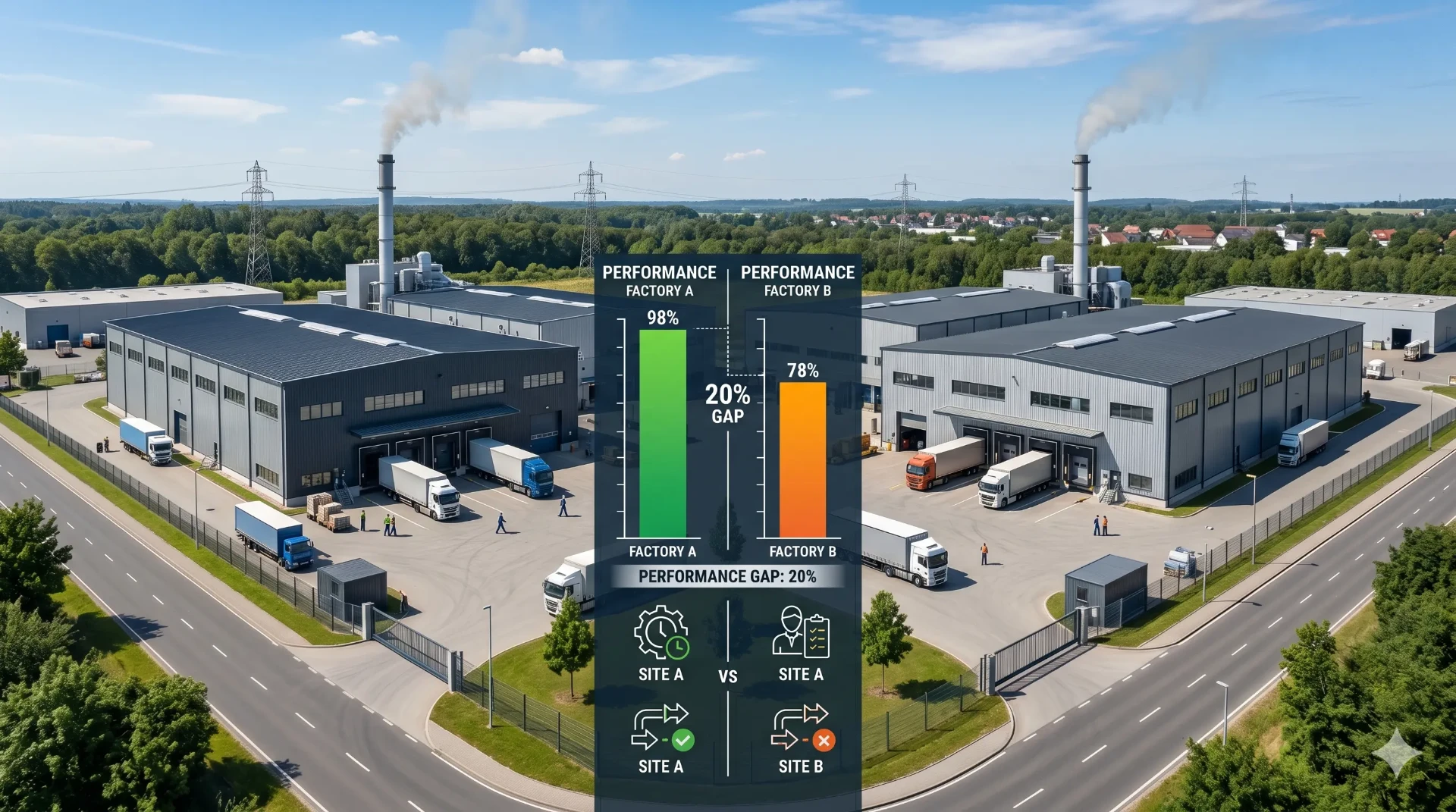
One of the habits I've noticed in operations is our willingness to accept simplistic explanations for performance gaps that are anything but simple. Two factories can be remarkably similar in assets and technology yet deliver very different levels of operational performance and operational excellence.
Every operational leader has seen it. Two sites operating under the same company, producing similar products, using similar equipment and employing similar numbers of people, yet one consistently outperforms the other. Sometimes the gap is modest. Sometimes it is substantial. In some cases the difference in productivity, quality, downtime, customer service or overall effectiveness can exceed 20%.
When these differences are discussed, the explanation often arrives quickly.
One site has better people.
One site has better equipment.
One site has a better manager.
One site has more experience.
One site has better products.
Occasionally those explanations are correct. More often they are incomplete.
What I've found over the years is that organisations tend to look first at the things they can easily see. The machinery. The automation. The technology. The capital investment. The physical assets. Yet in many cases the real explanation sits somewhere else entirely.
In fact, the longer I've worked in operations, the less convinced I've become that physical assets explain most of the performance variation between otherwise similar operations.
Instead, I think the answer is usually found in something much harder to see.
The Hidden Drivers of Operational Excellence
Most organisations spend enormous effort managing what is visible.
Production output.
Downtime.
Inventory.
Labour utilisation.
Waste.
Asset utilisation.
These things are measurable and important. They deserve attention.
What receives far less attention is the management system that sits around the physical assets.
How effectively are problems identified?
How quickly are they escalated?
How rigorously are problems solved through structured problem solving and root cause analysis?
How consistently are standards followed?
How effectively are leaders developing people?
How quickly does knowledge move through the organisation?
How often does the organisation learn from experience?
These things rarely appear in management reports. They don't sit on the balance sheet. They're difficult to quantify and often harder to discuss.
Yet they have an enormous influence on performance.
The Same Equipment, Different Outcomes: Why Management Systems Drive Operational Excellence
One of the most useful observations I've made over the years is that equipment tends to amplify management systems rather than replace them.
Put simply, a well-managed operation usually gets more value from the same assets than a poorly managed one which is why two similar sites can deliver very different levels of operational performance.
I've seen older facilities consistently outperform newer ones. I've seen one shift outperform another on exactly the same line. I've seen one supervisor create a highly capable team while another becomes the bottleneck for every decision.
The equipment wasn't creating the difference.
The management system was. The systems that support continuous improvement, organisational learning and operational capability were.
The way information moved through the operation was.
The way problems were solved was.
The way people were developed was.
The way learning was captured was.
The difference was not usually visible from the car park.
Small Differences Compound
One of the reasons performance gaps are difficult to explain is that they are rarely caused by one major factor.
More often they are the result of dozens of small differences accumulating over time.
A problem is escalated earlier.
A corrective action is followed up more rigorously.
A supervisor spends more time coaching than firefighting.
A lesson learned on one line is shared with another.
A standard is improved rather than simply enforced.
None of these actions appear significant in isolation.
Together they become significant.
The effect is much like compound interest. Small improvements repeated consistently create capabilities that are difficult for competitors to replicate. After several years, the gap becomes obvious even though nobody can point to a single event that created it.
The Real Difference Is Organisational Learning
If I had to identify one factor that explains the majority of long-term performance differences between otherwise similar operations, it would be learning.
Not training.
Not knowledge.
Learning.
Specifically, the organisation's ability to learn from experience and convert that learning into improved operational capability.
Every operation experiences breakdowns.
Every operation encounters quality issues.
Every operation makes mistakes.
Every operation faces unexpected challenges.
The question is not whether problems occur.
The question is what happens afterwards.
Does the lesson stay with the individuals involved?
Does it remain trapped inside a shift, department or site?
Or does it become part of the organisation's capability?
This is where many businesses quietly struggle.
The problem isn't that people don't learn.
The problem is that organisations often don't.
Without organisational learning, improvement becomes temporary and continuous improvement becomes difficult to sustain.
Over time, the organisations that consistently achieve operational excellence are not necessarily the ones that solve more problems.
They're the ones that turn learning into repeatable systems, stronger decisions and long-term capability.
The Cost of Paying for the Same Lesson Twice
One of the more expensive habits I've seen in operations is solving the same problem multiple times while convincing ourselves we're continuously improving.
A breakdown occurs. An investigation is completed. Corrective actions are raised. Everybody agrees the lesson has been learned.
Then six months later the same issue returns wearing a different shirt.
The first occurrence costs money.
The second occurrence costs credibility.
By that point the organisation has already paid for the lesson.
The issue isn't problem solving. Most organisations are reasonably competent at that.
The issue is turning problem solving into continuous improvement and retaining organisational capability.
Can the organisation retain what it learned?
Can it spread that learning?
Can it prevent another team from paying for the same lesson again?
The operations that consistently outperform their peers tend to answer yes to those questions.
Why This Matters More Than Ever
For many years competitive advantage was often built around access to capital, technology, equipment or information. That world is changing. Technology is becoming more accessible. Best practices are easier to find. Information travels faster. Competitors can often buy the same equipment, implement similar systems and access similar expertise. What remains difficult to copy is an organisation's ability to learn and adapt. To learn is to adapt. And adaptation is becoming one of the defining capabilities of modern organisations. Markets change faster. Technology changes faster. Customer expectations change faster. The pace of change itself has become a competitive force. In that environment, the organisations that thrive won't necessarily be those with the newest equipment. They'll be the ones that recognise, learn and adapt faster than those around them.
Systemising Learning
This is where many organisations miss the opportunity.
Most businesses have smart people.
Most businesses contain valuable experience.
Most businesses generate lessons every single day.
The real challenge is turning those lessons into organisational capability.
The magic isn't individual learning.
The magic is systemised learning through repeatable processes, standard work at every level, and organisational memory.
When a lesson learned on one shift improves every shift.
When a problem solved in one site prevents the same problem in another.
When knowledge survives changes in personnel.
When improvement compounds because the organisation remembers.
That's when learning becomes a competitive advantage.
Looking Beyond the Physical Factory
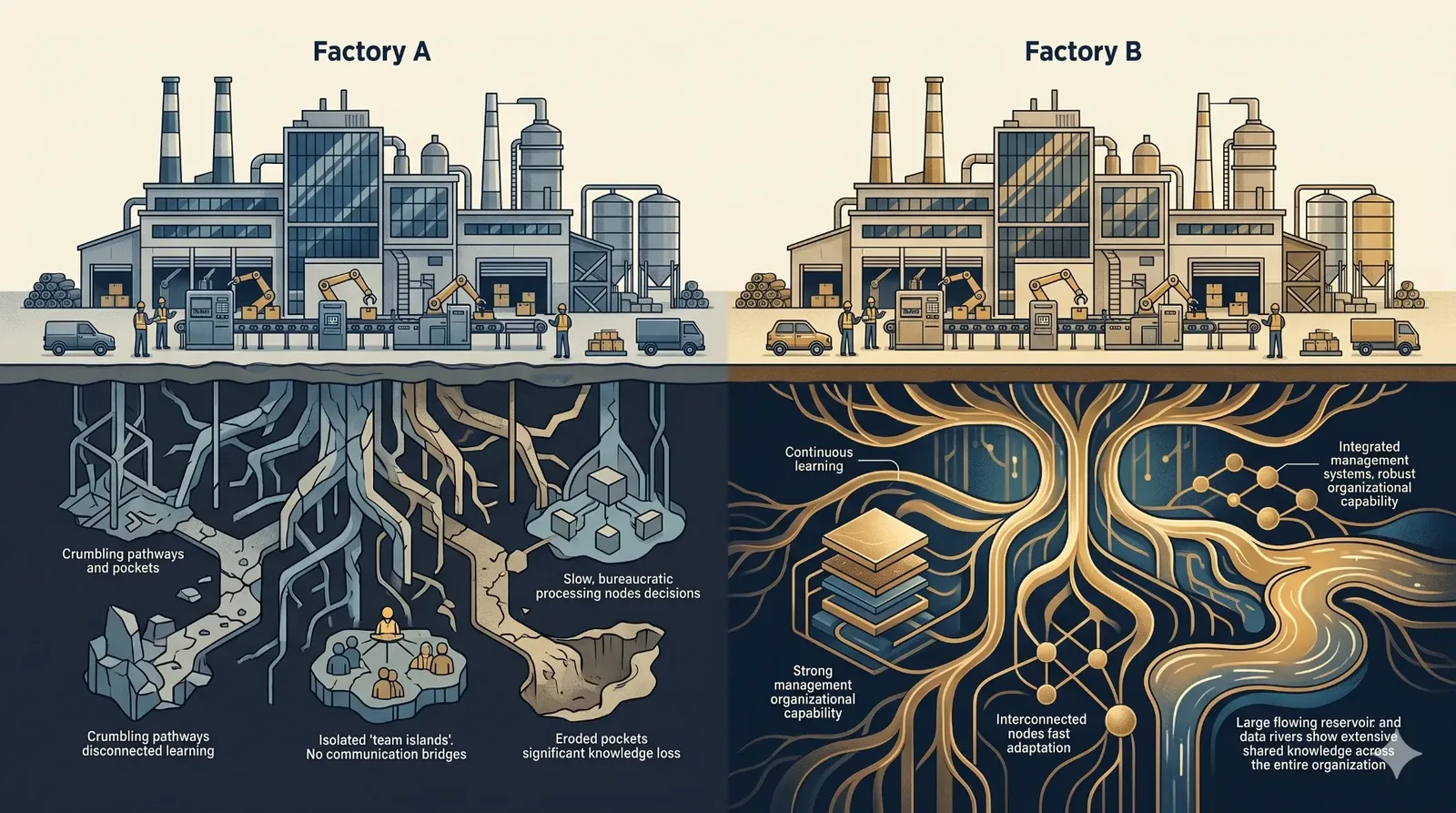
When leaders encounter a 20% performance gap between two seemingly similar operations, the instinct is often to search for a 20% difference in equipment, technology or investment.
In my experience, that's usually the wrong place to start.
More often, the explanation sits in the quality of the management system, the speed of learning, the effectiveness of communication and the organisation's ability to turn experience into capability.
The physical assets may be similar.
The learning systems may not be.
The equipment may be identical.
The rate of adaptation may not be.
And increasingly, I suspect that's where the real competitive advantage lives.
Not in what an organisation owns.
But in how effectively it learns.
Sustainable operational excellence is increasingly determined not by what an organisation owns, but by how effectively it learns.
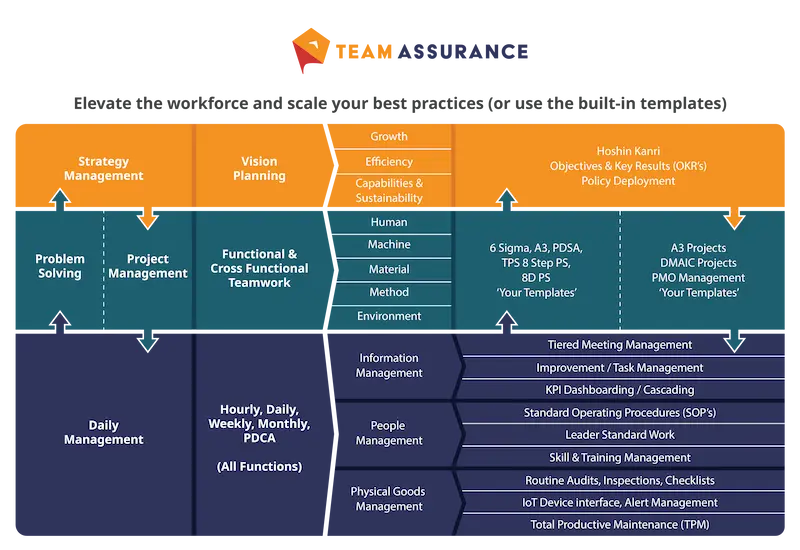
The illustration below shows how TeamAssurance connects the core elements of a strong Management System into a single operational platform. Rather than relying on disconnected tools and isolated processes, it brings together Daily Management, Structured Problem Solving, Continuous Improvement and Operational Learning to help organisations strengthen capability and improve Operational Performance over time.
If you'd like to explore how TeamAssurance can help your organisation build a more connected management system and achieve sustainable operation excellence, Contact Us to book a demonstration today.