
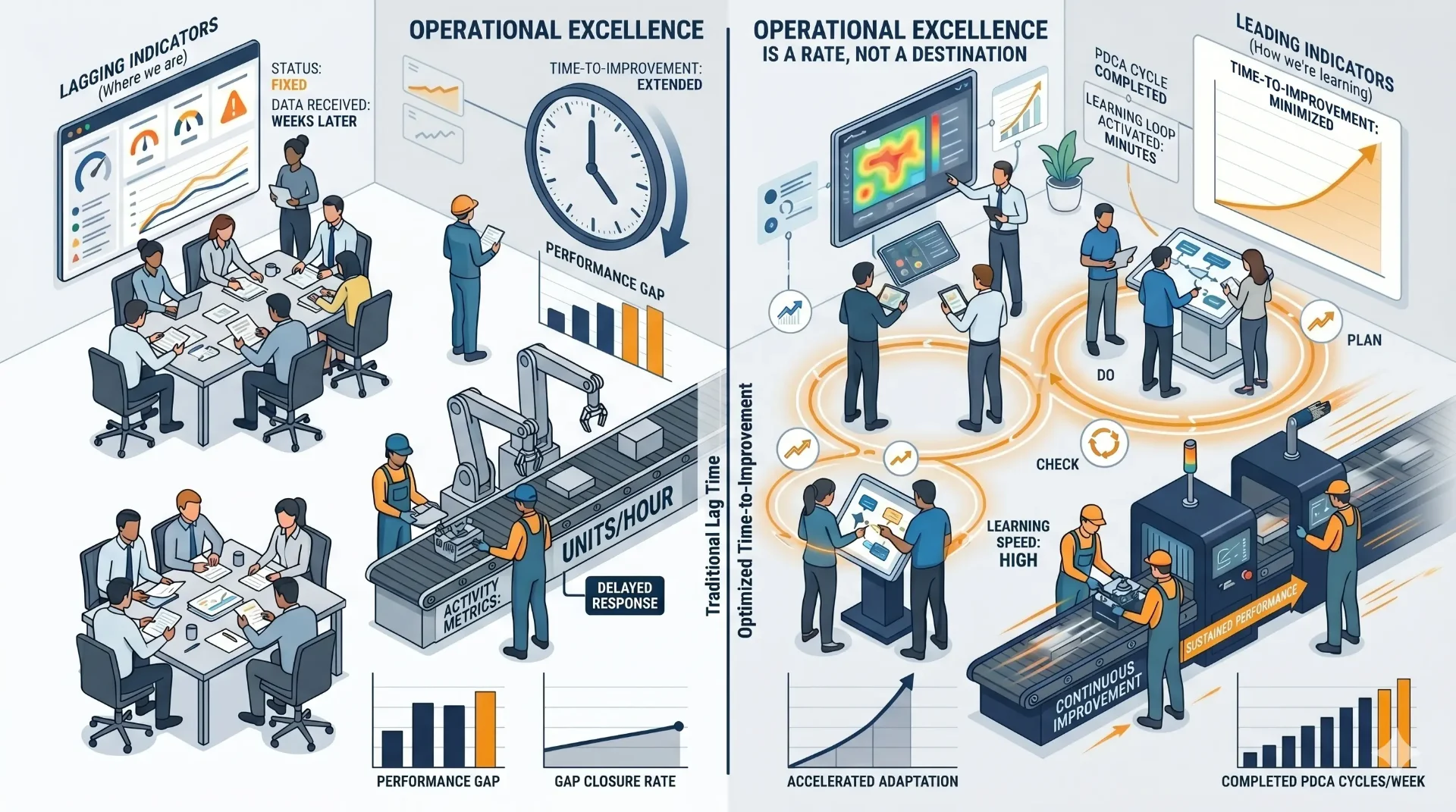
Most operations measure performance.
Very few measure the speed at which they improve performance or accelerate continuous improvement.
That might sound like a subtle distinction, but I think it's one of the biggest blind spots in modern operations.
Walk into almost any factory and you'll find no shortage of metrics. Safety performance, quality performance, delivery performance, OEE, downtime, labour productivity, customer complaints, inventory levels and cost performance are all carefully tracked. Entire management systems have been built around collecting, reporting and reviewing these numbers.
None of those metrics are bad. In fact, most are important.
The problem is that they are all describing the result of something. They tell us where we are. They tell us what happened. They tell us whether performance is improving or deteriorating.
What they don't tell us is how quickly the organisation is learning and converting experience into capability through continuous learning.
Over the years I've become increasingly convinced that the organisations that pull ahead are not necessarily those with the best current performance. More often they are the organisations that improve faster than everyone else around them.
That raises an interesting question.
If improvement speed matters, why don't we measure it?
The Problem With Traditional Operational Metrics
Most operational metrics were designed to measure outcomes. That's understandable because outcomes are visible. They are relatively easy to quantify and they fit neatly into reports, dashboards and executive reviews.
The challenge is that outcomes are lagging indicators of capability.
By the time a quality metric deteriorates, the conditions that created the problem have often existed for weeks or months. By the time customer complaints increase, the underlying causes may already be deeply embedded in the operation. By the time a monthly report highlights a trend, the opportunity to respond quickly may already have passed.
This creates an interesting situation. Organisations become highly effective at observing performance while remaining surprisingly poor at accelerating performance improvement.
I've sat through countless reviews where teams spent hours discussing performance gaps and very little time discussing how quickly those gaps were being closed. The scoreboard received enormous attention while the speed of continuous improvement received very little. The rate at which the organisation was learning received very little.
Yet in the long run, the second is usually more important than the first.
Why Learning Speed Matters
The world has become increasingly unforgiving of slow learning.
Markets change faster. Technology changes faster. Customer expectations change faster. Competitive advantages disappear faster. The pace of change itself has become a competitive force.
In that environment, organisations are no longer competing solely on assets, scale or expertise. Increasingly they are competing on their ability to recognise, respond, adapt and sustain operational excellence.
You can see this play out everywhere.
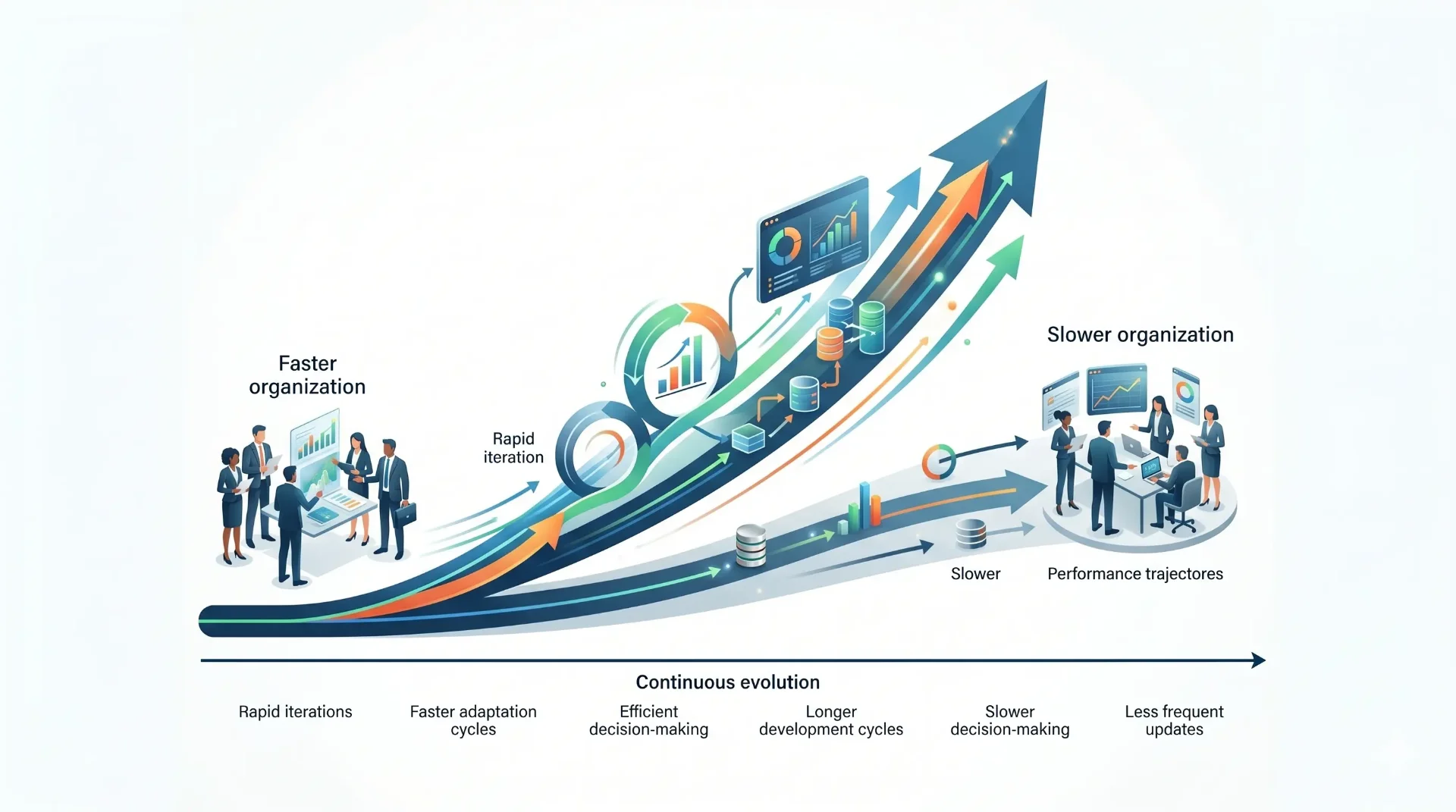
Two operations begin in roughly the same position. Five years later one has significantly outperformed the other. The difference is often attributed to leadership, culture, technology or investment. Sometimes those factors matter.
More often, what sits underneath them is learning speed.
One organisation recognises problems earlier. It solves them faster. It spreads learning more effectively and embeds improvements more consistently through its management system. Over time those advantages compound.
The organisation becomes progressively smarter. The gap widens.
Introducing Time-to-Improvement
This is where the concept of Time-to-Improvement becomes useful.
Time-to-Improvement is the elapsed time between recognising an opportunity to improve and achieving a sustained performance improvement.
The clock starts when an abnormality, opportunity, risk or problem becomes visible.
The clock stops when the improvement has been implemented, embedded and is consistently producing the intended outcome.
Simple concept. Powerful implications.
Because the moment you begin measuring improvement speed, you start looking at your operation differently.
Instead of asking whether problems are being solved, you start asking how long they remain unsolved. Instead of asking whether improvements are occurring, you start asking how quickly they occur. Instead of measuring activity, you start measuring adaptation and the speed of continuous improvement.
And adaptation is ultimately what operational excellence is all about.
The Hidden Delays Inside Most Organisations
One of the reasons I find this metric interesting is that it exposes something most organisations rarely see.
Delay. Not production delay. Not machine delay. Improvement delay.
I've seen obvious issues identified in January that remained unresolved in June. I've seen corrective actions spend months moving between departments while improvement opportunities remain stalled. I've seen opportunities discussed repeatedly in meetings without meaningful progress ever occurring.
Nobody intends for this to happen, yet it happens constantly.
The reason is simple — most organisations don't measure the delay.
Imagine a machine sat idle for six months waiting for somebody to make a decision. The waste would be obvious. It would attract immediate attention. Yet organisations regularly allow improvement opportunities to sit idle for similar periods of time without anybody noticing.
The cost is enormous, but it's simply hidden.
Time-to-Improvement Is Really A PDCA Metric
At first glance, Time-to-Improvement looks like an improvement metric. I think it's something deeper than that. It's a measure of how effectively an organisation completes learning cycles.
Every improvement begins with recognising a condition and strengthening the organisation's ability to execute continuous improvement. It then requires investigation, experimentation, action, evaluation and standardisation. In other words, every improvement is a PDCA cycle.
What Time-to-Improvement really measures is the speed at which those cycles are completed.
This becomes particularly interesting when organisations quietly drift away from PDCA and into something else.
Plan. Do. Plan. Do. Plan. Do.
The Check and Act phases become progressively weaker. Learning slows because capability is not being embedded into standard work. Activity continues. Meetings continue. Projects continue.
Learning slows and Time-to-Improvement stretches. The organisation remains busy while becoming only marginally smarter.
In my experience, slow improvement cycles are rarely caused by a lack of effort, they're usually caused by weak continuous learning systems.
The Future Belongs To Organisations That Improve Faster
Most organisations spend their time measuring where they are. The more important question may be how quickly they're moving because in the end, operational excellence is not a destination — it's a rate.
It's the speed at which an organisation can identify reality, learn from it and adapt.
The organisations that pull ahead over the next decade will not necessarily be those with the best equipment, the biggest budgets or the most impressive dashboards. They will be the organisations with the shortest Time-to-Improvement because sustained performance improvement ultimately depends on learning speed.
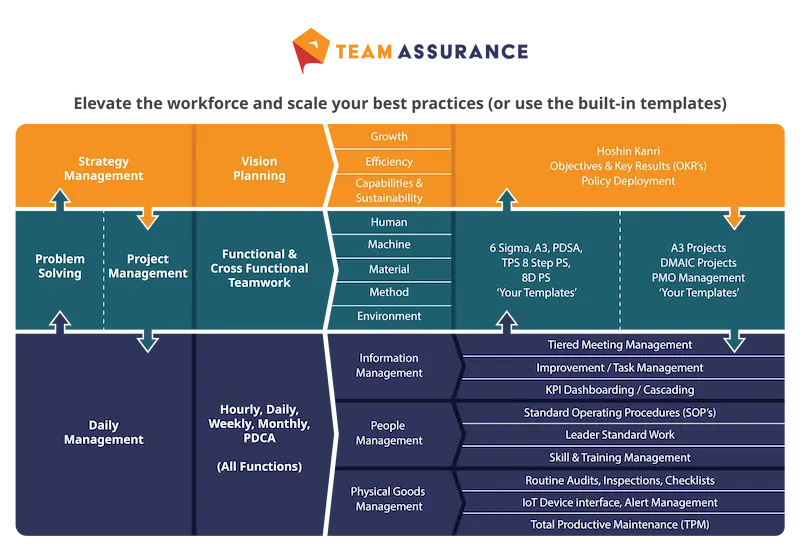
The TeamAssurance Operational Excellence Framework below illustrates how strategy, problem solving, project management and daily management work together as one connected system. By aligning these capabilities, organisations can reduce Time-to-Improvement and drive more sustainable performance improvement.
Ready to shorten your organisation's Time-to-Improvement? Book a demo to see how TeamAssurance helps connect strategy, daily management and continuous improvement into one Operational Excellence platform.