
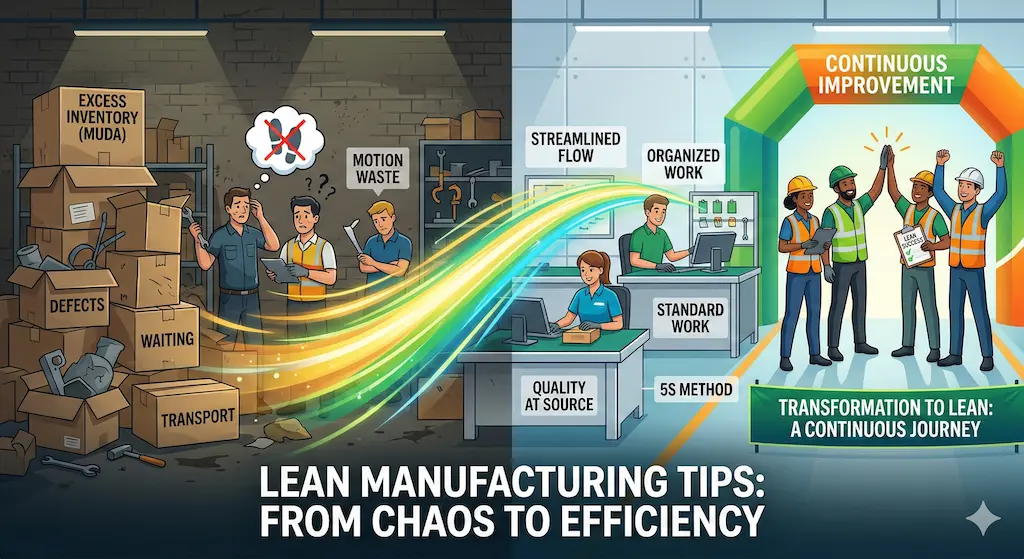
Practical lean tips to help your organisation improve performance and sustain continuous improvement.
The lean tips that sustain operational excellence are mostly about routine rather than tools: run short daily tier meetings at a fixed time, keep the measures few and visible, give every problem an owner and a date, go and see before deciding, and keep leaders in the rhythm through their own standard work.
At a glance
- Focus: routines over tools, starting with a daily tier meeting at the board.
- Six tips: focus on fundamentals, invest in people, use digital tools thoughtfully, connect strategy to daily management, build habits not events, and learn from everything.
- Sustaining gains: standardise the improvement, train it through the skills matrix, audit the standard and keep the measure on the board.
- Related: what is operational excellence? and daily habits.
As we reflect on what makes Lean transformation successful, some principles stand out as consistently important. Whether you're just beginning your Lean journey or looking to reinvigorate an established program, these tips will help you focus on what matters most.
1. Why focus on fundamentals?
The most successful Lean organisations excel at the basics – standard work, visual management, and problem solving. It's tempting to chase advanced tools and methodologies, but without a solid foundation, they simply don't stick.
Ask yourself: Do our frontline teams have clear, documented standards for how work should be done? Is deviation from those standards immediately visible? Can every team member articulate a simple problem-solving approach?
If the answer to any of these is no, start there. The fundamentals are fundamental for a reason.
2. Why invest in your people?
Lean transformation is fundamentally about developing people who can see problems and solve them. Tools and systems are important, but they're only as effective as the people using them.
This means:
- Training – Not just classroom training, but on-the-job development through coaching and practice
- Empowerment – Giving frontline teams the authority and capability to make improvements in their areas
- Respect – Truly listening to the people closest to the work and valuing their insights
- Recognition – Celebrating improvement efforts, not just results
Toyota's principle of "respect for people" is not a nice-to-have – it's the engine that drives sustainable improvement.
3. How should you use digital tools?
Technology can enhance Lean practices when applied thoughtfully and in service of Lean principles. The key word is enhance – digital tools should amplify good practices, not substitute for them.
A digital daily management platform can extend the reach of your tier meetings, connect distributed teams, and provide data insights that physical boards cannot. But the technology must serve the process, not the other way around.
4. How do you connect strategy to daily management?
Ensure that improvement efforts are aligned with organisational priorities. Without this connection, you risk generating lots of activity that doesn't move the needle on what matters most.
Hoshin Kanri provides a structured approach to cascading strategic objectives through the organisation. When combined with tiered daily management, it creates a system where everyone understands how their daily work contributes to strategic success.
5. Why build habits, not events?
Sustainable improvement comes from consistent daily practice, not occasional events. Kaizen events have their place, but they cannot substitute for the discipline of daily improvement.
The organisations that sustain Lean over the long term are those where improvement is woven into the fabric of daily work. Every huddle, every shift handover, every quality check is an opportunity to identify and act on improvement.
Discipline is the bridge between intention and results. Build the habits that support daily improvement and the results will follow.
6. How do you learn from everything?
Becoming a learning organisation requires capturing and sharing knowledge systematically. Every problem solved, every process improved, every experiment run generates learning that can benefit the wider organisation.
Create systems that capture this learning – not in reports that nobody reads, but in accessible, visible formats that inform daily decisions. The organisations that learn fastest are the ones that improve fastest.
Frequently asked questions about lean tips
What is the single most useful lean practice to start with?
A daily tier meeting at the board with a standard agenda. It creates the habit of looking at performance and acting on gaps, and gives every other lean tool a place to be reviewed.
Which lean tools matter most for operational excellence?
Visual management, standard work, structured problem solving (5 whys, A3 report, PDCA) and leader standard work. Tools used inside a daily management rhythm hold; tools used in isolation fade.
How do you sustain lean gains?
Standardise the improvement, train it through the skills matrix, audit the standard, keep the measure on the board after the project ends, and treat drift as a problem to solve rather than a failure to blame.
Why does a connected framework matter for all of these tips?
These tips are interconnected – each supports and reinforces the others. And they all benefit from a connected framework that brings together standardised problem solving, SOPs, tiered daily management, and strategy deployment.
The illustration below shows how TeamAssurance connects these elements into an integrated platform.
If you're a business in need (or a consultant with clients in need) and you'd like to explore how TeamAssurance can support your Lean journey, contact us for a demonstration today.