

Welcome to the first instalment in a series exploring the transformative power of digitization in front line operations. In this article, we delve into the key reasons behind this shift. We will look at Total Productive Maintenance (TPM) and the Lean methods it utilises as practical examples of how Small & Medium sized businesses are now able to unlock benefits previously only available to their larger competitors.
Understanding the Need for Digitisation in Operations
Your competitors have already understood that digitization unlocks the possibility for step change improvement. Firstly, when thinking of your competitors, don't just think of individual companies, think of whole economies (like India) embracing digitization.
Furthermore, when thinking of step change, simply try to visualize '10X' levels of improvement. To simplify what 'step change' means, choose a critical frontline process and roughly calculate what a 10X increase in velocity, capacity and agility would do for the organization.
This is what is available to both you – and your competitors – right now.
Digitizing Your Total Productive Maintenance Program
Total Productive Maintenance (TPM) is widely demonstrated to ensure the most reliable assets, at the highest levels of safety & quality, at the lowest cost.
But it is both resource intensive – and by definition – is a team game. It requires careful and continuous coordination so that all links in the chain, or 'pillars' are at their best. Some of these pillars include:
- Tiered Daily Management Systems
- Equipment Maintenance Management
- Continuous Improvement Frameworks
- Quality Management
- Safety and Environment Management
- Education and Training Management
Applying a Step Change mindset to each and every one of these Pillars is critical in delivering the final promise.
Since TPM relies on all areas improving simultaneously, we will first take a broad look at what digitization can deliver across all of these Pillars simultaneously.
The Benefits of Digitisation: A Triple-Threat Advantage
10X Velocity: Digitisation accelerates every process, turning the batching of information into a real-time business wide feed. It enables all functions involved to triage, prioritise and empower employees in their day-to-day activity, to always be working on the right thing – together as a Team.
Through the emphasis on proactive 'discovery' of problems in their infancy, digitisation enables the org to connect its internal processes cross-functionally, rather than simply optimising one group of people, to the exclusion of others.
Continuous feedback also means Team members stay engaged and can see the outcomes of their discretionary efforts bearing fruit.
10X Capacity:
Today, every Team member must be seen as a knowledge worker. But what knowledge do we mean? The answer is 'All of it': whether this is knowledge within the Process, People or Systems of the business, it should obviously all be made available to whoever needs it, when and wherever its needed.
When we view this challenge as simply a process of removing the barriers that prevent this knowledge from being available, a fresh approach may be made. Fortunately, using an existing Tiered Daily Management & Learning System provides the structure to identify and eliminate these barriers as they are seen.
When each of our Team members have all that they need at hand to execute best-in-class processes, connected with their adjacent functions, the power of 1+1 = 3 really does begin to make sense.
10X Agility:
The digital era demands flexibility. Operations digitization allows businesses to pivot quickly, adapting to new opportunities or challenges with ease. Simply gaining visibility of each and every system, with granular real-time detail, provides all Team Members the opportunity to respond or adapt in an informed way.
The automatic collation of Process & System performance (best suited to computers) across all levels and reporting cadences, gives valuable time back to those Team Members for analysis, Team discussion and most importantly decision making (best suited to humans).
Speeding up the PDCA process is one thing, but being able to accurately communicate in a timely manner to all stakeholders involved, ensures that people not only know what they need to prioritise, but why they need to.
TPM Is Not an Isolated Continuous Improvement Process
Implementing total productive maintenance should follow traditional PDCA approach in order to be effective. To do so, you must ensure the alignment of all of the people, processes and systems involved. That means considering how adjacent processes and systems within our CI framework interact. Plus, ensuring that each element is connected to another.
The Lean tools we discuss regularly like tiered daily management, standardised problem solving techniques, daily huddles, and Kamishibai Boards should all be developed alongside the elements of our TPM program.
The illustration below demonstrates how we designed the interconnected TeamAssurance platform to avoid locally optimised, disconnected 'Point Solutions' (digital or analog) that do not help and can hinder your organisation's TPM efforts.
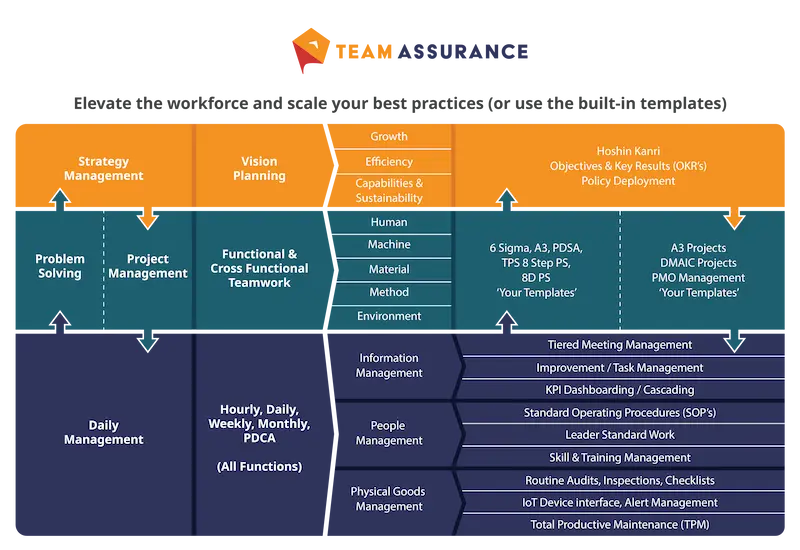
If you're a business in need (or a consultant with clients in need) and you'd like to explore how to implement TPM digitally contact us for a demonstration of the TeamAssurance platform today.