In a world overwhelmed with data, the challenge isn't accessing information – it's making it meaningful, timely, and actionable. Visual management is the Lean practice of making the status of work, performance, and problems immediately visible to everyone who needs to see them.
What is Visual Management?
Visual management is the use of visual signals, displays, and controls to communicate information at a glance. The goal is to create an environment where anyone can walk into a workspace and immediately understand:
- What should be happening
- What is actually happening
- Whether there is a gap between the two
This principle applies everywhere – from factory floors to office environments, from frontline operations to executive boardrooms.
Why Visual Management Works
Humans process visual information far more quickly than text or speech. A well-designed visual display communicates in seconds what might take minutes to explain verbally. This speed matters in operations where timely response to abnormalities can prevent small issues from becoming big problems.
Visual management also:
- Democratises information: Everyone sees the same data, reducing information asymmetry between management and frontline workers
- Drives accountability: When performance is visible, teams naturally take ownership
- Enables rapid response: Abnormalities are spotted quickly, enabling faster intervention
- Supports standard work: Visual aids make standards easier to follow and deviations easier to spot
Types of Visual Management
Performance Displays
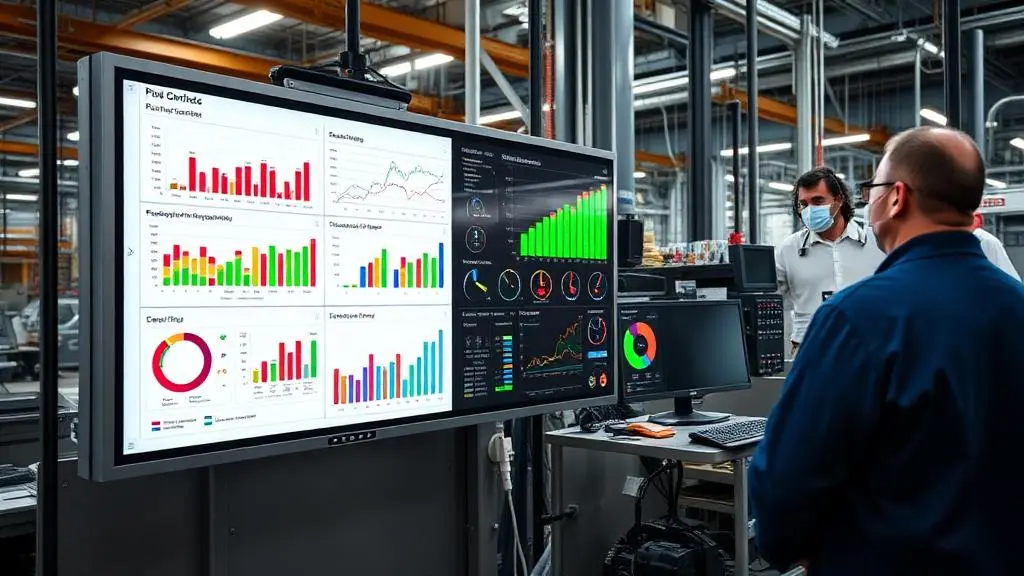
Boards, screens, or dashboards showing key metrics – safety incidents, quality rates, production output, delivery performance. These are typically reviewed in daily tier meetings.
Process Controls
Visual signals that indicate the status of a process – traffic light indicators, andon boards, kanban signals. These enable real-time response to abnormalities.
Standard Work Displays
Visual instructions, one-point lessons, and standard operating procedures displayed at the point of use. These support consistent execution of standard work.
Problem-Solving Displays
A3 reports, action tracking boards, and root cause analysis displays that make improvement activity visible to the team.
From Physical Boards to Digital Displays
Traditionally, visual management relied on physical boards – whiteboards, printed charts, sticky notes. While physical boards have their advantages (tactile interaction, simplicity), they also have limitations:
- Information becomes stale if not updated regularly
- Remote team members can't see the boards
- Historical data is lost when boards are cleared
- Scaling across multiple sites is difficult
Digital visual management tools address these limitations while preserving the core principle: making information visible, timely, and actionable.
TeamAssurance provides digital tier boards that combine real-time data with the visual simplicity of a physical board. Teams can view performance, log issues, track actions, and escalate problems – all from a single, always-current display.
Visual Management in Tiered Daily Management
Visual management is most powerful when embedded in a tiered daily management structure:
- Tier 1: Frontline teams review their visual boards daily, identifying issues and tracking actions
- Tier 2: Supervisors and managers review aggregated visual data, triaging cross-functional issues
- Tier 3: Senior leaders review site-wide visual dashboards, connecting daily operations to strategic goals
At each tier, the visual display should answer three questions: Where are we? Where should we be? What are we doing about the gap?
Getting Started with Visual Management
- Identify the critical few metrics that matter most to your team's performance
- Make them visible – whether on a physical board or digital display – where the team gathers daily
- Review them daily in structured tier meetings
- Act on abnormalities by logging issues and tracking countermeasures
- Iterate – adjust what you display based on what drives the most value
Part of the Connected C.I. Framework
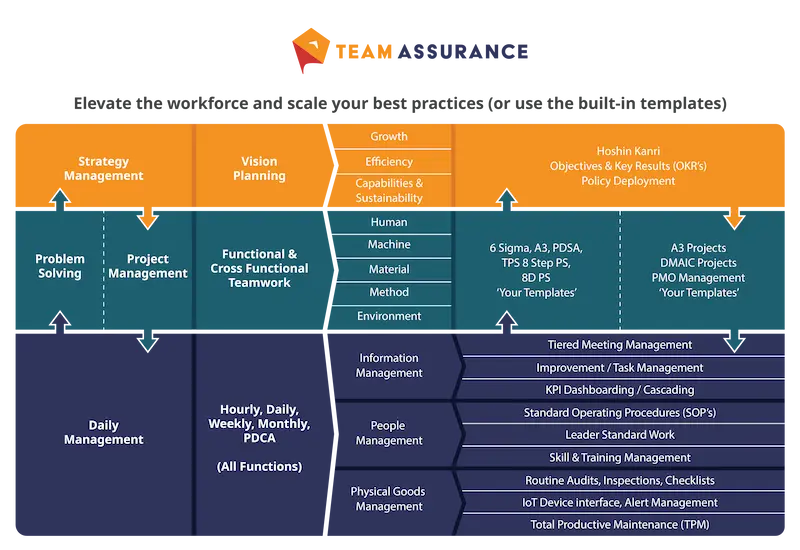
Visual management doesn't exist in isolation. It's the communication layer that connects daily management, problem solving, standard work, and strategy deployment.
If you're a business in need (or a consultant with clients in need) and you'd like to explore how digital visual management can transform your operations, contact us for a demonstration of the TeamAssurance platform today.