
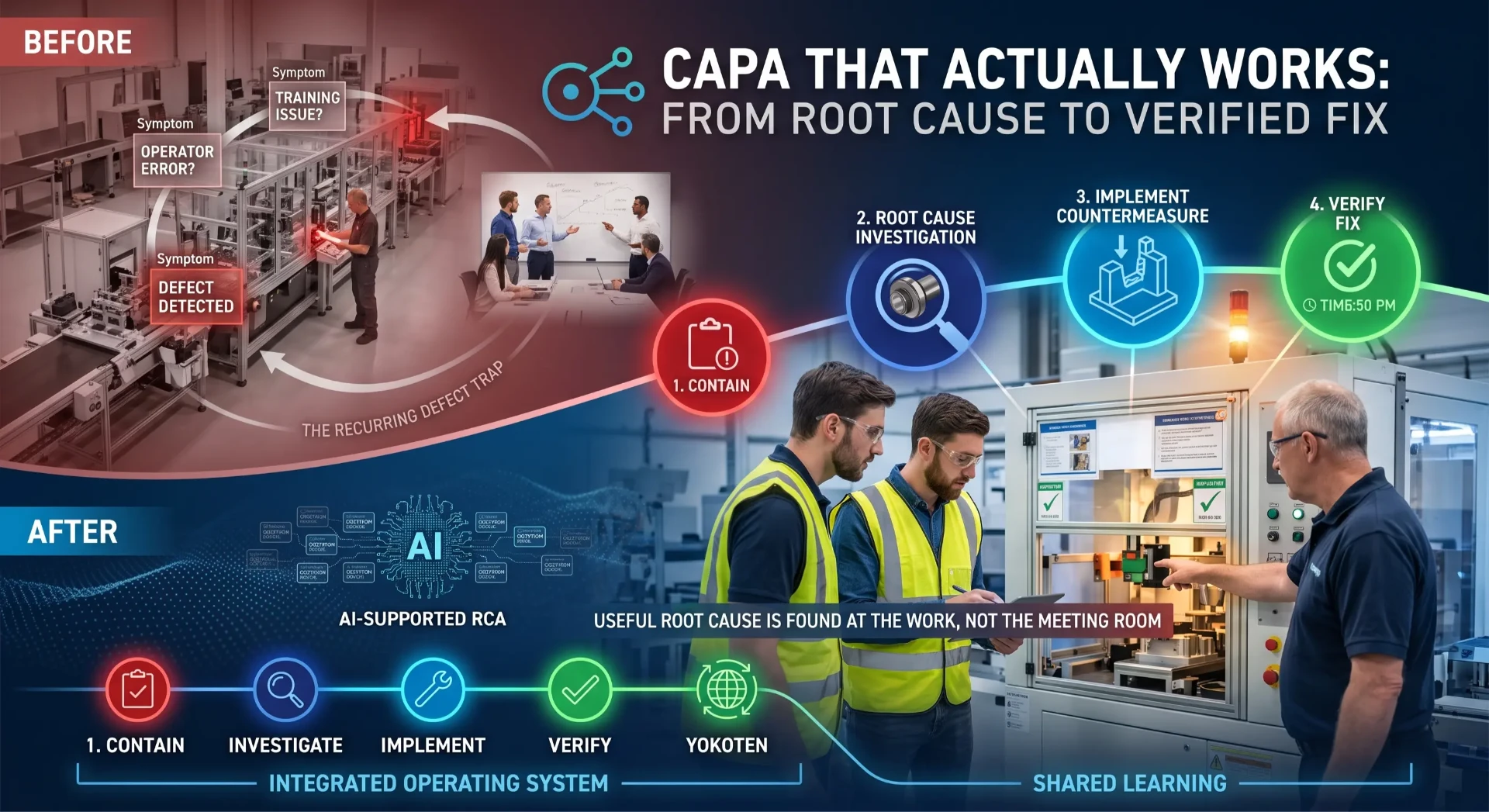
CAPA is one of those words that sounds more serious than it often behaves.
Corrective and Preventive Action. Big acronym and promise, but too often a small result.
At its best, CAPA is how a business learns from failure, removes the cause, verifies the fix, and shares the lesson before another team endures the same lesson. At its worst, it becomes a polite document trail behind a recurring defect. Everyone fills in the boxes. The issue returns anyway. A good CAPA process should change the work - that is the whole point.
What Is CAPA, and Why Do Most Processes Fail at It?
CAPA is meant to deal with problems properly. Not just contain the mess, not just apologise nicely, not just close the complaint, but understand what happened, why it happened, what allowed it, what needs to change, and whether the change actually worked.
The useful version is practical because it connects the defect, the investigation, the action, the owner, the standard, the training, the check, and the verification. It does not let the lesson float away after the meeting and that is where its value is.
The Difference Between Corrective and Preventive Action
Corrective action deals with the issue that has already happened. A defect escaped, a batch failed, a customer complained, a process drifted, a control broke down. Corrective action should remove or reduce the cause so the issue does not repeat.
Preventive action looks wider. It asks where the same condition might exist elsewhere. Same product family. Same line. Same business unit, Same supplier. Same method. Same inspection weakness. Same training gap. Same workaround waiting to bite.
Corrective action fixes the wound. Preventive action checks whether the same risk is still lying around the building.
Why CAPA Becomes a Paperwork Exercise
CAPA becomes paperwork when the process is built around completion rather than learning.
The investigation gets written, the cause gets named, the action gets assigned and the due date gets chased. The status turns green and everyone sleeps better...then the problem comes back.
Sometimes the action was weak. Sometimes the cause was guessed from a meeting room. Sometimes the 'root cause' was really just a symptom. Sometimes the fix was never verified at the work or sometimes the lesson simply never reached the next shift, line or site. The form was completed but the process was not improved.
The Real Cost of a CAPA That Doesn't Stick
A CAPA that does not stick is expensive in a sneaky way. It rarely shows up as one clean line in the accounts. It seeps in though scrap, rework, customer credits, overtime, customer irritation, extra inspections, repeated meetings, repeated investigations, and the slow loss of confidence that comes when people see the same issue return.
Repeat Defects, Repeat Investigations
Repeat defects are a tax paid for weak learning. The second investigation is usually duller than the first and the third one starts to feel like improvement theatre. People already know the issue, have seen the pictures, have heard the theory, and know the customer is annoyed. They know the team is tired of it.
A strong CAPA process should make the second occurrence less likely because the first one was handled properly. The business should not need to rediscover its own lessons every month & quarter.
The Hidden Cost of Reopened Problems
Reopened problems carry more than technical cost - they chew up trust.
The customer wonders whether the business really understood the issue. The operator wonders why the same defect keeps getting urgent attention after the fact. The supervisor wonders why another action has appeared for a condition that was supposedly fixed. The quality team gets dragged back into the same issue. Rework inside the CAPA system is still rework.
A reopened problem tells the business something useful. The fix did not hold, the cause was incomplete, the standard was not changed, the training did not land, the control was too weak, or the verification step was skipped.
Root Cause Analysis: Where Most CAPA Processes Go Wrong
Root cause analysis is where many CAPA processes start off on the wrong foot.
The business wants speed, the customer wants answers, the team wants closure, and someone wants the action list cleaned up before the review. So the cause gets named too early. Operator error. Training issue. Procedure not followed. Communication breakdown - the four phrases that should make any serious operations person sit up and take notice. Root cause...or symptom?
Symptom vs. Root Cause
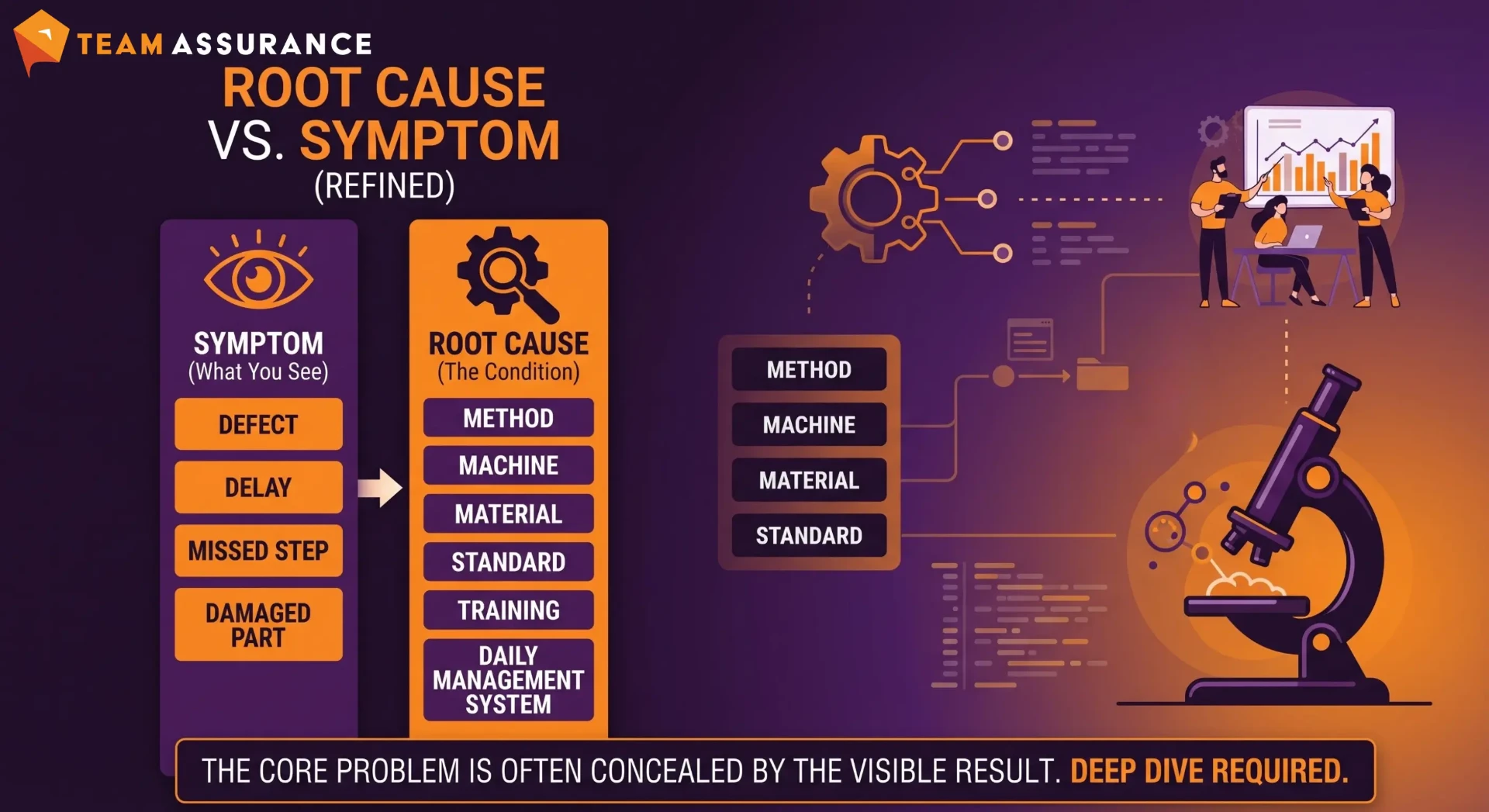
A symptom is what the business can see. A defect, a delay, a failed check, a customer complaint, a missed step, a damaged part. The root cause is the condition that allowed it to happen.
That condition may sit in the method, material, machine, measurement, environment, supplier process, standard work, training, layout, maintenance plan, change control, inspection design, leadership routine, or daily management system.
A good CAPA process keeps digging until the cause is useful enough to act on. Not perfect, just useful.
If the action after the investigation is "retrain operator," tread carefully. Training has its place, but when every problem becomes a training problem, the business has stopped looking properly.
Common RCA Methods: 5 Whys, Fishbone and Fault Tree
The tools are fine. Use 5 Whys, a fishbone, a fault tree analysis. Use whatever helps the team think clearly. Just do not worship the template.
Five bad whys are still bad. A fishbone full of guesses is still guessing. A fault tree built away from the work can look impressive while missing the obvious condition sitting beside the machine. The method should help people see the work more clearly and that is all.
Good RCA uses facts, direct observation, evidence, process knowledge and deeply involves the people closest to the work. It tests assumptions and separates what is known from what is imagined and importantly, it avoids blaming the last person who touched the process.
Why RCA Needs to Happen at the Work, Not in a Meeting Room
The work environment has all the clues. The meeting room has coffee, a comfy chair, everyone's opinions and a whiteboard someone should have cleaned six months ago.
Go to the process, look at the part, watch the method, check the fixture, read the standard, talk to the operator. Compare shifts, review the inspection point, look at the actual condition, not the version described three handovers ago.
A CAPA process gets stronger when root cause analysis happens where the problem was created. That is where the awkward tool and the unclear label is. That is where the standard does not match the work and where the machine behaves differently after hour 6, or where the inspection point catches the defect too late.
Building a CAPA Process That Creates Real Change
A strong CAPA process has rhythm. It moves from containment to investigation, countermeasure, verification, standardisation and sharing. Each step has a job. Skip one and the process gets weaker.
Step 1 — Contain the Immediate Issue
Containment protects the customer and the next process. Stop the defect travelling. Isolate suspect stock, add temporary checks, notify the right people and stabilise the condition. Make the risk visible and do what is needed to keep the issue from spreading. Containment is not the fix but it buys time for thinking.
Step 2 — Investigate the Root Cause
Investigation should explain how the issue happened and why the system allowed it. Use the tools, but stay close to the work. Pull the data, review the history, compare similar issues and check recent changes. Look across shifts, suppliers, equipment, standards and inspection points.
The investigation should end with a cause that can be acted on. If the cause points only to carelessness, awareness or communication, keep digging a little longer. The process is probably hiding something.
Step 3 — Implement the Countermeasure
A countermeasure should change the condition. It may improve a fixture, update a standard, change an inspection method, modify a PM, improve a poka-yoke, clarify a specification, change supplier controls, adjust a layout, update some training, or improve escalation. The action should be specific enough to inspect and strong enough to matter. "Remind team" is rarely a countermeasure folks...
Step 4 — Verify the Countermeasure Actually Worked
Here is where the rubber grips the road. Verification asks whether the countermeasure changed the condition and prevented recurrence. It needs evidence from the work. Not just a completed task. Not just a photo or closed status.
Check the process after the fix has had time to prove itself. Review the defect data, talk to the team, audit the standard, watch the method and confirm the control is being used and still makes sense.
Closed means the action was completed, where fixed means the condition changed. A CAPA system with integrity treats the two differently.
Step 5 — Standardise and Share the Lesson: Yokoten
When a lesson is useful, share it. Yokoten is the habit of sharing learning horizontally. Across shifts, lines, products, departments and sites. The purpose is simple. Do not make another team pay for the same lesson at full price.
Update the standard, adjust the training, add the audit point, share the watch-out. Check similar processes and build the improvement into the operating system. This is where the compounding effects silently take effect.
Why Verification Is the Step Most CAPA Systems Skip
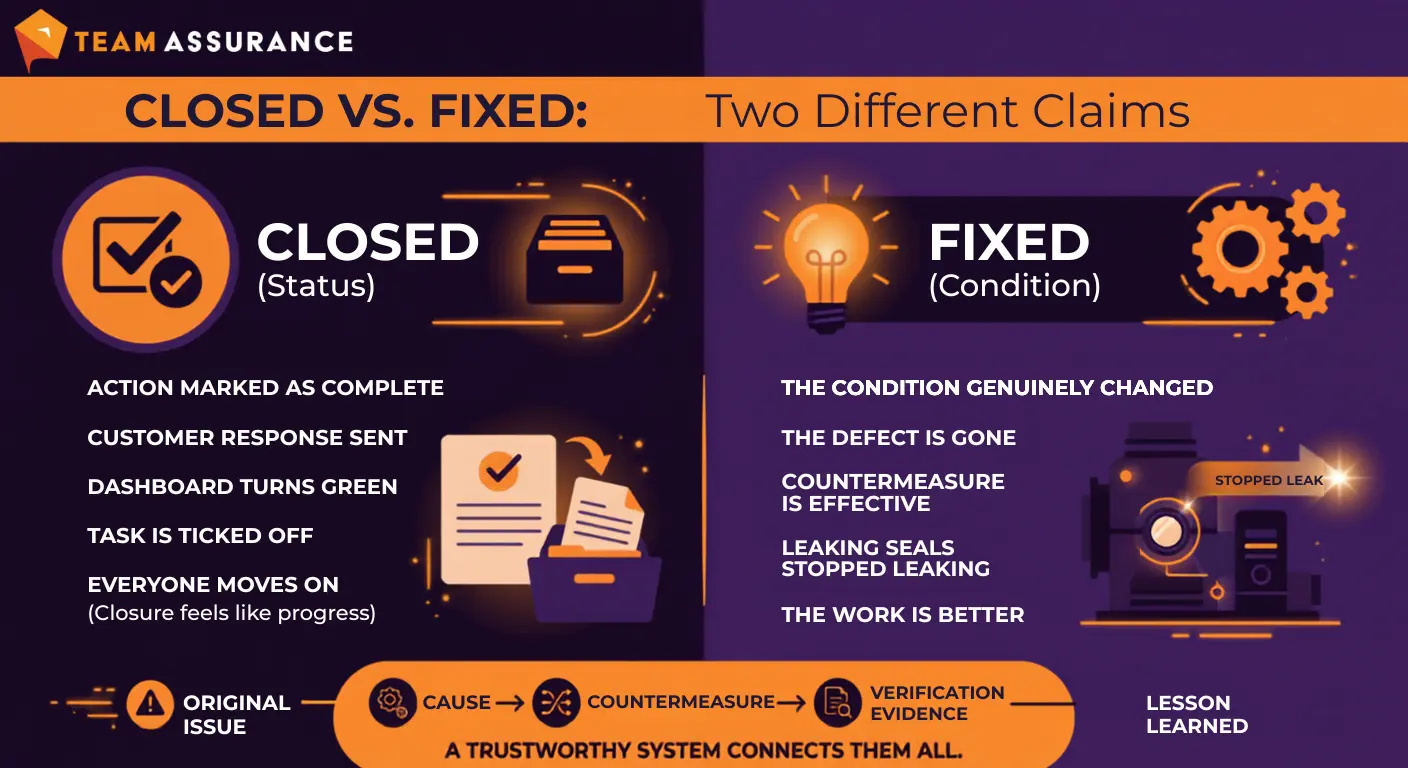
Verification gets skipped because everyone is busy and closure feels like progress. The action is done, the customer response is sent and the meeting is over. The dashboard looks cleaner, a dopamine hit kicks in. But the defect does not care about any of this.
Verification is the step that protects the business from false closure. It proves whether the action worked in the real process. It stops weak countermeasures being celebrated too early. It shows whether a problem has actually been reduced or merely administrated.
This is where TeamAssurance thinking matters. The action should not just disappear into a list. It should stay connected to the issue, the cause, the countermeasure, the verification evidence, and the lesson to be shared. The system should help people finish the work properly.
Connecting CAPA to the Rest of the Operating System
CAPA should be part of the way the business runs. Quality does not live on an island, despite the number of systems trying to build one.
A defect may connect to safety, delivery, cost, people, maintenance, training, supplier performance, customer requirements, change control, standard work or daily management. Treating CAPA as a separate quality ritual cuts it off from the places where the fix often needs to happen. That is how the same defect can begin to feel like a work colleague.
Why CAPA Shouldn't Live in a Silo
A siloed CAPA process creates local closure and system-level blindness. Quality owns the file, operations owns the pain, Maintenance owns part of the cause, Engineering owns the fixture, Procurement owns the supplier conversation, Training owns the skill gap and the customer owns the irritation. The CAPA process needs all of them to be connected.
A good operational management system lets CAPA move through the business with clear ownership, escalation, support and visibility. The issue does not get trapped in one department's queue. It becomes managed work.
How CAPA Connects to Safety, Quality, Delivery, Cost and People
CAPA is naturally cross-functional. In safety, a corrective action may remove a hazard or strengthen a control. In quality, it may reduce defects and complaints. In delivery, it may stabilise flow and reduce interruptions. In cost, it may reduce scrap, rework, credits and wasted effort. In people, it may improve standards, training and confidence. Its the same operating system with different doors into the work.
The best CAPA processes make those connections visible. One issue can have many consequences. One good fix can create permanent value across the business.
How AI Is Changing CAPA and Root Cause Analysis
AI can make CAPA sharper when it has real operational context. It can scan history, cluster 'like' issues, surface recurring causes, compare countermeasures, identify reopened problems, and show where the same condition appears across sites. That saves time and improves the starting point for human judgement.
The machine can do the dull looking. People still need to do the thinking, checking, deciding and verifying. In a large and fast moving business, this is a good arrangement.
Clustering Similar Issues Automatically
CAPA records are often written in different words for the same basic issue. One site calls it a seal failure. Another calls it leakage. Another calls it contamination risk. Another calls it customer complaint, packaging defect, line stoppage or supplier issue.
AI can simply help cluster those records and show the pattern underneath. That gives quality leaders a better view of repeated problems that would otherwise stay scattered across reports and systems, so the lesson becomes easier to find.
Surfacing Recurring Root Causes Across Sites
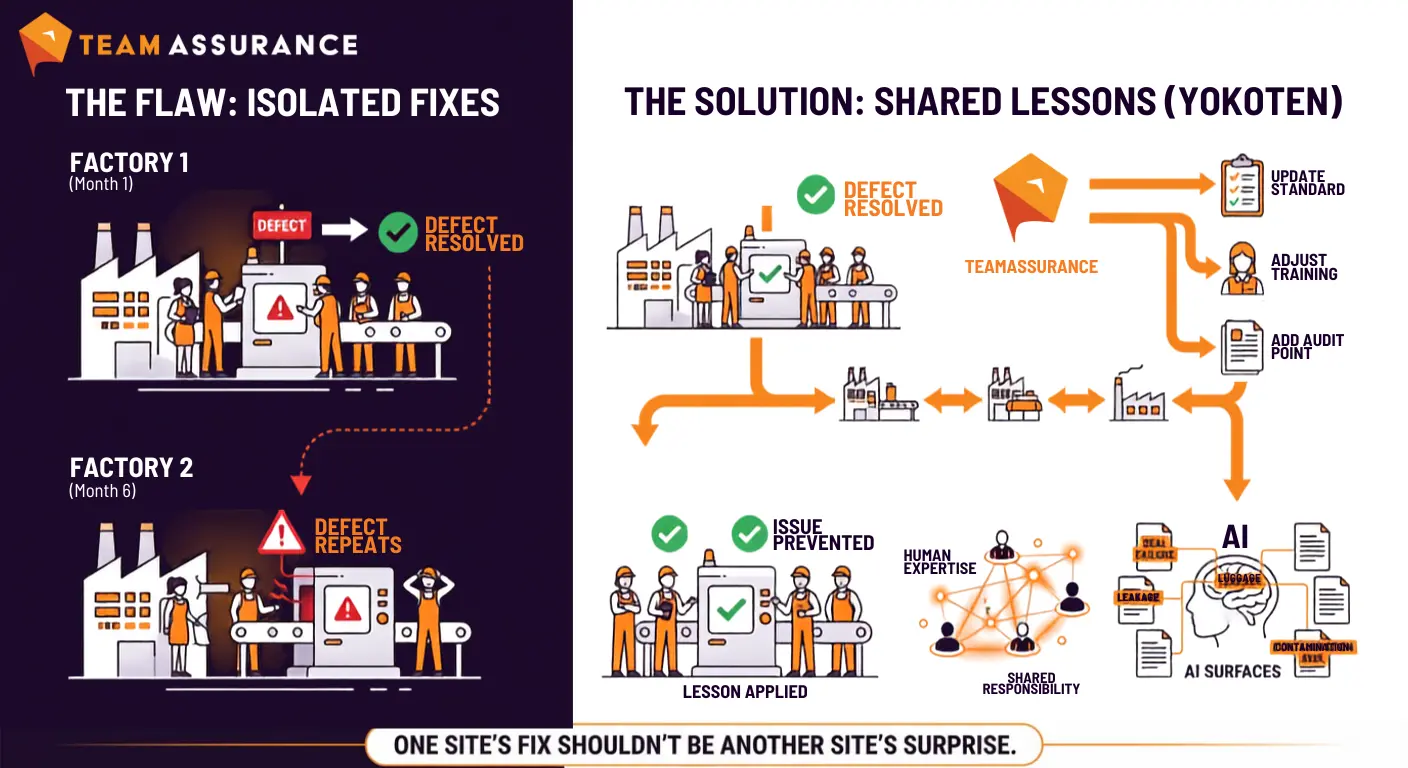
Multi-site operations need this badly.
A problem solved in one factory should help the next factory before it becomes their problem too. AI can help surface recurring root causes across sites, product families, lines, suppliers and equipment types.
That does not remove the need for local investigation. It improves the starting point. A team can see what others tried, what worked, what failed, and which countermeasures held after verification. This is very practical support.
CAPA Best Practices Checklist
Keep the process close to the work. Define containment clearly. Use evidence, not opinions. Separate symptoms from causes. Test assumptions. Assign actions to owners with enough authority to change the condition. Link actions to the cause. Verify before closure. Standardise the learning. Share it through Yokoten. Check similar areas. Use AI to find patterns, not to replace judgement. Keep the customer response honest. Keep the operating system connected.
Frequently Asked Questions
What's the Difference Between CAPA and Root Cause Analysis?
Root cause analysis is one part of CAPA. It helps the team understand why the issue happened and what condition allowed it. CAPA is the full process: contain the issue, investigate the cause, implement the countermeasure, verify the result, and standardise the learning. RCA finds the cause. CAPA carries the learning into action.
How Long Should a CAPA Stay Open Before Verification?
Long enough for the countermeasure to prove itself.
That timing depends on the issue. A high-frequency defect may be verified quickly because new data appears within days. A rare failure mode may need weeks or months. The key is to define the verification method, who will verify it, and timing when the action is created, not after everyone has forgotten why the action existed.
Set the expectation early. Then go and check.
What Software Is Used for CAPA Management?
CAPA can be managed in quality management software, incident management systems, operational excellence platforms, ERP quality modules, spreadsheets, or a mixture of all the above, because apparently businesses enjoy archaeology.
The better option is a connected operational management system that links CAPA to actions, meetings, escalations, audits, standards, skills, daily management and cross-site learning.
TeamAssurance supports CAPA as part of the operating system, not as a lonely quality file waiting for someone to reopen it.
Conclusion
CAPA works when it changes the work. The issue is contained. The cause is understood. The countermeasure is implemented. The result is verified. The lesson is standardised and shared. The same problem becomes harder to repeat.
Good CAPA protects the customer, strengthens the process, reduces waste, supports operators, improves standards and builds organisational memory. Add AI carefully and the system can find patterns faster, connect similar issues, and help teams start from what the business already knows.
But the final test remains beautifully plain.
Did the fix hold? If yes, share the lesson. If no, keep working.
Book a demo to see how TeamAssurance connects CAPA, actions, verification and operational learning into one management system.