
Introduction
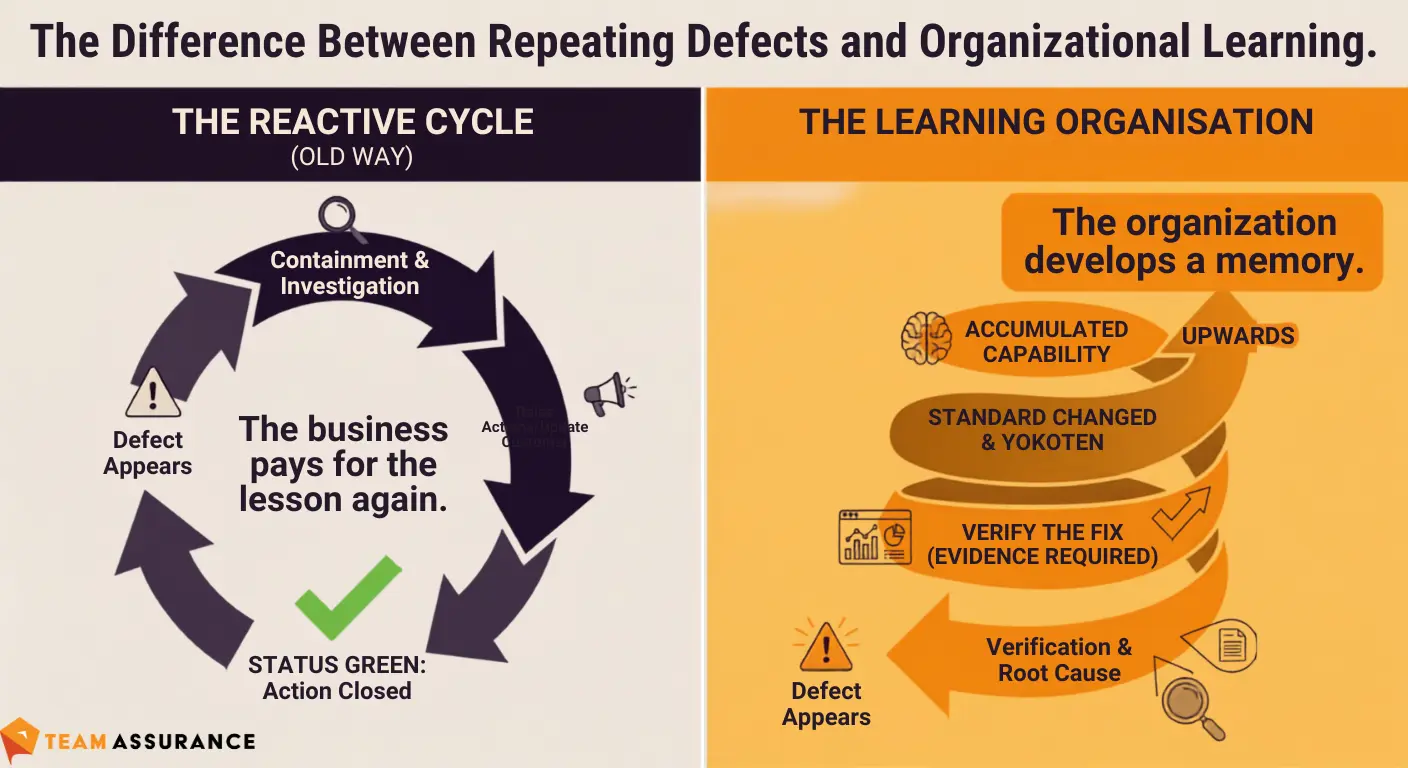
Every defect teaches the business something. The expensive part comes when the business pays for the same lesson again six months later.
A quality issue appears, the team contains it, investigates it, raises actions, updates the customer, and eventually turns the status green. Everyone moves on. Then another shift, another line or another factory meets a remarkably similar problem under a slightly different description and starts the whole process again.
Good manufacturers get increasingly difficult to surprise in the same way twice. They keep what they learn. They verify whether fixes actually worked, move lessons across the organisation, and build that learning into standards, training, controls and Tiered Daily Management. Over time, that becomes an advantage because the organisation develops a memory.
Why Some Manufacturers Stop Seeing the Same Defect Twice
A mature quality system does more than process defects. It gets smarter from them.
When a seal failure occurs, the lesson should survive the investigation. When contamination is traced to a cleaning method, that knowledge should reach similar processes. When an inspection catches a defect too late, the improvement should influence the next standard. When one site finds a countermeasure that genuinely holds, another site should not have to rediscover it through its own customer complaint.
This takes discipline. Someone has to verify the fix, capture what mattered and move the lesson to the places where it can be reused. Do that consistently and the organisation begins to accumulate capability instead of merely accumulating closed records.
Organisational Learning vs. Good Luck: What's the Difference?
Sometimes a defect disappears after an action and never returns. The temptation is to declare victory. A learning organisation asks one more question: do we know why it stopped?
Perhaps the countermeasure worked or the demand changed. Perhaps the troublesome material lot disappeared. Perhaps maintenance quietly corrected something else. Perhaps the defect simply has not had another opportunity to show itself.
Knowing the difference matters because Organisational learning requires evidence. The countermeasure is understood, the result is checked, the standard changes where required, and the lesson becomes available to other people facing the same condition. Luck requires considerably less administration, although unfortunately it is difficult to standardise.
What Organisational Learning Actually Means in Manufacturing Quality Management
Organisational learning sounds academic until you put it beside a production line.
In manufacturing quality management, it means the business can use yesterday's experience to make today's decision better. A defect raised on one shift becomes context for the next. A countermeasure developed on one line becomes useful to similar lines. A customer complaint improves the inspection, standard, training or process that created it. Knowledge moves from individual experience into the operating system.
That movement matters because factories already produce enormous amounts of learning. Every abnormality, deviation, defect, complaint, breakdown, inspection and improvement contains information. The challenge is retaining the useful part and making it available when somebody needs it.
The process always gets the last say
The word "closed" has done a lot of damage to quality systems.
An action can be completed without the underlying condition changing. A procedure was updated. Training was delivered. A reminder was sent. An inspection frequency increased. The workflow is satisfied and the record can now enjoy retirement.
But the actual process will always have the last say.
Verification means returning after the countermeasure has had enough opportunity to prove itself. Has the defect rate changed? Is the new standard actually being followed? Does the control still work on night shift? Has the customer issue disappeared? Are operators working around the solution because somebody designed it beautifully from a conference room?
A fix earns the name when the condition has changed and the evidence supports it.
How the Same Issue Resurfaces Under a Different Name
Repeat defects are not courteous enough to use consistent terminology.
One site records "seal integrity failure." Another records "leaking pack." Production calls it a machine setup problem. Quality records a packaging non-conformance. Maintenance describes worn tooling. The customer writes "product leaking in transit."
To a spreadsheet, these may be five different issues.
This is where organisational memory becomes valuable. The quality system needs enough connected context to recognise similarity across products, shifts, equipment, suppliers and sites rather than relying on identical wording.
What Leading Manufacturers Do Differently
Leading manufacturers create a deliberate path from defect to learning.
The issue is contained, investigated and acted on. Then comes the part that separates activity from improvement: the countermeasure is verified, the standard is changed where necessary, and the lesson is pushed sideways through the organisation.
There is no great mystery here. It is disciplined follow-through, repeated often enough that the organisation becomes measurably better at remembering.
Verifying the Countermeasure, Not Just Closing the Action
The action owner completing the work is only part of the story.
Someone needs to verify the result. Depending on the issue, that might mean reviewing defect rates after several production runs, observing the process, checking capability, auditing the revised standard, reviewing customer complaints, or confirming that the control performs under different operating conditions.
The verification method should be agreed when the countermeasure is created. Waiting until closure to decide how success will be measured is a fine way to discover that nobody collected the evidence.
This also changes the quality conversation. Instead of asking whether the action is finished, leaders start asking whether the process is better. That is a much more useful question.
Sharing the Lesson Across Shifts, Lines, and Sites: Yokoten
Toyota uses the term Yokoten for horizontal sharing of learning. The idea is wonderfully practical: when somebody learns something useful, move it sideways.
A strong countermeasure on Line 2 should trigger a sensible question about Lines 3, 4 and 5. A defect found in Melbourne may have relevance in Sydney, Toronto or Singapore. A supplier issue affecting one product family may deserve attention elsewhere before another complaint arrives.
Yokoten does not mean blindly copying every solution. Different processes need local judgement. It means making the lesson visible so another team starts ten metres further up the road. The first factory pays for the learning, and the next factory should get a discount.
Case Study: How a Global Food and Beverage Company Stopped a Packaging Defect From Coming Back
The Problem Before
A large global food and beverage company was dealing with a recurring defect linked to packaging supplied by an external supplier. Individual incidents were being contained and managed, but the same basic issue kept surfacing in different batches and at different times.
Sometimes the language changed. Sometimes the affected product changed. Sometimes the defect showed up as damage, labelling trouble, dimensional variation or another packaging-related failure. The supplier remained the common thread.
TeamAssurance connected these supplier-related incidents through Supplier Incident Reports, or SIRs, giving Quality and Operations a clearer history of what had occurred, which packaging material was involved, which supplier was affected, what actions had already been taken and whether previous countermeasures had actually held. That changed the conversation, because the company could see the accumulated pattern rather than treating each packaging defect as another isolated complaint.
What Changed
The SIR became the shared piece of work between the manufacturer and the packaging supplier.
Rather than firing complaints over the fence and waiting for a response, the two organisations worked the issue together. They reviewed the defect history, compared affected packaging batches, examined the supplier process, challenged the likely causes and agreed the countermeasures needed to remove the condition.
Actions remained visible in TeamAssurance, with ownership on both sides where appropriate. The manufacturer could see what the supplier had committed to, what still needed verification and whether the same packaging issue appeared again after the change.
Once the countermeasure was implemented, the work stayed open long enough to prove that it held. Similar packaging formats, materials and supplier processes could then be checked, and the lesson shared rather than left inside one SIR.
The Result
The relationship with the packaging supplier moved from complaint management to joint problem solving.
The food and beverage company gained a clearer view of recurring supplier quality issues, the supplier gained better context around the operational impact of the packaging defect, and both sides could work from the same history rather than reconstructing the story every time another issue appeared.
Most importantly, the lesson became part of the organisation's memory. A future packaging issue could be compared against previous SIRs, countermeasures and verification results before everybody began again from a blank page. That is what good supplier quality management should look like: manufacturer and packaging supplier solving the problem together, verifying that the fix holds, and keeping the learning available for the next person who needs it.
Building Organisational Learning Into Your Manufacturing Quality Management System
A manufacturing quality management system should accumulate useful memory as the business operates.
That means keeping issues connected to investigations, actions, verification, standards and the operating routines that manage them. A customer complaint should connect to what happened in production. A CAPA should connect to the actions that changed the condition. A supplier incident should connect to the SIR, the supplier response, the countermeasure and the verification evidence. A lesson should connect to the standard that was improved.
Similar processes should be searchable before another team begins an investigation from scratch. The organisation gradually becomes less dependent on who happens to remember what happened three years ago.
Connecting Quality to Tiered Daily Management, Not a Separate Silo
Quality has formal systems for good reason. eQMS records, CAPA, deviations, change control and audit trails matter, particularly in regulated environments.
The operational work surrounding those records still needs to be managed.
A defect may require help from Production, Engineering, Maintenance, Supply Chain, a supplier, Training and Quality. Waiting for each department to manage its piece in a separate system produces plenty of local activity and very little shared rhythm.
Tiered Daily Management gives that work somewhere common to appear. Tier 1 sees the issue close to the process. Tier 2 coordinates cross-functional support. Tier 3 sees patterns, unresolved barriers and issues needing leadership attention. The quality system remains the appropriate system of record while the management system carries the operational response.
That connection speeds execution and makes the lesson easier to retain.
Turning Every Defect Into a Data Point, Not Just a Closed Ticket
A defect has value after it closes.
Its product, equipment, supplier, shift, failure mode, root cause, countermeasure, verification result and related standards become part of the operating history. Multiply that across thousands of issues and the business has something far more useful than an archive. It has a learning dataset.
That changes what leaders can ask. Which defects keep returning? Which suppliers are showing recurring patterns? Which countermeasures consistently hold? Which root causes appear across different product families? Which sites are solving problems others continue to encounter? Where are we closing actions quickly but seeing weak verification afterwards?
Those questions turn historical quality records into management intelligence.
How AI Supports Organisational Learning in Manufacturing Quality Management
AI becomes useful here because manufacturing history is messy.
Humans can remember a handful of similar issues. Experienced people may remember dozens. A multi-site manufacturer can accumulate tens of thousands of records written by different people, in different language, over many years.
AI can do some of the dull looking.
Give it governed access to the right operational context and it can compare descriptions, cluster related events, surface previous investigations, identify recurring themes and bring old learning forward while someone is dealing with a new issue.
The people still make the judgement. AI simply improves what is available to judge from.
Clustering Similar Defects Logged Under Different Names
This may be one of the most practical uses of AI in quality.
Traditional reporting depends heavily on categories, codes and consistent data entry. Real humans have a nasty habit of describing the same thing differently.
AI can look beyond the exact label. It can identify similarities in the defect description, equipment, product, supplier, symptoms, actions and root causes, then show Quality and Operations that apparently separate issues may belong together.
A pile of isolated defects begins to look like a pattern. Once the pattern is visible, the organisation can work on the common cause instead of polishing individual records forever.
Surfacing a Solved Problem Before Another Site Rediscovers It
This is where multi-site manufacturers have an enormous opportunity.
Imagine a supervisor raises a defect and the system immediately surfaces a similar problem solved eighteen months earlier at another factory. It shows the investigation, the countermeasure, the verification result, the supplier involvement where relevant, and the standard that changed.
That does not dictate the answer. Local conditions still need to be understood. It gives the team a much better place to begin.
The percentage improvement in response time might look modest on one issue. Applied across hundreds of defects, investigations and sites, those minutes and days begin to matter. Faster access to proven learning means less containment, less investigation, less scrap, less rework and fewer customers discovering what another part of the company already knew. That compounds.
A Quick Checklist: Is Your Manufacturing Quality Management System Actually Learning?
Use a few practical tests:
-
Can you see whether a countermeasure was verified after implementation?
-
Can teams find similar defects even when they were described differently?
-
Can a lesson from one shift, line, supplier or site reach another without relying on somebody remembering to send an email?
-
Are CAPA, defects, SIRs and operational actions connected to Tiered Daily Management?
-
Can leaders distinguish a completed action from a proven improvement?
-
Do standards, training or controls change when the learning warrants it?
-
Can you see recurring root causes across products, assets, suppliers and sites?
-
Can a supervisor find previous solutions while the current issue is still being managed?
-
Does Quality retain the formal system of record while operational work remains visible to the people who need to execute it?
-
Is the organisation getting faster at solving familiar classes of problems?
If most of those answers are yes, the system is beginning to learn.
Conclusion
The Manufacturers Pulling Ahead Aren't the Ones With Fewer Defects
Every manufacturer will have defects. Complex processes, equipment, materials, suppliers and people guarantee enough variation to keep Quality employed for a while yet.
The interesting difference is what happens after each one.
Leading manufacturers turn the event into memory. They investigate at the work, verify the countermeasure, improve the standard, work with suppliers where the cause crosses the factory gate, move the lesson through Yokoten and make that knowledge available the next time somebody sees a familiar signal.
AI can now help them find connections across a volume of history no individual could reasonably hold in their head. Over years, this creates something difficult to copy: an organisation that gets quicker at learning from itself.
Turning Learning Into the Operating Rhythm
Quality systems already contain valuable knowledge. Supplier incident reports contain more. The opportunity is to connect that knowledge to the people managing the work, verify that improvements actually hold, and make lessons travel before another shift, site or supplier relationship pays for them again. This is where TeamAssurance helps, by connecting manufacturing quality management, Supplier Incident Reports, Tiered Daily Management, verified actions and organisational learning across the operation.
Interested in turning repeat defects into organisational learning? Explore how TeamAssurance's Quality Management capabilities connect defects, CAPA, Supplier Incident Reports, verified actions and Tiered Daily Management, helping teams retain and share what they learn across shifts, sites and suppliers. Combined with AI Assisted Workflows, TeamAssurance can help surface similar past issues, recurring patterns and proven countermeasures before teams have to solve the same problem again. Learn more about TeamAssurance's Quality Management and AI Assisted Workflows, or book a demo to see it in action.