
Introduction
Customer complaints are usually treated as things to close. Log it, respond, assign an action, move on. That keeps the queue tidy, but it misses one of the richest sources of Quality Management data in the business.
That instinct is understandable. Complaints arrive with customers attached to them, and customers quite reasonably want answers. Somebody therefore needs to acknowledge the complaint, investigate it, communicate the outcome and close the record. Good complaint management absolutely requires that discipline.
But there is a danger in becoming very efficient at processing complaints while learning surprisingly little from them. Customers reveal where the system is failing, and our mission is identifying the pattern before the next complaint arrives.

One complaint may be noise. Ten complaints describing slightly different symptoms may be telling you something very important about a process, product, machine, supplier, packaging condition, changeover, standard or training gap. If those complaints are treated as ten separate administrative transactions, the business can become very good at responding while remaining fairly ordinary at preventing recurrence.
Keep the ERP as the Source of Truth
There is an important architectural point to make early here.
For most established businesses, the ERP should remain the authoritative source for the information it was designed to manage. Customers, products, material codes, orders, batches, suppliers, production references and other important master and transactional data should not suddenly be recreated in another system because somebody wants a better complaint process.
The connection to the ERP should be maintained.
In fact, I would argue that this sort of integration is simply table stakes in a modern technology stack. A complaint raised against a customer, product, batch or order should be able to reference the authoritative information already sitting in the business systems. People should not be retyping product codes, creating parallel customer lists or maintaining another slightly different version of the truth.
But being the source of truth does not mean the ERP has to be the place where all the work happens.
That is an important distinction.
An ERP is extremely good at being an ERP. It can tell you what product was made, for which customer, against which order, using which material and perhaps which batch. That information is enormously valuable during a complaint investigation.
What it is generally less suited to is the messy human work surrounding the complaint: bringing Production, Quality and Maintenance together, managing investigation activity, clustering similar complaints, assigning cross-functional actions, escalating issues through Tier meetings, verifying whether countermeasures worked, changing standards, capturing lessons and moving those lessons to another site.
Trying to force all of that into the ERP simply because the ERP contains the authoritative transaction can create another kind of compromise.
Keep the single source of truth but connect to it properly, then use the right operating system to manage the work around it via the normal daily management rhythms already in the business.
Making complaints work harder
A comprehensive Quality Management System should connect customer feedback to the work that created it. Complaints should not live in a separate customer-service pile while Quality, Production and Operations investigate their own versions of the same problem. This is where the architecture matters.
The customer sees a failed product or service. Quality may see a non-conformance. Production may remember an unusual condition on the line. Maintenance may have attended the machine twice that week. Procurement may know there was a supplier change. The supervisor may know that a particular job has required experienced operators to nurse it through every changeover for the last month.
The ERP may contribute the authoritative customer, product, batch, supplier and order information.
All of those observations can be true at the same time.
Unfortunately, they often live in different systems, different meetings and different people's heads.
A complaint management process becomes much more useful when it can connect those pieces. The complaint is then no longer merely something Customer Service or Quality owns. It becomes another signal entering the operating system.
That is the important shift.
Data Quality Management
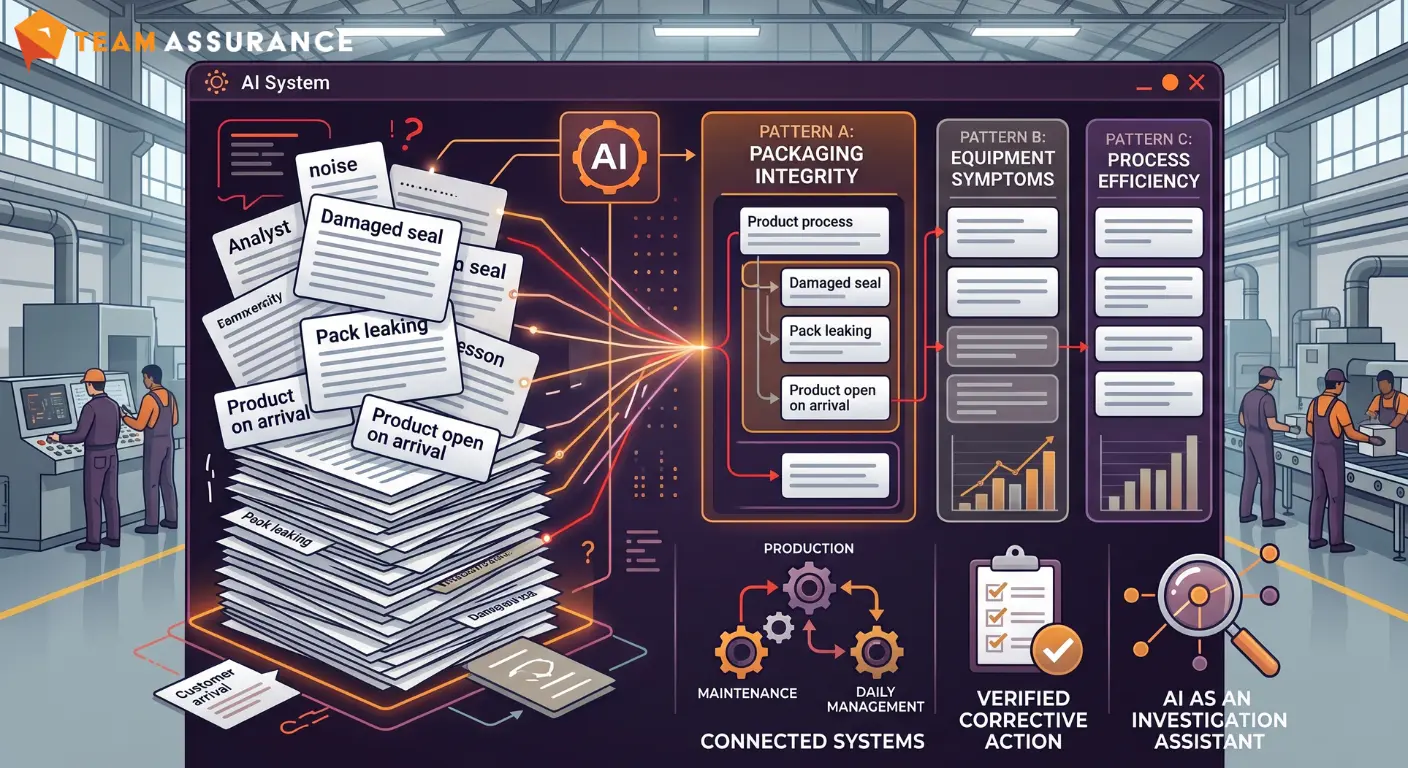
Complaint data is messy. Customers describe the same failure differently. One writes "damaged seal", another says "pack leaking", another says "product open on arrival". A spreadsheet sees three descriptions. An experienced quality manager may see one problem.
Multiply that across hundreds or thousands of complaints and it quickly becomes difficult.
Product names are entered differently. Customers use their own language. Fault descriptions vary enormously. Some complaints are detailed; others are a sentence. The person logging the complaint may categorise it differently from the person who logged an almost identical issue three weeks earlier.
This is another reason integration with the ERP matters. Where structured information already exists, use it.
A complaint should inherit the correct product, customer, material, supplier, batch or production reference wherever possible rather than relying on somebody typing it again. That removes a surprisingly large amount of rubbish before the analysis even starts.
Traditional reporting handles structured fields reasonably well. Count the complaints by product. Count them by customer. Count them by defect category. Produce a Pareto chart.
Useful, but incomplete.
The valuable information often sits in the free text.
A customer may describe a smell, a feel, a sound, an intermittent condition or a sequence of events that does not neatly fit the categories designed when the system was configured five years ago. Experienced people can often recognise those relationships, but asking someone to manually read every historical complaint is hardly scalable.
This is where newer tools are becoming useful. Natural-language analysis can group similar complaints, identify recurring products, equipment, suppliers or sites, and bring structure to thousands of comments that were previously difficult to analyse.
That does not eliminate the need for good data discipline. Product codes, production dates, batch information, customer details, equipment references and defect categories still matter. Better structured data gives the analysis more anchors.
The opportunity is to combine authoritative structured data from systems such as ERP with the messy language that humans naturally use.
Now the organisation can start asking better questions.
Are complaints containing similar language increasing? Are several apparently different defect categories describing the same underlying failure? Does a theme occur disproportionately on one product, line or site? Does a particular supplier or raw material appear repeatedly? Did the pattern begin after a change?
This is the complaint pile starting to behave like useful operational data.
The Curse of the Optimised Silo
There is a trap in all of this which I think manufacturing and operations has become rather good at creating - We optimise the information silo.
Quality buys a very good Quality system. Safety buys a very good Safety system. Maintenance buys a very good CMMS. Customer Service gets a CRM. Production gets another dashboard. Each function improves its own workflow and celebrates the improvement.
The trouble starts when each system becomes very good at managing its piece of the truth while the operation as a whole becomes harder to see. Complaint management can easily fall into exactly this trap.
A specialist complaint platform may become excellent at case numbers, acknowledgement times, categorisation, correspondence, approvals and closure. The queue gets faster. Compliance gets cleaner. Reports look better.
Meanwhile, the same complaint keeps coming back because the information never properly joins Production, Maintenance, Daily Management, problem solving and standard work.This is the curse of the optimised silo - The local process has improved while the broader system has barely moved.
The same warning applies at the other end of the spectrum. Trying to push every operational workflow back into the ERP because it is the corporate system of record does not necessarily solve the silo problem either. The ERP should remain authoritative for the information it owns, but the work triggered by that information needs to happen in a system designed for people to manage conditions, actions and learning.
The architecture should connect the systems, not pretend one system is naturally brilliant at everything.
Sometimes the silo becomes harder to penetrate because digitisation makes it look so complete. The dashboard is green. SLA performance is excellent. Ninety-eight per cent of complaints were closed within target.Great, but how many came back? That question interests me more.
Quality Assurance Innovations
AI can do the dull looking, not the deciding. Complaint analysis involves a lot of fairly unglamorous work. Reading descriptions. Comparing language. Looking for repeat combinations. Searching old cases. Checking whether similar complaints happened elsewhere. Pulling together histories before somebody starts a proper investigation.
Machines are increasingly good at that kind of work. It can cluster free-text complaints, suggest themes, surface unusual increases and connect new complaints with similar historical cases. A quality engineer can then investigate the pattern with considerably more context.
When the architecture is properly integrated, that context can include authoritative ERP information as well. AI does not need to guess which product or customer somebody meant if the complaint is already connected to the correct record. The quality specialist is still needed because context matters.
Five complaints may look identical in language but have completely different causes. Two complaints described differently may come from exactly the same physical condition. Someone still needs to go to the work, understand the process, speak to people, examine evidence and test the assumptions. AI can greatly improve the starting position.
It should help the engineer arrive at the investigation with more of the history already assembled rather than spending the first three hours searching for it.
Better still, this does not need to wait for the monthly Quality meeting. When complaint information is connected to the operating system, emerging themes can become visible in Tier meetings while there is still time to act.
That changes complaint management from retrospective reporting into something closer to an early-warning mechanism.
A Tier 2 team may see that customer complaints mentioning poor seals have increased over the previous fortnight. Production may recognise that the same period contained several short stops on a sealing machine. Maintenance may know that a component has been adjusted repeatedly. Quality may already have internal defects with similar characteristics. ERP data may tell us which products, orders, customers or material batches were involved.
The conversation becomes very different once those signals appear together.
Root Cause Analysis Advances
Clustering changes the starting point for root cause analysis. Twenty apparently unrelated complaints may suddenly become one recurring theme around a product family, changeover, machine condition or supplier batch. Instead of investigating twenty transactions, the team can investigate the common condition behind them.
That is a much better use of people's time and this matters because complaint investigation itself can become waste. Not the investigation that teaches us something, that is the valuable work.
The waste is repeatedly reconstructing the same history, speaking with the same people and discovering the same contributing factors because the organisation never connected the previous cases. A cluster gives the problem solver a different frame.
Instead of asking, "Why did complaint 4387 happen?", the question might become, "What common condition explains these seventeen complaints across three product codes?" The answer to this feels like instant progress.
The answer may point toward a changeover method, an equipment setting, a packaging material, a temperature range, a supplier lot or a work-around that operators have quietly developed to keep production moving.
Once a plausible common condition is identified, the normal disciplines of root cause analysis still apply. Go and see. Understand the current condition. Separate symptoms from causes. Test the relationship. Implement a countermeasure. Verify that it worked. Verify, verify, verify.
AI did not solve the problem, but it helped us find the problem worth solving and that is a much more credible use of it.
Customer Satisfaction and Quality Management
Customer feedback becomes particularly valuable when it is connected to internal history. Has Production seen the same abnormality? Was there a quality defect before the customer complained? Has Maintenance been working on the equipment? Has this problem already occurred at another site?
Those are obvious questions to an experienced operations person.They are surprisingly difficult to answer when every function owns a different system.
The complaint may contain the customer symptom, while the internal defect is sitting in the Quality system. The machine history sits in the CMMS. The production loss sits in MES. Customer, product and order history may sit in ERP. A previous corrective action is buried in an old spreadsheet. The relevant Tier meeting discussion disappeared when the whiteboard was wiped.
Nothing is technically missing, It is simply inconvenient enough to retrieve that people stop looking and that is why integrations matter.
The user should not need to become an archaeologist across six systems. The appropriate information should be brought into the operating context while the source systems remain authoritative.
Now the complaint becomes part of organisational learning rather than an isolated customer event. An isolated complaint has a beginning and an end. A learning event has relationships. It connects the symptom with the process, the action, the countermeasure, the verification and eventually the changed standard.
Closing the loop matters too. The customer gets a better response when the business can explain what was found, what changed and how recurrence will be prevented. Customers can generally tell the difference between administrative closure and genuine investigation.
"We have reminded the operator" is not a particularly confidence-inspiring corrective action.
"We identified a recurring condition during changeover, changed the setup method, verified the countermeasure over the next four production runs and deployed the revised standard across the other two lines" is a very different conversation. One closes the complaint, the other demonstrates that the organisation learned something.
From Complaint to Action
Actions are where many complaint systems quietly lose their effectiveness.
An investigation generates actions. Those actions are assigned. Somebody changes the status to complete. The complaint is closed. The paperwork looks respectable but completion and effectiveness are not the same thing.
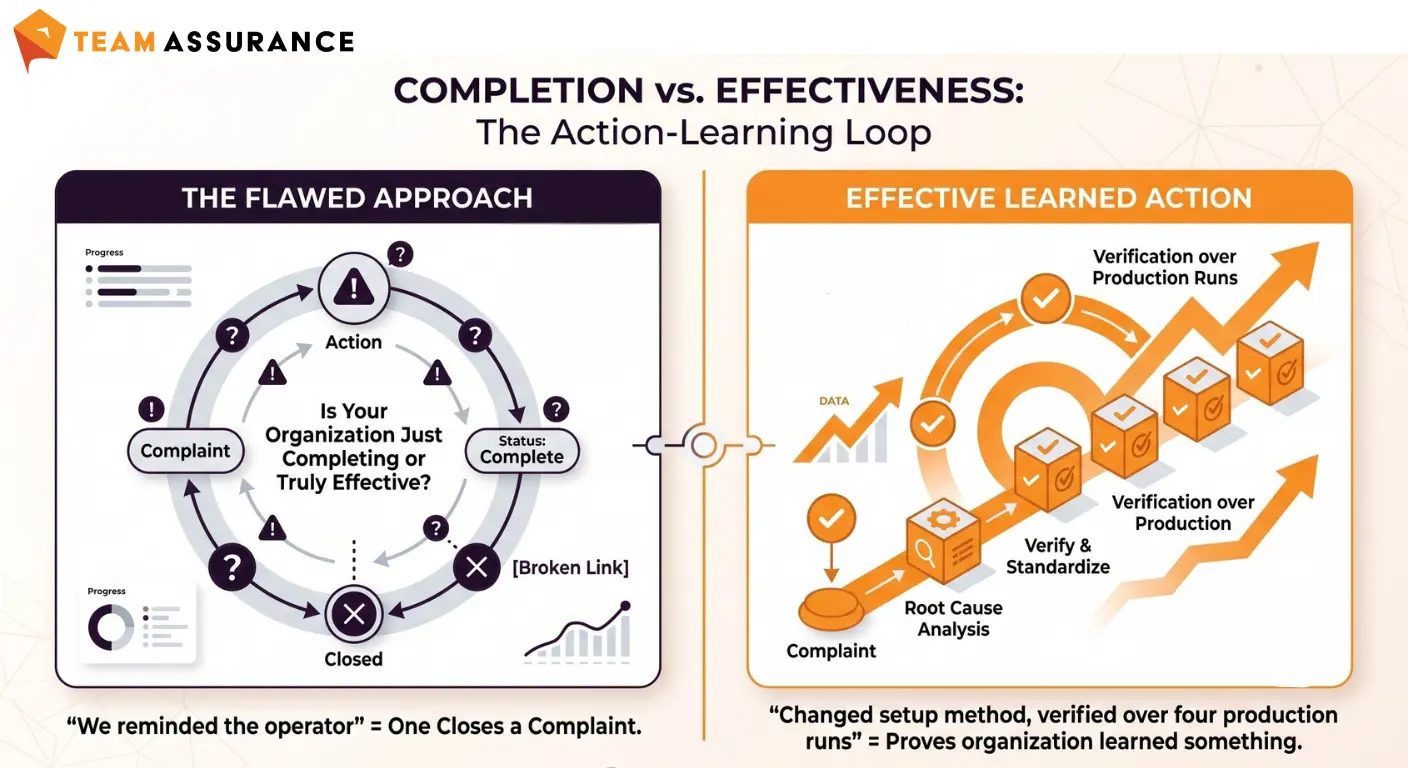
If the complaint related to a leaking seal and the action was to modify a machine setting, the interesting question is whether leaking seals stopped occurring. If the action was additional training, did the condition improve afterwards? If a supplier specification changed, did the defect disappear?
Corrective action verification should be built into normal Quality Management.That means defining what success looks like before closure. It means allowing enough time for the countermeasure to prove itself. It means checking the condition in the work rather than accepting a green status on a screen. Otherwise, complaint management becomes a machine for producing completed actions rather than improved processes.
I know which one I would rather have.
Continuous Improvement and Yokoten
Lean thinking applies perfectly here: find the recurring condition, understand it at the work, improve the process, verify the countermeasure and share the lesson everywhere. The final part matters enormously. A plant may conduct an excellent investigation, genuinely solve the problem and prevent recurrence on its own line.
Then another factory in the same business creates exactly the same defect six months later. Technically, the first investigation was successful. Organisationally, something was missed.
The real waste is investigating the same complaint repeatedly because a previous learning never got past the small team managing it. This is where Yokoten matters. The lesson should move sideways into similar situations like they are under the same roof.
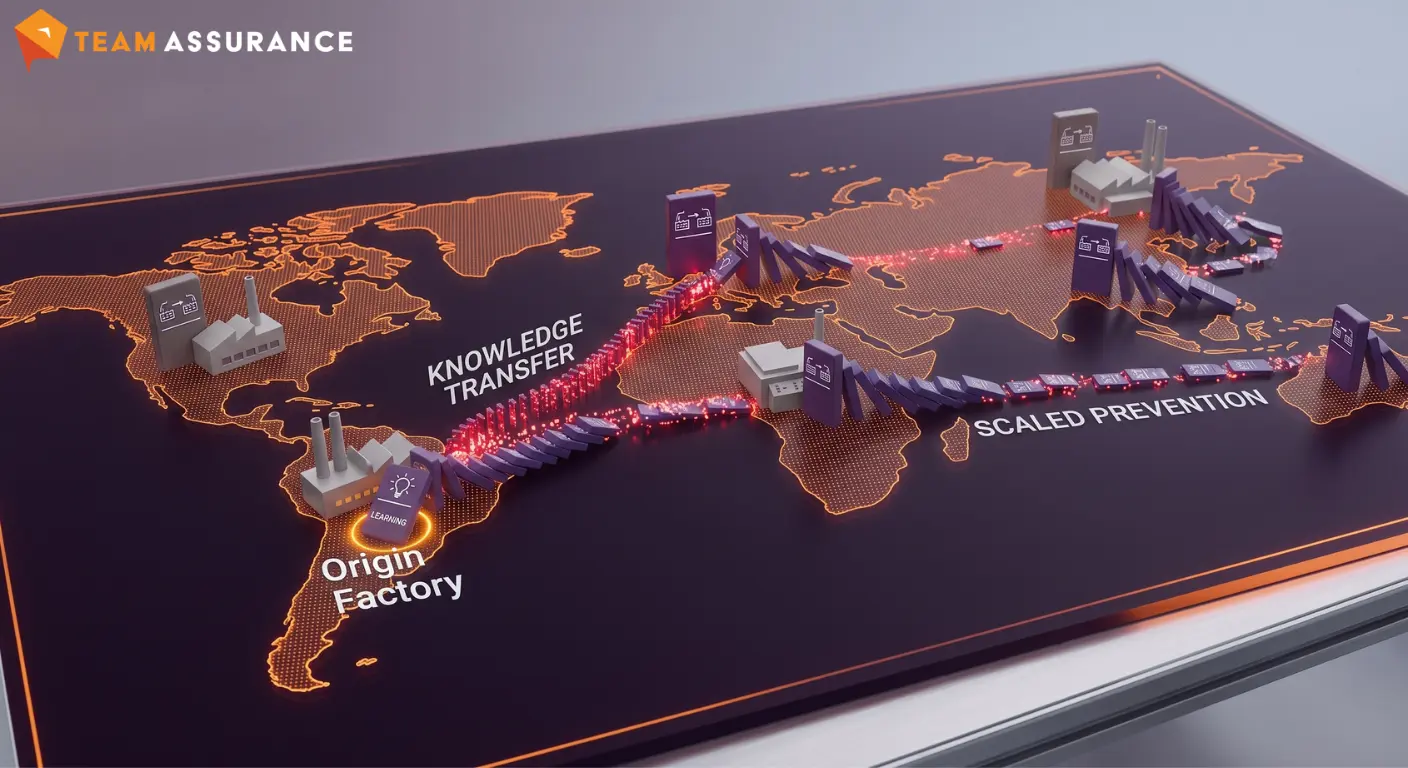
If one site discovers that a particular equipment condition can produce a defect, where else does the same equipment exist? If one product family is vulnerable to a certain changeover error, who else runs that family? If a packaging supplier issue affected one region, where else is that supplier used?
Again, the authoritative ERP data can be extremely useful here. It may tell us which other plants use the same material, which customers receive the same product, or where the relevant supplier is used.
That is precisely why the ERP connection matters. It provides the truth needed to determine the reach of the problem. The operating system provides the mechanism for doing something about it. This does not mean blindly copying every countermeasure everywhere. Yokoten is not photocopying.
It means making the learning visible so other teams can assess whether it applies to their condition. That is how complaint management becomes continuous improvement rather than simply customer recovery.
Continuous Learning and Recurrence
One of the best measures of a complaint system besides how quickly it closes cases, is whether the organisation gets better at not creating the same complaint again. That sounds obvious, but it changes what you measure.
Closure speed still matters. Customer response time matters. Investigation quality matters, but recurrence deserves much more attention.
How many complaint themes are returning after corrective action? Which countermeasures repeatedly fail verification? Which sites are experiencing problems already solved elsewhere? Which defect families have been around for years under slightly different names? Those questions tell us something about the learning rate of the organisation.
A mature Quality Management system should gradually make the business harder to surprise. The organisation accumulates experience. That experience becomes easier to retrieve. Proven countermeasures are available to the next person. Weak countermeasures become visible. New starters inherit some of the judgement of experienced people rather than beginning from zero. That is operating memory.
Quality Management Systems of the Future
Cloud-based complaint systems will keep getting better at capture and workflow. The bigger opportunity is integration. I think this distinction will become increasingly important. There is still plenty of room to improve forms, mobile interfaces, notifications, routing, approvals and dashboards. All of these are really useful, but the larger benefit comes when complaint information stops being a destination and becomes part of the wider operating system.
Complaint data should connect with ERP, Quality, Safety, Maintenance, Production, actions, standards, training and daily management. AI can then work across the operating context instead of optimising another silo.
The ERP remains the authoritative source for the business information it owns. Nobody needs another copy of the customer master or another manually maintained product database. But the operational platform can use that context to manage everything that happens around the complaint.
That means a complaint about damaged packaging can be connected to the correct customer, product, order and batch in ERP, while also connecting to internal defects, machine history, downtime, previous actions, changeover standards and similar complaints from another site.
It means a Quality Manager can ask whether a new complaint resembles anything seen previously. It means a Tier meeting can surface an emerging customer theme before somebody builds a monthly report. It means a corrective action can remain connected to the original customer problem and later show whether the condition genuinely changed. It means lessons can travel.
That is a much bigger opportunity than giving the complaint team a cleverer inbox.
Integration With the Wider Operating System
This does not mean every specialist system needs to be thrown away. That is another easy mistake. ERP, MES, CMMS, CRM and specialist Quality systems may all have important roles and may remain the authoritative sources for particular records. In fact, they should.
The ERP should continue being the ERP. The MES should remain authoritative for the manufacturing data it owns. The CMMS should manage the maintenance records it was built to manage. A CRM may remain the customer-facing system of record.
The objective is not to build one giant database for the sake of architectural purity. Nor is the objective to reproduce all of those systems inside a Quality Management platform. The objective is to stop operational learning disappearing between them.
Modern APIs, integration platforms and governed connectivity mean that asking people to choose between maintaining the ERP as the source of truth and having an effective operational workflow is increasingly a false choice. We should expect both. Integration is table stakes, that is why we do it for free.
The complaint enters. It references the authoritative customer, order, product or batch. The relevant operational context becomes visible. The problem moves into the normal management rhythm. Somebody owns it. Actions are taken. Effectiveness is verified. The standard changes if required. The lesson becomes available elsewhere.
The source data remains where it belongs. The work happens where people can actually manage it and that is the operating thread we should preserve.
The system architecture should support the way the factory actually learns, not force the factory to behave like the organisational chart or the database structure of its ERP.
The Complaint Pile Should Get Smaller
That is when the complaint pile stops being a pile and becomes a source of operational intelligence, better root cause analysis and faster learning. The real opportunity in customer complaint management is not simply faster processing, it's better memory.
Every complaint contains some information about the gap between what the process was supposed to produce and what the customer actually experienced. Individually, those signals can be noisy. Collectively, they can tell you an enormous amount about the health of the operating system.
Keep the ERP as the single source of truth for the data it owns. Integrate with it properly. Then connect that truth to the people, workflows and management rhythm required to actually solve the problem.
Capture complaints properly. Cluster them intelligently. Connect them to the work. Investigate the common conditions. Verify that countermeasures actually work. Move the lessons across the organisation and resist the temptation to congratulate ourselves merely because we built a beautifully optimised complaint silo.
The customer does not care how efficient the workflow was, they care whether they have to complain again and ideally, you are dealing with a much smaller pile in the next month!
Interested in turning customer complaints into real operational learning? Explore how TeamAssurance's Quality Management capabilities help teams connect complaints, non-conformances, corrective actions and verification with the wider daily management system. Combined with AI Assisted Workflows, TeamAssurance can help surface recurring patterns, connect related issues and turn customer feedback into meaningful continuous improvement. Learn more about TeamAssurance Quality Management and AI Assisted Workflows, or book a demo to see it in action.