
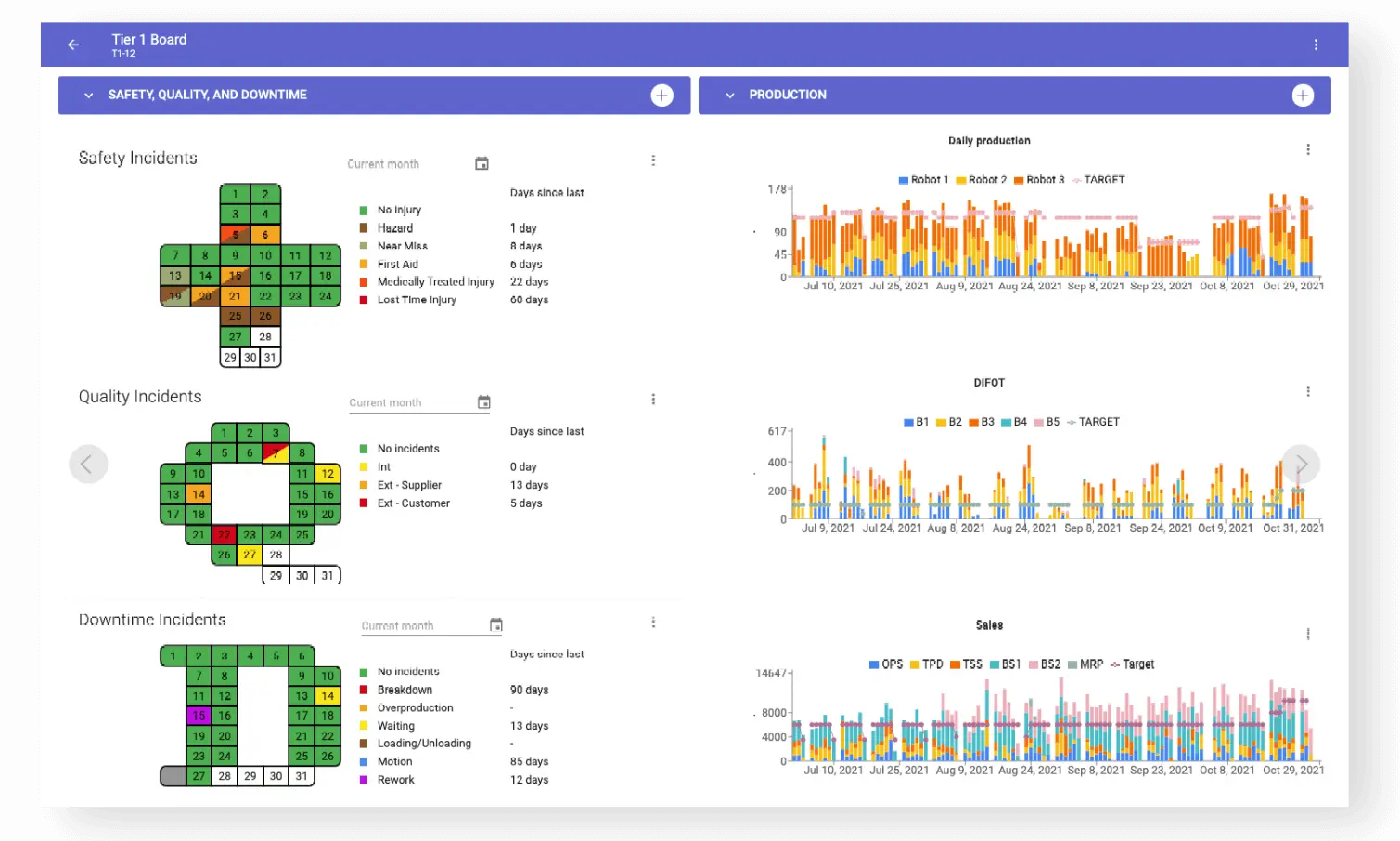
A tier meeting cadence sets how often Tier 1, Tier 2 and Tier 3 meet, and how the shift handover feeds each one.
For a multi-shift plant, hold a short Tier 1 meeting at the start of every shift, a Tier 2 meeting once a day to resolve what Tier 1 escalated, and a weekly Tier 3 review of site performance. Shift handover links the shifts, so each shift starts from the open items the last one left on the board.
At a glance
- Tier 1: every shift, 5 to 10 minutes, on the shift's own tier board.
- Tier 2: daily, 15 to 20 minutes, resolves what Tier 1 escalated from all shifts.
- Tier 3: weekly, 30 to 45 minutes, reviews site KPIs and cross-departmental issues.
- Handover: part of the start-of-shift Tier 1 meeting, not a replacement for it.
- Related: tier meetings are not just for the frontline and lean tier meetings: practical steps.
How often should each tier meet on a multi-shift plant?
Each tier meets on a fixed rhythm, set by how often its inputs arrive. Tier 1 follows the shift, Tier 2 follows the day and Tier 3 follows the week.
| Tier | Cadence | Length | Who attends | What it covers |
|---|---|---|---|---|
| Tier 1 | Every shift (once a day where an area runs one shift) | 5 to 10 minutes | Shift team and shift leader | Safety moment, previous shift results, today's tasks, blockers, handover |
| Tier 2 | Daily | 15 to 20 minutes | Functional leads | Escalations from every Tier 1 meeting, cross-functional resources |
| Tier 3 | Weekly | 30 to 45 minutes | Site leaders | Weekly KPIs, trends, cross-departmental issues, improvement projects |
Why does a multi-shift plant need a Tier 1 meeting on every shift?
A single day-shift meeting leaves the other shifts with no structured review. Problems that start on nights or afternoons can sit unseen until the next morning, and the team that ran the shift never gets to say what happened. A short Tier 1 meeting at the start of each shift gives every team the same review, the same board and the same chance to escalate.
How does shift handover fit into the cadence?
Handover is how one shift's Tier 1 review carries into the next. Keep it on the board, not only in conversation:
- The outgoing shift leader updates the Tier 1 board with open issues, what was done and what the incoming shift must check.
- The incoming shift leader reviews the board at the start-of-shift Tier 1 meeting, confirms the handover and sets the shift's priorities.
- Any issue the shift cannot resolve is escalated to that day's Tier 2 meeting.
- Tier 2 reviews escalations from all shifts and closes items on the board, so the next shift can see the outcome.
What does the Tier 2 meeting need to cover across shifts?
Tier 2 is where shift-level issues meet the functional leads who can act on them. Because it runs once a day, it should review every escalation logged since the last Tier 2 meeting, from every shift and not only the day shift. If a shift's leader cannot attend, nominate a delegate to present that shift's escalations and record the outcome on the board.
How often should Tier 3 meet for a site with several shifts?
Weekly, for 30 to 45 minutes. Tier 3 reviews the week's KPIs and trends across all shifts combined, so it looks at patterns such as repeat stoppages or recurring quality issues rather than the detail each shift handled. Shift-level detail is reviewed at Tier 1 and Tier 2.
What does this look like in practice?
This is an illustrative example, not a customer result. A plant runs day, afternoon and night shifts. The night team logs a repeat machine stoppage on its board at the end of the shift. The day Tier 1 meeting reviews it during handover and assigns a check. The item is still open at that day's Tier 2 meeting, so the maintenance lead takes it on. At the weekly Tier 3 review, the stoppage appears in the KPI trend and the site decides whether it needs a project.
In TeamAssurance
The Tiered Daily Management capability runs Tier 1, 2 and 3 meetings on live digital tier boards. Each shift works from the same board, escalations move up with their context, and the weekly view draws on the same data. Request a demo to see how the cadence would run on your shifts.
Tier Meeting Cadence FAQs
How often should a Tier 1 meeting run on a multi-shift plant? At the start of every shift, typically 5 to 10 minutes, so each shift reviews its own results and handover.
Should the night shift hold its own tier meeting? Yes. The Tier 1 meeting runs on every shift, including nights, so issues from nights are reviewed and escalated like any other.
Does shift handover replace the Tier 1 meeting? No. Handover passes the open items on, and the Tier 1 meeting at the start of the next shift confirms them and sets priorities.
How often do Tier 2 and Tier 3 meetings run? Tier 2 runs daily for 15 to 20 minutes, and Tier 3 runs weekly for 30 to 45 minutes.