
The Operating Rhythm of a Site
A pharmaceutical Tiered Daily Management system is the way a site turns today's operating reality into visible, managed work.
Not the annual strategy deck. Not the monthly review pack. Not the heroic spreadsheet someone built in Quality because the official system was too slow to answer a practical question.
Tiered Daily Management is the operating rhythm of the site. It is how Safety, Quality, Delivery, Cost and People are reviewed, escalated, acted on and learned from while the work is still close enough to influence.
Why Tiered Daily Management Matters in Pharma
In pharmaceutical manufacturing, the work is regulated, documented, validated and inspected, and that discipline matters. The site still has to run every day.
Batches need to move. Deviations need attention. Actions need ownership. Maintenance needs support. Training gaps need visibility. Quality decisions need context. Operators and supervisors need a system around them that helps, rather than another administrative cave to crawl into.
The Job of a Tiered Daily Management System
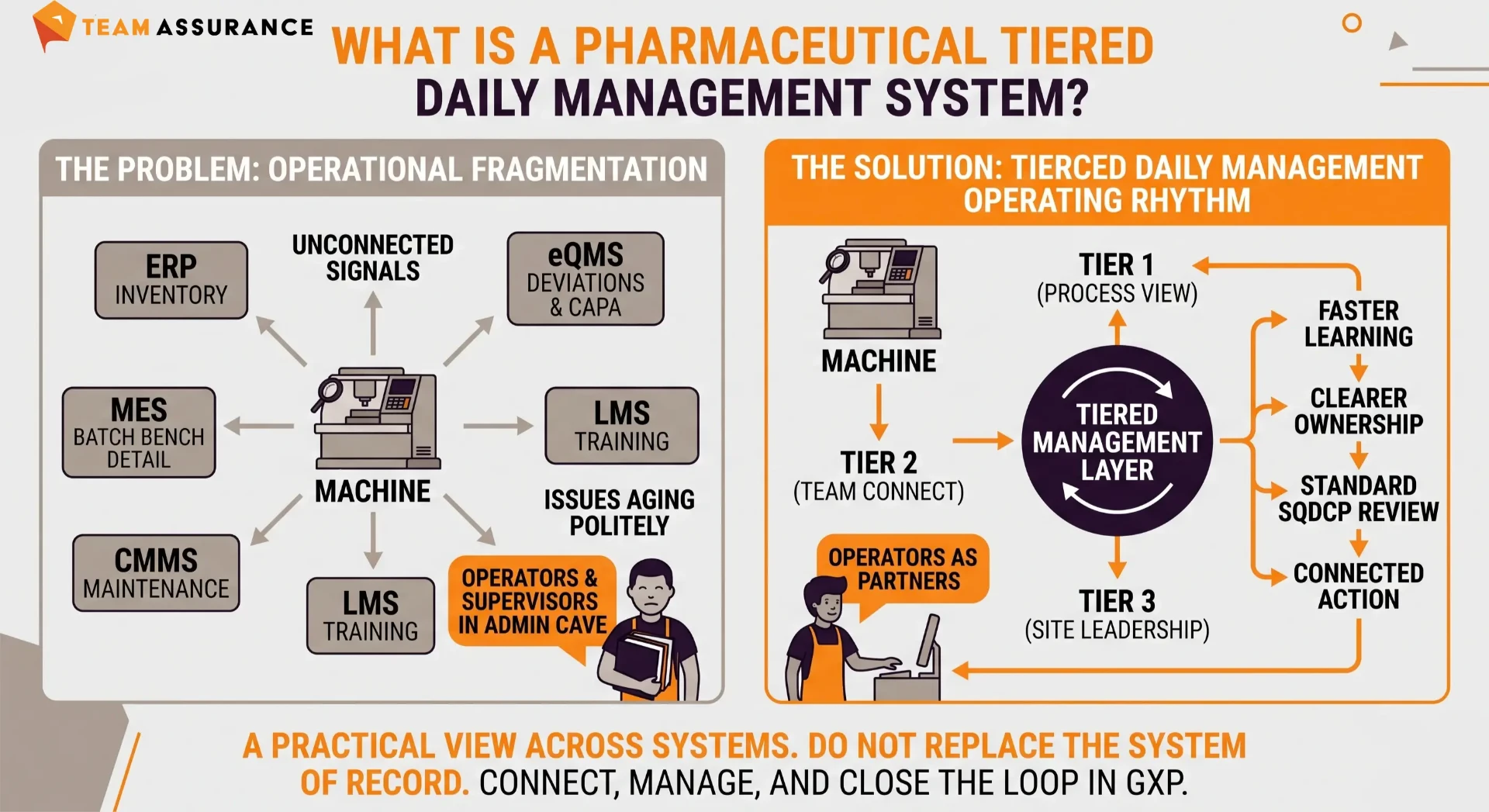
A good pharmaceutical Tiered Daily Management system connects the operating floor to the leadership team through a clear tiered rhythm.
Tier 1 sees what is happening at the process. Tier 2 connects teams across departments. Tier 3 brings site leadership to the issues that need help, decisions or resources.
The point is not more meetings. The point is faster learning, clearer ownership and fewer issues ageing politely in the background.
How It Fits With ERP, MES and eQMS
This is where pharmaceutical operations often get interesting.
The official systems may all be doing their job. ERP holds orders, inventory and financial truth. MES holds batch and production execution detail. eQMS holds deviations, CAPA, change control and quality records. CMMS holds maintenance work. LMS holds training.
These systems are necessary, and they should remain strong in the places where they are meant to be strong.
The operating question remains: what needs attention today, who owns it, what is stuck, what needs escalation, and what has actually changed in the work?
That question needs a management system.
Do Not Replace the System of Record
The Tiered Daily Management system should not replace these pharmaceutical systems of record. That would be silly, risky and unnecessary.
The system of record stays where it belongs. The Tiered Daily Management layer gives the site a practical operating view across those systems, so people can manage the work, connect the signals and close the loop.
A deviation should not sit in one world while the operational action lives somewhere else, the maintenance fix lives somewhere else again, and the supervisor's real concern sits in a notebook from Tuesday's shift. That is how learning gets thin.
A connected Tiered Daily Management system keeps the threads together.
Working Properly in a GxP Environment
A serious system respects the GxP environment.
Roles, permissions, audit trails, validation expectations, data integrity and change control all matter. A pharmaceutical operating system needs to support that discipline, not wander around beside it with a grin and a workaround.
The aim is to make operations clearer without creating a second uncontrolled universe of decisions and records. Pharma should expect discipline, and the software supporting pharmaceutical operations should be built with that expectation in mind.
What Leaders Actually Need to See
Done properly, Tiered Daily Management gives Quality a better view of operational risk. It gives Operations a cleaner way to raise and resolve barriers. It gives Site Heads a live sense of what is moving and what is stuck.
It also gives Operational Excellence leaders a practical way to standardise routines across departments and sites without turning every plant into a local invention factory.
Standardisation Across Sites
Standardisation is where Tiered Daily Management becomes especially useful in a pharmaceutical network.
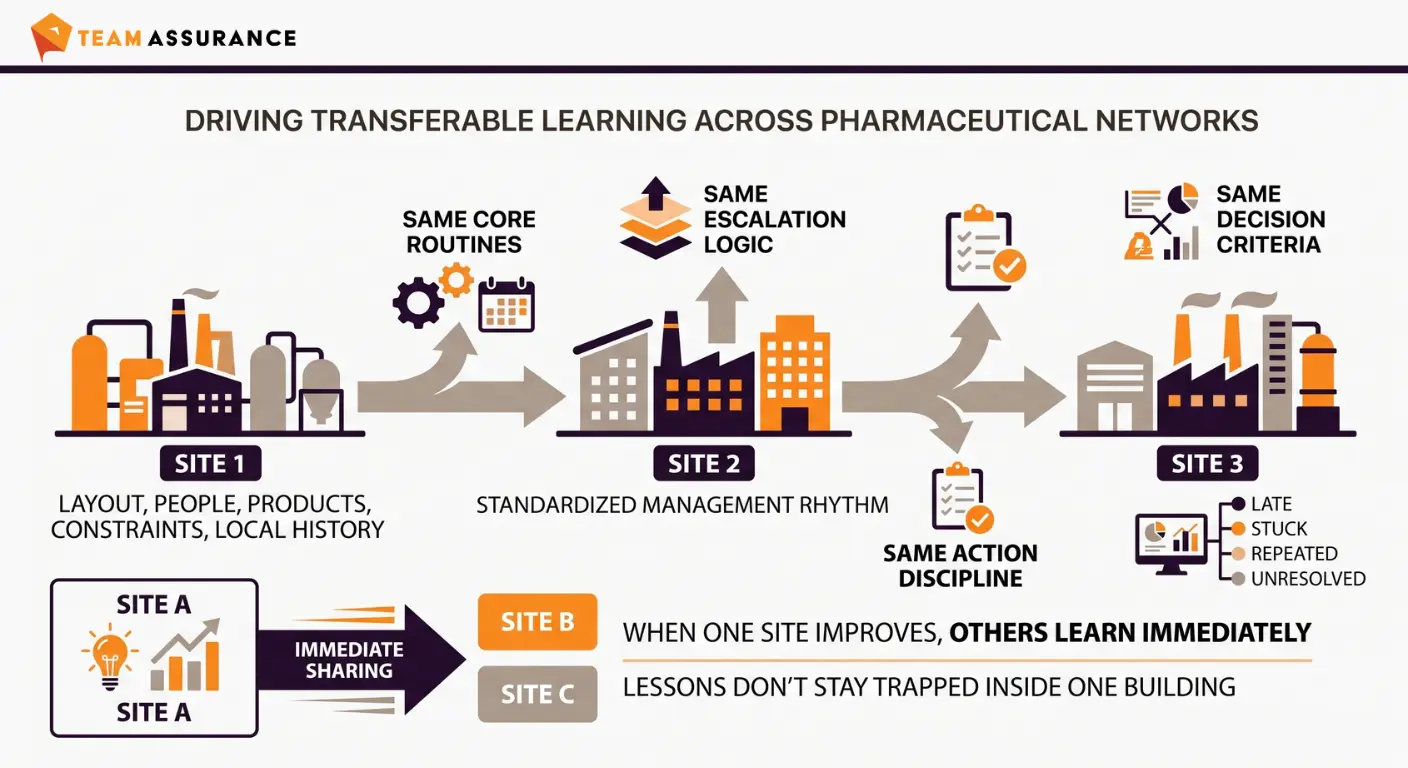
Each site will always have its own layout, people, products, constraints and local history. That is normal operating reality. But the management rhythm should not be reinvented every time you cross a car park, a state border or a country line.
The same core routines should exist across the network. The same escalation logic. The same action discipline. The same verification expectations. The same approach to SQDCP. The same way of seeing what is late, stuck, repeated or unresolved.
That does not make sites identical. It makes learning transferable.
When one site improves a deviation response, another site should be able to learn from it. When one plant finds a better way to manage a recurring maintenance issue, the lesson should not stay trapped in that building. When one leadership team improves its Tier 2 rhythm, the method should become available to the next site without needing a consultant, a pilgrimage or a lucky conversation over coffee.
That is how standardisation earns its keep.
Speed of Execution Matters
Speed in pharmaceutical operations is often treated carefully, and it should be. Nobody sensible wants speed without control.
But speed with control is powerful.
A 5% or 10% improvement in the time it takes to raise an issue, assign ownership, escalate support, complete an action, verify the fix or share the lesson can produce a much larger business outcome than the percentage sounds like it should. The site does not just move faster. It spends less time waiting, searching, chasing, reworking and rediscovering. That compounds.
A deviation gets attention earlier. A maintenance issue reaches the right support sooner. A training gap is visible before it becomes a batch problem. A recurring quality issue is recognised before another lot is affected. A site leader sees the stuck work while there is still time to help.
The speed is not frantic. It is cleaner. Less delay between signal and action.
What Good Looks Like
The best version is simple to understand.
The site sees the work. The right people own the work. Issues escalate through the right level. Actions are followed through. Fixes are verified. Lessons become standards. Similar sites learn before they repeat the issue.
That is Tiered Daily Management doing its job.
Better Control, Closer to the Work
In pharma, the goal is better control, closer to the work, with enough structure to satisfy the environment and enough practicality to help the people running the operation.
A pharmaceutical Tiered Daily Management system should make the site easier to run, easier to support and harder to fool. It should help leaders see earlier, supervisors act faster, Quality stay connected to the operating condition, and teams learn across shifts, departments and sites.
The batch record, deviation record, ERP and MES all still matter. But the tiered rhythm that connects people, issues, actions and learning is where the operation becomes manageable, and this is where TeamAssurance helps, by giving pharmaceutical sites a practical Tiered Daily Management layer that standardises the way work is managed, improves speed of execution and connects the work without replacing the systems that must remain the source of truth.