
Daily Management System Software
TeamAssurance is daily management system software: the Tier 1, 2 and 3 meetings, the boards they run from, the actions and escalations they produce and the problem solving they trigger, in one connected system that frontline teams and site leaders both work from.
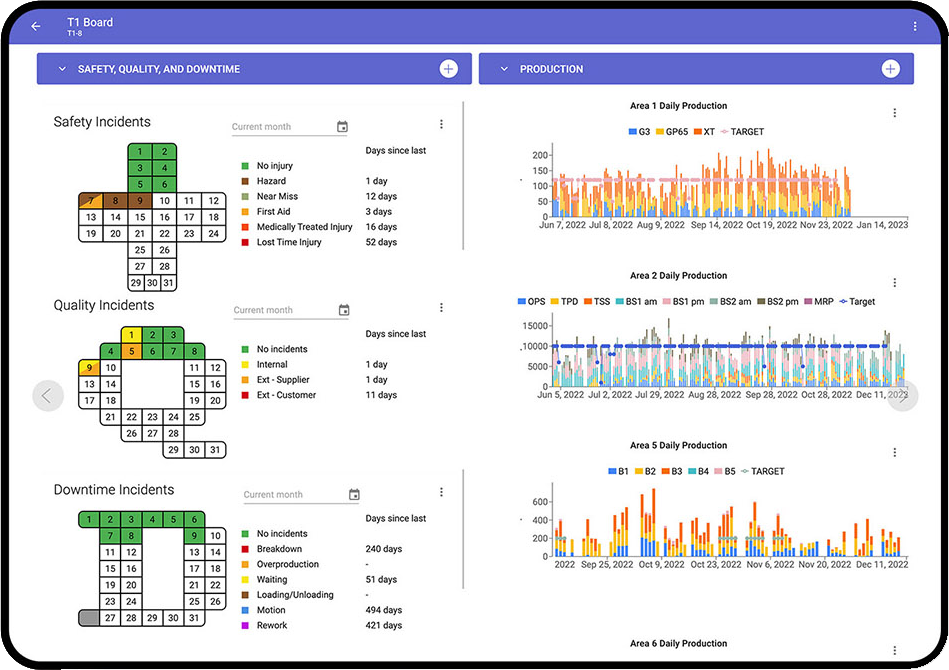
The basics
What is a daily management system?
A daily management system (DMS) is the routine by which an operation checks its performance against plan every day, raises the gaps as problems with owners, escalates what a team cannot resolve and connects the daily work to improvement and strategy. Its parts are a tiered meeting rhythm, visual boards with a few measures per level, a single list of actions, an escalation path and a problem-solving method.
Daily management system software runs those parts in one place: boards that update through the shift, actions that move between tiers without re-keying, measures fed from the systems of record, and a history that shows which problems repeat. Whiteboards and spreadsheets can start a DMS; software is what lets it scale across shifts, lines and sites.
How a daily management system runs a day: at shift start the outgoing shift's handover and the overnight measures are already on each team's board. The Tier 1 daily huddle at the line takes ten to fifteen minutes: safety first, then quality, delivery, cost and people against target, then the action list. Team members raise problems, the team solves what it can and gives each gap an owner and a due date. What it cannot solve, such as a recurring breakdown or a supplier shortage, is escalated to Tier 2 with its context attached.
An hour or so later the Tier 2 meeting brings area leaders and support functions such as maintenance, quality and planning together around a roll-up of the Tier 1 boards. They take on the escalated issues, assign corrective actions and push the few that need a site decision up to Tier 3, where site leadership reviews the key metrics across areas and links them to strategic goals. Decisions travel back down the same path, so the team that raised a problem hears the answer at its next huddle.
Between meetings the work is in the actions. Owners update them as they go, overdue items stand out on every board, and repeating problems move into structured problem solving. Leaders close the day on the shop floor with a gemba walk, checking that the boards match the work and coaching frontline teams on the action plans they own. Real-time visibility at every level of the organisation is what turns lean principles into a habit: each team can manage daily performance, solve problems close to where they happen and see how its daily activities connect to operational excellence and employee engagement.
What it does
The parts of a daily management system, in one system
Tier boards at every level
Build each team's meeting agenda into a live board in minutes; Tier 2 and Tier 3 boards roll up the boards below.
Measures with targets and trends
Safety, quality, delivery, cost and people measures on the board, with embedded reports and live spreadsheets where needed.
One action list
Every gap becomes an action with an owner and due date; New, To Do and Overdue are visible in each team's list.
Escalation between tiers
Issues move up with their context and decisions come back down, so nothing is lost between meetings.
Problem solving linked to the board
Repeating issues move into A3, PDCA or 5 whys and the countermeasure is verified against the measure.
Connected to strategy
Strategic goals and their projects appear on the boards, so the daily rhythm and the strategy review look at one picture.
Compared
Whiteboards, spreadsheets or a daily management system?
| Capability | Whiteboards | Spreadsheets | TeamAssurance |
|---|---|---|---|
| Boards at the line, visible to the team | |||
| Measures update during the shift | |||
| Actions with owners, due dates and reminders | |||
| Escalation to the next tier with context | |||
| Repeat problems visible across shifts and sites | |||
| Strategic goals on the same boards |
How it works
Setting up a daily management system
- 01
Start at Tier 1
One area, a few measures the team can influence, a ten-minute huddle at a fixed time, actions with owners.
- 02
Add the tiers above
Tier 2 for functional leads and Tier 3 for site leadership, each reviewing a roll-up of the boards below.
- 03
Connect the measures
Feed boards from checklists, issue reports and integrations with ERP, MES and CMMS systems.
- 04
Close the loop
Escalations come back with answers, repeating problems get solved, and standards are updated when improvements hold.
Use cases
Where daily management systems run
- Start-of-shift Tier 1 huddles at the line
- Daily Tier 2 reviews of escalated issues across functions
- Weekly site leadership (Tier 3) performance reviews
- Multi-site operations with regional Tier 4 reviews
- Pharmaceutical and GMP sites managing deviations and actions daily
- Food and beverage plants coordinating production, quality and maintenance
FAQ
Daily management system software FAQ
What is daily management system software?
Software that runs the daily management routine: tier boards with measures, actions with owners, escalation between tiers and the problem solving that follows, so the meetings review a live picture rather than reconstruct yesterday.
How is a daily management system different from a dashboard?
A dashboard shows numbers. A daily management system pairs each number with a meeting, an owner and an action, and escalates what a team cannot fix. The software supports the routine; it is not the routine.
Do we need software to start daily management?
No. Many sites start with a whiteboard and a ten-minute huddle. Software becomes necessary when there are several teams, shifts or sites, when actions and escalations need to move between tiers, and when the history of problems matters.
What is a DMS board?
The visual board a team reviews in its daily meeting: a few measures against target, the action list, open problems and escalations. In TeamAssurance it is a tier board built from the team's agenda.
How long does it take to set up?
A team can build its tier board from its meeting agenda in minutes. A stable three-tier rhythm across a site usually takes a few months, because the discipline matters more than the boards.
Does it integrate with our ERP or MES?
Yes. Measures on tier boards can come from ERP, MES, CMMS and HRIS systems, and live spreadsheets and Power BI reports can be embedded on a board.
What is the difference between lean daily management and tiered daily management?
Lean daily management is the wider practice of managing each day against standard with visual tools, leader routines and quick problem solving. Tiered daily management is its meeting structure: linked Tier 1, 2 and 3 meetings that escalate issues up and bring decisions back down.
Guided tour
See how daily management system fits the connected operation
A five-minute walkthrough of strategy, improvement and daily management on one system: the tier boards, the actions, the escalations and the problem solving, with worked examples from the floor up.
Learn more
Definitions
See a daily management system run end to end
Book a demo and we will walk a Tier 1 huddle, an escalation to Tier 2 and the site review on live boards built from a real agenda.
Request a Demo