
Digital Gemba Walk Software
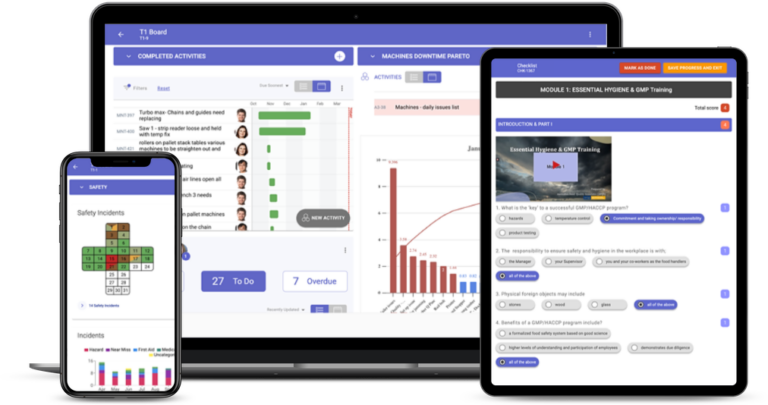
TeamAssurance runs gemba walks as scheduled mobile checklists: leaders walk the floor with a theme, record observations and photos at the place, and every finding becomes an action with an owner on the team's tier board, so the walk changes the work instead of filling a notebook.
The basics
What is digital gemba walk software?
Digital gemba walk software replaces the clipboard and notebook a leader carries to the shop floor with a scheduled checklist on a phone or tablet. The walk itself stays physical: the leader goes to the place where work is done, observes and asks. What changes is what happens to the findings.
Observations, deviations from standard and problems raised by the team are captured where they are seen, with photos, and appear as owned actions on the team's tier board the same day. Repeating findings are visible across walks, areas and sites, so leaders see the pattern as well as the day.
What it does
What a digital gemba walk includes
Scheduled through leader standard work
Walks are assigned to each leader at the right frequency and theme, so the routine does not depend on a free hour.
Checklist at the work
The walk checklist, questions and standards are on the phone, with photos and notes captured at the place they are made.
Findings become actions
Each observation or problem gets an owner and due date and lands on the team's tier board for the next huddle.
Escalation with context
What the team cannot resolve moves to the next tier with the photo and note attached.
Patterns across walks
Reports show which findings repeat by area, standard and site, and whether walks are being done.
Respect for people built in
Recognition and ideas raised on the walk are recorded alongside problems, so the team sees both.
Compared
Notebook, spreadsheet or digital gemba walk?
| Capability | Notebook | Spreadsheet | TeamAssurance |
|---|---|---|---|
| Walk scheduled and visible as done or missed | |||
| Observations and photos captured at the work | |||
| Findings become owned actions on the tier board | |||
| Escalation to the next tier with context | |||
| Repeat findings visible across walks and sites | |||
| Links to standards, audits and problem solving |
How it works
From clipboard to a walk that changes the work
- 01
Build the walk checklist
Start from the gemba walk checklist and the standards for each area; set the theme rotation.
- 02
Schedule it
Assign walks to leaders in their standard work: team leaders daily, supervisors several times a week, site leaders weekly.
- 03
Walk and capture
Observe, ask, record at the place. Findings become actions with owners and dates.
- 04
Review and improve
The huddle reviews the actions; repeating findings move into structured problem solving.
Use cases
Where teams use digital gemba walks
- Daily team-leader walks with a rotating theme
- Weekly site-leader walks that check the boards against the floor
- Safety walks and observations that feed the tier board
- 5S and standard work checks carried on the walk
- Multi-site operations where leaders compare findings
- Coaching walks for new supervisors with a shared checklist
FAQ
Digital gemba walk FAQ
Is a digital gemba walk still a gemba walk?
Yes. The leader still goes to the place where work is done and observes and asks in person. Only the clipboard changes: the checklist, notes, photos and actions are captured on a phone so they reach the tier board the same day.
What is the difference between a digital and a virtual gemba walk?
A virtual gemba walk observes a remote site over video when travel is not possible. A digital gemba walk is physical, with the recording done in software. The first is a supplement; the second is how most sites now run their routine walks.
How do findings from a walk reach the tier meeting?
Each finding is recorded as an action with an owner and due date against the team's board, so it appears in the next huddle's action list without being re-keyed, and escalates to the next tier with its context if the team cannot resolve it.
Can we use our own walk checklist?
Yes. Checklists are built from your standards and questions, with a theme rotation and frequency per leader, and refined as the findings show what matters.
Who should do digital gemba walks?
Every level of leadership, at a frequency written into their standard work: team leaders daily, supervisors several times a week, site leaders weekly. The checklist and theme change by level; the routine is the same.
Guided tour
See how digital gemba walks fits the connected operation
A five-minute walkthrough of strategy, improvement and daily management on one system: the tier boards, the actions, the escalations and the problem solving, with worked examples from the floor up.
Learn more
Definitions
See a digital gemba walk end to end
Book a demo and we will walk through a leader's checklist on a phone, the finding landing on a tier board and the action closing in the next huddle.
Request a Demo