
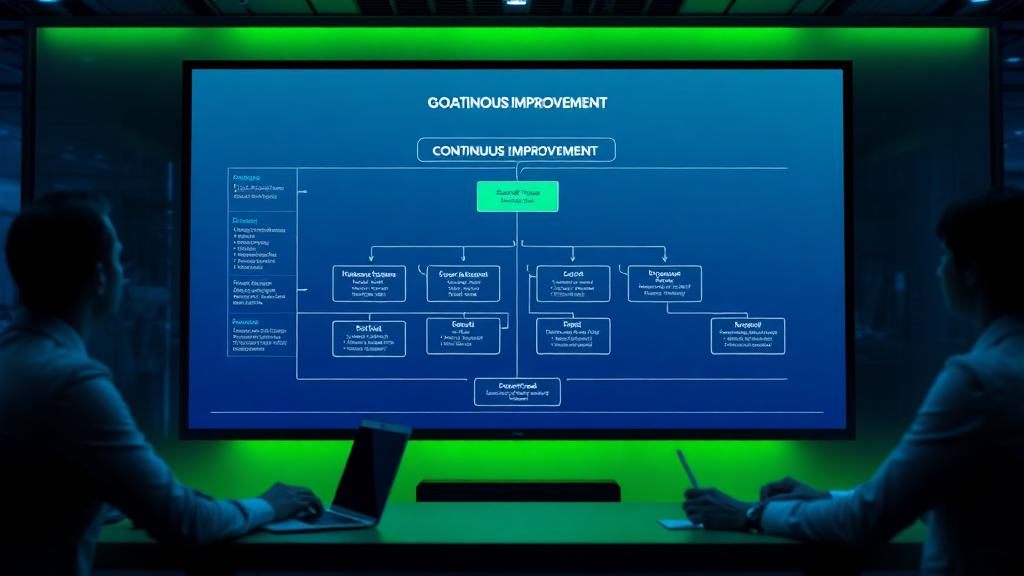
Continuous improvement planning turns an improvement idea into owned, scheduled work: what will change, who will do it, by when, what result is expected and how it will be checked. Done at every level, from a frontline action to a strategic project, it keeps improvement simple, tied to PDCA and visible in the meetings that review it.
At a glance
- What it is: the step that turns an improvement idea into owned, scheduled work.
- What a plan contains: the problem or opportunity, the measure to move, the countermeasures with owners and dates, and how it will be checked.
- How detailed: as simple as the problem allows, from one line on a tier board to a one-page A3.
- Related: what is PDCA? and what is an A3 report?.
As the old adage says – if you fail to plan, you plan to fail. In the world of continuous improvement having a plan at each step and at each level is a must. A plan ensures any activity is considered and executed to a standard that optimises the inputs and the outcomes. This is a fundamental step where most individuals, teams and organisations fail to capitalise on the opportunity presented.
Not through the will or the desire to make positive change, but through neglecting to take the time to clarify, document, structure and understand the requirements of the journey towards the objective(s).
How simple should an improvement plan be?
Planning for improvement does not need to be a complex process. It should be a simple, accessible and inclusive activity that produces a tangible map to focus and guide people. The word itself can send people into a cold sweat and panic. Statements like, 'I don't know how to plan', 'I'm not good at planning', or 'It's only bosses who make plans' can often be heard when announcing a planning activity.
The volume of wasted time, energy and resources in organisations through poor planning or no plan at all is significant. It speaks to the dichotomy of busyness versus effectiveness. We can often dive in, deploy resources, jump to conclusions and solutions feeling we are doing something positive. However, without a plan in hand we are simply hoping for the best. There is an appearance of things happening yet any achievements will be gained through good luck rather than by good design.
Conversely, we simply do nothing; constrained by overthinking and overanalysing the situation. We become stuck in a state of inertia. We don't know what to do due to a lack of clarity regarding the current state or why we need to move toward a specific objective or process condition.
How to Create a Continuous Improvement Plan
A continuous improvement plan can be a single line on a tier board or a page-long A3. The steps are the same either way:
- Identify areas for improvement. Start from the facts: missed targets on your boards, repeat problems, customer complaints, audit findings and ideas from the people doing the work. Pick the few that matter most rather than everything at once.
- Understand the current state. Go and see. Describe what is happening now, with data, before deciding what should change.
- Set the target and the measure. Choose the key performance indicators the work should move, and by how much. Where it makes sense, link them to customer satisfaction, safety or delivery so people can see why the work matters.
- Plan the improvement activities. List the countermeasures or experiments. Each one gets an owner and a due date, which is what turns good intentions into actionable plans.
- Agree the review rhythm. Decide where progress will be checked: the daily huddle, a weekly Tier 2 review or a monthly strategy meeting.
- Check, then standardise. Compare the result with what you predicted. If it worked, update the standard; if not, adjust the plan and go again.
Keep each improvement plan visible to the people doing the work. A plan locked in someone's laptop isn't a plan the team can act on.
How does improvement planning connect to PDCA?
A plan creates a standard and an expectation, it allows us to track and measure our progress and to celebrate milestones along the way. Plans can and should evolve as they progress; serving as a learning and reflective tool with regular cycles of review. The Plan Do Check Adjust (PDCA) cycle of improvement essentially starts and ends with Plan.
The Plan component is where we establish the justification or the need to take action, or to do something differently. This stage ensures we stop to consider (and understand) the current state as well as the target condition. We essentially define the problem or objective and create / illuminate the road ahead.
Planning can play out in five minutes on the frontlines of the organisation, scrapped out on a piece of paper. It can also play out over days and weeks in the boardroom, developing a strategic direction over the long term. The point is that having a documented direction, with clear next step(s) that describes what we want to achieve, by how much, by when, and by who provides something tangible and meaningful for people to work toward.
Why is communication key to executing the plan?
A well articulated and communicated plan supports alignment. It enables individuals and teams to make the appropriate decisions and adjustments along the way. Good planning and a culture of open communication creates an environment of safety and stability where the cadence is set, the thinking is proactive and consultation / inclusion is a primary consideration. Planning by its nature should also incorporate the collective experience and learning of a team or organisation.
Each subsequent plan should have some basis on the reflections of a previous planning cycle. As stated, a plan could be designed for the next hour or it could be designed for the next 5 years – and every timeframe in between.
Planning helps us to prioritise and to build accountability into the day-to-day. Without a clear plan our objectives are nothing more than good intentions. How many new year's resolutions last longer than March?
Don't forget, a plan can take many forms in the Lean world. It could be:
- Leader standard work
- A production schedule
- A quick changeover procedure
- A meeting's objectives and agenda
- A short cycle improvement or problem-solving exercise
- A Hoshin or Strategy deployment document
- A daily plan formulated at a daily huddle meeting
- A response to a process deviation through A3 problem solving
Deming said that, 'Without data you are just another person with an opinion.' Without a plan we are just another person or team with a bunch of hope and unrealised aspirations. Planning is something that takes practice and discipline – but without a plan we are rudderless at sea.
Why shouldn't you keep your improvement plan isolated?
To make the most of our planning efforts, we must ensure that they are built with adjacent processes and systems in mind. Leader Standard Work and Daily Huddles must be supported by standardised problem solving techniques, and documented Standard Operating Procedures (SOPs).
The goal is to build a Tiered Daily Management process that can handle the full PDCA loop to deliver the desired continuous improvement. To achieve this we must ensure that no element of the greater C.I. Framework is orphaned or developed in isolation.
The illustration below shows how we designed an interconnected platform that ensures there are no disconnected 'Point Solutions' (digital or analog) that can hinder organisations from achieving their objectives.
Frequently asked questions about continuous improvement planning
What should a continuous improvement plan contain?
The problem or opportunity, the measure it should move and by how much, the countermeasures with an owner and date for each, the review rhythm, and the check that confirms the result before the change becomes the standard.
How detailed should an improvement plan be?
As simple as the problem allows. A frontline action needs a line on the tier board; a cross-functional problem needs an A3; a strategic goal needs a project plan. Over-planning small improvements is itself a waste.
How does improvement planning connect to PDCA?
The plan is the P in PDCA: it states the predicted result so the check has something to compare against. Without a written expectation, the check becomes an opinion and the adjust step never happens.
Set a course and steer the organisation in the right direction with a platform for Strategy, Project and Daily Management. Contact us to learn more about TeamAssurance today.