
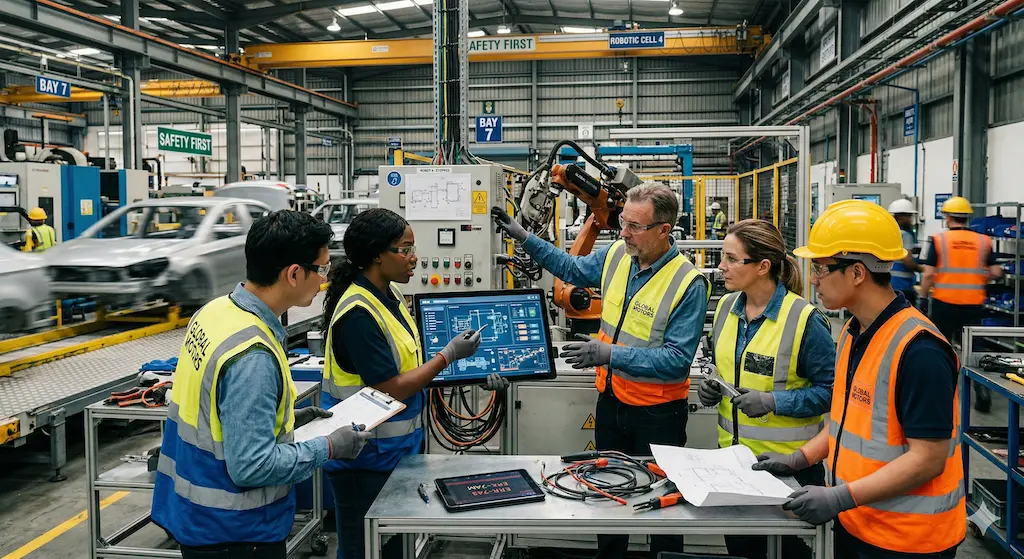
Paul Dunlop discusses how unlocking employee potential is at the core of Lean yet often overlooked by even the most well-meaning practitioners.
Unlocking employee potential is at the core of lean: the people doing the work know the problems, the workarounds and the better ways, and a management system either draws that knowledge out daily or leaves it unused. The levers are a daily forum to raise problems, authority to act, skills development and leaders who ask rather than tell.
At a glance
- What it is: drawing out the knowledge of the people doing the work, rather than leaving it unused.
- Levers: a daily forum for raising problems, authority to act, skills development against standards, and leaders who ask rather than tell.
- Lean waste: non-use of skills is one of the wastes of lean.
- Related: what are the 8 wastes of lean? and what is a skills matrix?.
When we talk about continuous improvement as the elimination of waste in the pursuit of flow, there are many types of waste that can have an influence. We can debate endlessly about which waste has the bigger impact and why – and none of the arguments would be wrong.
However, in my experience the single biggest waste from a Lean viewpoint is non-use of skill. The waste of not utilising our human capital to its potential.
Why focus on unlocking employee potential?
If we are unable or unwilling to unlock the potential in our people then we will struggle to optimise our process no matter how we approach it. We can 'buy' our way to improvement – to a point. We can do this through equipment, layout, skills and additional labour. However, without genuine engagement, ownership, and investment from the people on the ground, improvement activity can only reach a certain level.
When I talk about non-use of skills I am referring to neglecting the single biggest resource every organisation has at their fingertips and is already paying for. It never ceases to amaze me how often organisations acknowledge and openly talk about employee engagement being a priority yet never actually enable it.
I'm talking primarily about employee engagement at the frontlines. There is a massive opportunity that is lost to organisations when we treat those people as simply a body for conducting labour rather than as a brain for driving innovation and improvement.
What does respect for people mean in lean?
In the Lean world we talk about the concept of 'respect for people'. This means that we place a great deal of value on the employee experience. We want to ensure that we provide the best quality work for a human being. We must prioritise providing that person with a clear sense of meaning and purpose in their daily work. It is incumbent on the organisation and its leadership to provide all of the necessary tools, training, systems and support to ensure that people are set up for success.
Part of the respect for people approach is to ensure that people have a legitimate voice and are heard by their peers and by their leaders. This voice should be one where people have the ability to raise legitimate frustrations and concerns. They must also be able to present ideas and improvement opportunities and have these items received with empathy and curiosity. Finally, they must see real action taken as a result.
If we look at the average working life of a human being we can spend anywhere in the vicinity of 50 years in the workforce – that is a seriously long time. I figure that the working experience should be the best possible experience it can be for humans. Respect for people recognises this and ensures no matter what people do that they feel there is meaning and purpose in their work.
How do we waste employee potential?
Back to waste – non-use of skills speaks to a number of wastes:
- Incorrectly assigning a person/people to a job
- Not providing people with the appropriate training and tools to conduct their work
- Not utilising past work experience or skills
- Not understanding what other skills a person has that could be utilised in their role
- Undervaluing their expertise, know how and insights in their role
Non-use of skill ultimately comes down to the fact that most of the time leaders and organisations fail to recognise that the only experts at doing the work in the organisation are the people who actually do the work.
This sounds so obvious however, it's commonplace for organisations to completely neglect these people and their thoughts. The best way to harness this talent is to bring people together by connecting them through structure and a set of common goals. Providing structured forums like daily huddles where people have a voice, can discuss and debate issues and ideas and can safely speak their minds is the way forward.
This must be combined with clear and unwavering support at all levels of leadership to ensure that a people-first approach is lived everyday.
Frequently asked questions about unlocking employee potential
Why is employee potential overlooked in lean programmes?
Because programmes focus on tools and results and treat people as the ones who follow the new standard, rather than the ones who know what the standard should be. Non-utilised talent is the eighth waste for a reason.
What helps people contribute their ideas?
A daily huddle where raising a problem is normal and safe, ideas that get an owner and a visible outcome, time and support to work on improvements, and recognition when an idea is implemented.
How does skills development connect to potential?
A skills matrix shows each person's next step and gives them a path to mastery, which, with autonomy and purpose, is what sustains motivation. People grow when they can see where they are going and are trusted to get there.
Which framework maximises employee potential?
Providing autonomy to individuals & teams requires systems that support decision making at every level - supported by the right data and at all times, aligned to strategy. Supporting individual Mastery requires people to be able to freely access the training & know-how they need to better themselves.
The image below outlines how we designed an interconnected TeamAssurance platform which achieves these goals. One that avoids the locally optimised and disconnected 'Point solutions' (digital or analog) that do not help sustain either lasting business performance or maximising individual employee potential.
TeamAssurance enables organisations to unlock employee potential at all levels through an interconnected platform. If you'd like to explore the opportunities offered by digital aids to Lean tools contact us for a demonstration.