
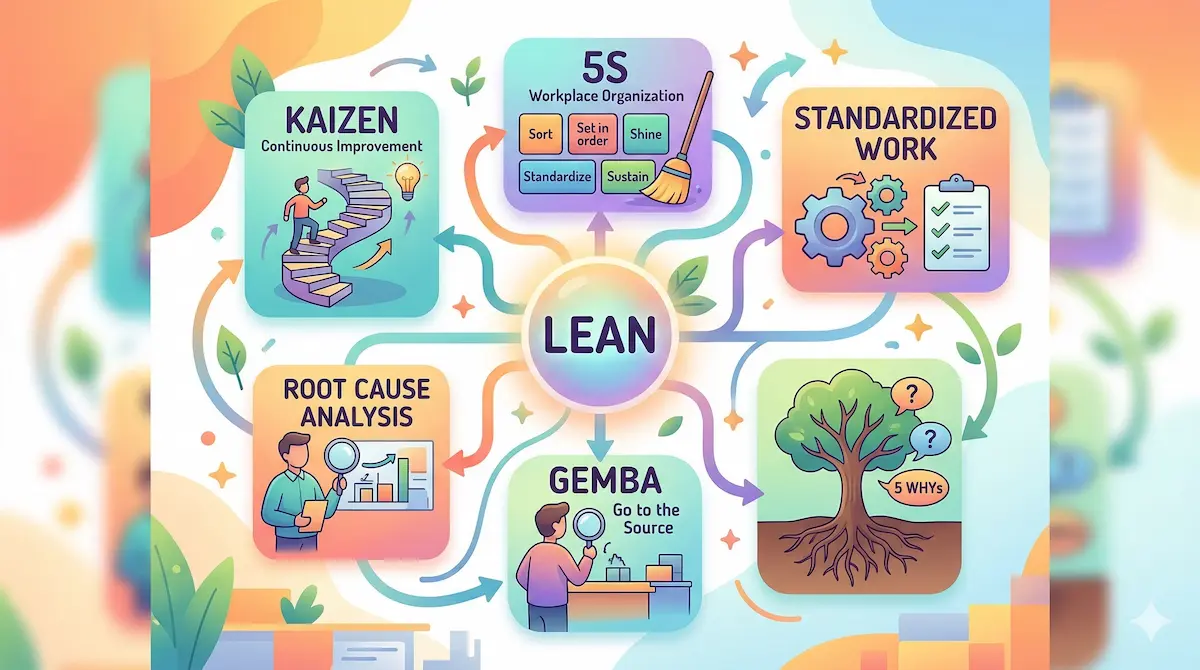
Digital lean is the use of connected software to run lean methods such as daily management, standard work, problem solving and PDCA, so problems, actions and standards stay visible. The practices that work are one source of standard work, tiered boards, one action list per team, structured problem solving and a measured result for every improvement.
At a glance
- What it is: lean methods run on connected software instead of paper boards, spreadsheets and email.
- What it needs: one current source of standard work, one action list per team, and a single improvement record.
- Where it runs: tiered meetings on the shop floor and in support functions such as maintenance, quality and safety.
- Related: what is lean management? and the 5 lean principles.
What does digital lean mean?
Digital lean does not replace lean thinking. It keeps the same principles of value, flow, pull and perfection, and it changes where the work lives. Instead of a board updated on Monday and a spreadsheet nobody owns, the problem, the owner, the due date and the standard sit in one place that every team can see. Lean stays the method; the software is the record and the rhythm.
The gain is mostly visibility and follow-through, not new theory. A problem raised on the floor can be seen by the maintenance and quality leads the same day, and an action that slips shows up at the next tier meeting rather than at the monthly review.
What are the digital lean practices that work?
- Keep one current source of standard work. Every operator and team leader should open the same version of the work instruction. Standard work is the baseline every improvement is measured against, so it has to be easy to find and easy to update. See what is standard work?.
- Run daily management from a tiered board. Put the few measures that matter on a board for each team, review them at a fixed time, and escalate what the team cannot solve. See what is tiered daily management? and the tiered daily management capability.
- Give each team one action list. Each action needs one owner, a due date and a status. Two lists for the same team means nothing is clearly owned.
- Use one structured problem-solving method. Pick one method for everyday problems, such as PDCA or the 5 whys, and use it everywhere. A deeper failure can move to root cause analysis.
- Make problems visible when they start. A problem that waits for the next review has already cost time. Log it when it happens, with a short description, so the right people see it the same shift.
- Audit the standard, not only the person. When a task drifts, ask whether the standard is wrong, unclear or missing before correcting the operator. Layered process audits make this a routine check.
- Measure every improvement before and after. Record the baseline, the change and the result. An improvement without a number is hard to keep and hard to repeat.
- Let anyone raise an idea and see it close. Frontline ideas are only kept if the person who raised them hears what happened. Close the loop on every idea, including the ones you decline.
- Share what works across teams and sites. When one team fixes a problem, the standard, the method and the result should be findable by the next team that has the same problem.
How is digital lean different from paper lean?
- Standard work: paper copies at the workstation, some out of date, versus one current version with a record of changes.
- Action lists: a separate list for each meeting, versus one list per team with owners and due dates.
- Problem visibility: found at the next review, versus logged when it happens and seen by the right people.
- Improvement record: scattered across folders, versus one history of problems, fixes and results.
- Escalation: re-keyed by hand, versus raised and tracked in the same system.
What does digital lean look like in practice?
An illustrative example, not a client case: a packaging line runs three shifts and has a repeat jam at the same station. On paper, each shift logs it on a different sheet, and the maintenance lead hears about it at the weekly review. With digital lean, the operator logs the jam on the station's board at the start of the shift, the team leader assigns a PDCA action with an owner and a date, and the tier meeting the next morning checks whether the trial change worked. The jam count before and after sits on the same record, so the team can keep the change or drop it.
Where does continuous improvement fit?
Digital lean sits inside the wider continuous improvement system. Everyday problems suit PDCA and the 5 whys. Complex variation problems suit Lean Six Sigma and its DMAIC projects. Changes to flow are easier to plan once the current state is mapped with value stream mapping.
How does TeamAssurance support digital lean?
TeamAssurance documents these continuous improvement capabilities: activity management, with owners, due dates and progress from idea to implementation; goal alignment, to link improvements to strategic goals; impact tracking, to measure results; idea capture from anyone; and trend analysis to find repeat problems. Problem solving is supported with A3, PDCA, DMAIC and 5 whys. Read the continuous improvement capability for the detail.
If you run lean on paper or spreadsheets and want to see how these practices fit together, request a demo of the platform.
Frequently asked questions about digital lean
What is digital lean?
Digital lean is the use of connected software to run lean methods such as daily management, standard work and problem solving. The methods stay the same. The software keeps the boards, actions and standards current and visible to the people who use them.
Do you need software to practise digital lean?
No. Lean works on paper. Software helps when the number of teams, shifts or sites makes paper boards and spreadsheets slow to update and hard to share.
Which digital lean practice should a site start with?
Start with one tiered board and one action list per team, with an owner and due date on every action. Standard work and a single problem-solving method can follow once the daily rhythm is working.
How is digital lean different from lean management?
Lean management is the management system and its principles. Digital lean is the same system run on connected tools, so that problems, actions and standards are visible across teams and tiers.
Further reading: Lean Enterprise Institute.