
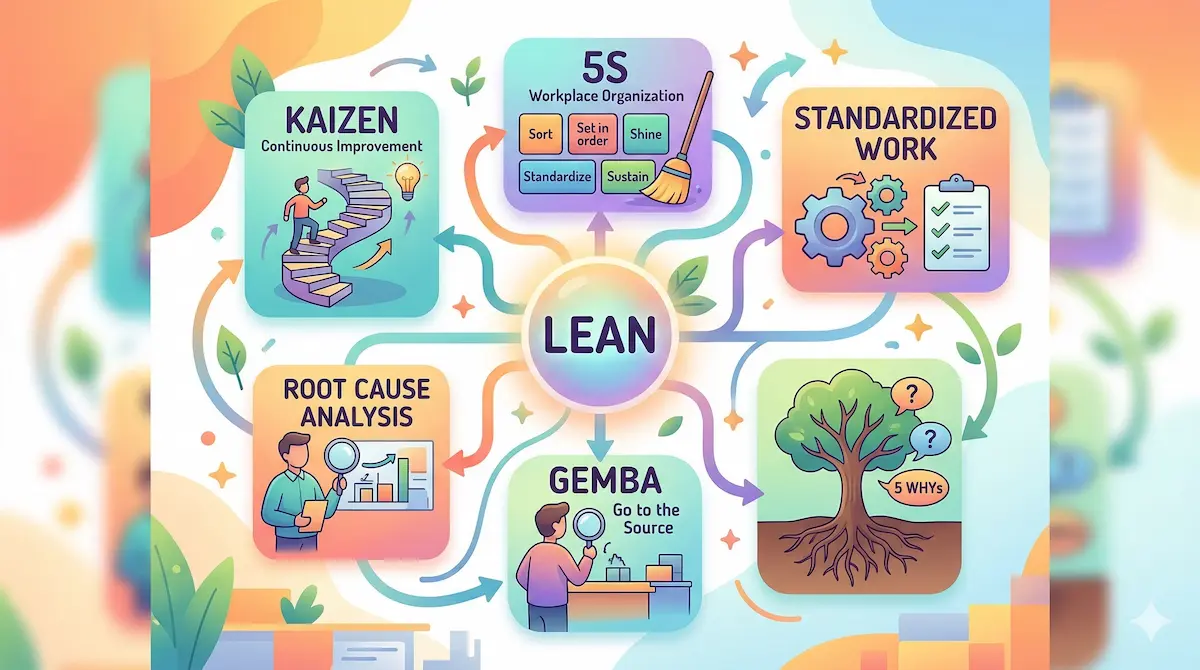
Lean tools raise productivity by removing the waste that hides inside busy days rather than by working harder: visual management that makes problems obvious, standard work that removes variation, daily tier meetings that resolve issues within the shift, structured problem solving that stops repeats, and 5S that removes searching and walking. Used together in a daily rhythm, they compound.
At a glance
- Idea: lean tools raise productivity by removing the waste that hides inside busy days, not by working harder.
- Five ways: standardised problem solving, skills management, goal trees and strategy alignment, connected checklists, and tags for organisation and search.
- Fastest payback: a daily tier meeting at a board usually surfaces waiting, shortages and stoppages first.
- Related: what are the 8 wastes of lean? and what is a skills matrix?.
Productivity is the holy grail of operations. But true productivity isn't about working harder – it's about working smarter. Here are five practical ways to boost productivity using Lean tools within a connected daily management system.
1. How does standardised problem solving boost productivity?
When issues arise, having a standardised approach to problem solving means teams don't waste time figuring out how to investigate – they can focus on what to investigate. Tools like 5 Whys, Ishikawa diagrams, and A3 reports provide structure.
The key is making these tools accessible to everyone, not just improvement specialists. When frontline teams can log and investigate issues themselves, resolution happens faster.
2. How does skills management boost productivity?
Knowing who can do what – and who needs development – is critical for daily planning. A dynamic skills matrix integrated into your daily management system means:
- Self-directed Training: Everyone can see their own progress and what training is automatically assigned to them
- Built-In Governance: Review steps are built-in with an auditable history
- Integration into Daily Management: Skill development becomes part of the daily routine, not a once-a-year activity
3. How do goal trees and strategy alignment boost productivity?
Productivity without direction is just busyness. Linking frontline improvement activity to strategic goals ensures that effort is focused on what matters most. When teams can see how their daily work connects to the bigger picture, engagement and output both increase.
4. How do connected checklists boost productivity?
Checklists aren't just tick-box exercises. When integrated into a daily management system, checklists become powerful tools for standardising processes and catching issues early. Non-conformances trigger immediate actions, and nothing falls through the cracks.
5. How do tags make work easier to find?
Tags are keywords or phrases that you can add to Tasks and Actions to help organize and find them later. For example, you could tag an Activity with '2023Q3', 'Audit' and 'Compliance'. Utilising Tags is a simple and fast way to boost productivity for all users:
- Organisation: Group your Activities by topic, project, or other criteria
- Improved Searchability: Search for Activities by Tag across the entire system
- Increased Collaboration: Teams across sites and countries can use the same Tags
Frequently asked questions about lean tools and productivity
Which lean tool gives the fastest productivity gain?
A daily tier meeting at a board usually pays back first, because it surfaces the waiting, shortages and stoppages that cost the most and gives them owners the same day.
How do lean tools reduce waste rather than add work?
Each one targets a waste: 5S removes searching and motion, standard work removes variation and rework, visual management removes the waiting for information, and problem solving removes repeats. The time they take is recovered many times over.
How do you measure productivity gains from lean?
Track output per labour hour, OEE and its losses, schedule adherence and overtime on the tier boards, before and after each change, so improvements are verified against the measure rather than assumed.
Why does productivity come from optimising the entire framework?
The above practical examples can boost productivity immediately. You'll start to experience the benefits in employee satisfaction, engagement and output.
From here, you must keep in mind that a Tiered Daily Management process that supports the entire PDCA loop is key to sustained continuous improvement.
If you're yet to see TeamAssurance in action – or know an organisation who could benefit from a connected platform for CI productivity – you can book a live platform demonstration.